CLFMI manual, revised March 2017; checked October 2026
Edition-specific fabric-wire reference. A wire breaking force is not a fence-system security or wind rating. Core wire and coating dimensions differ.
Sources and scope checked .
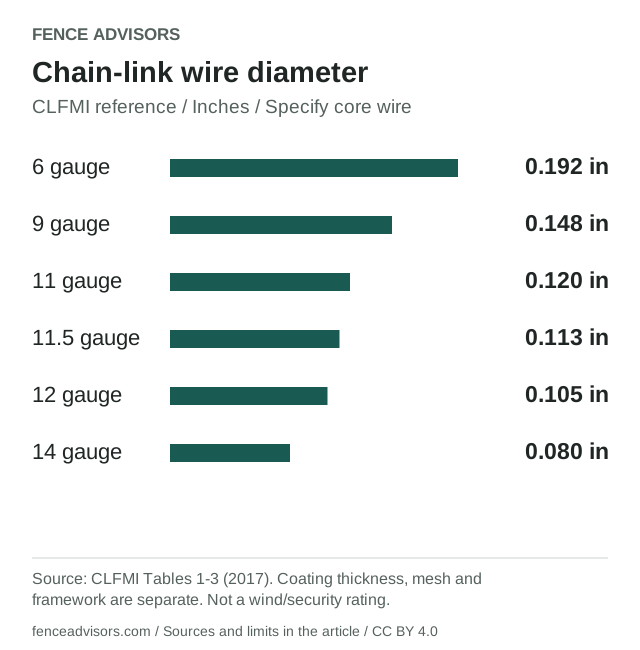
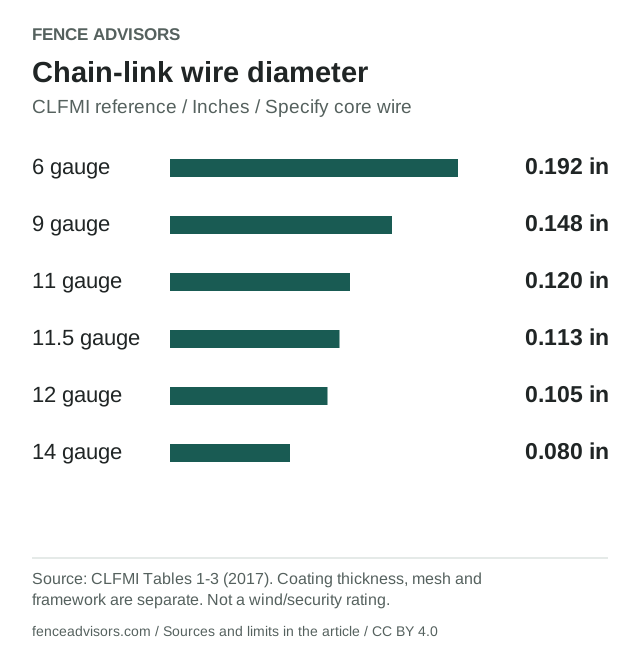
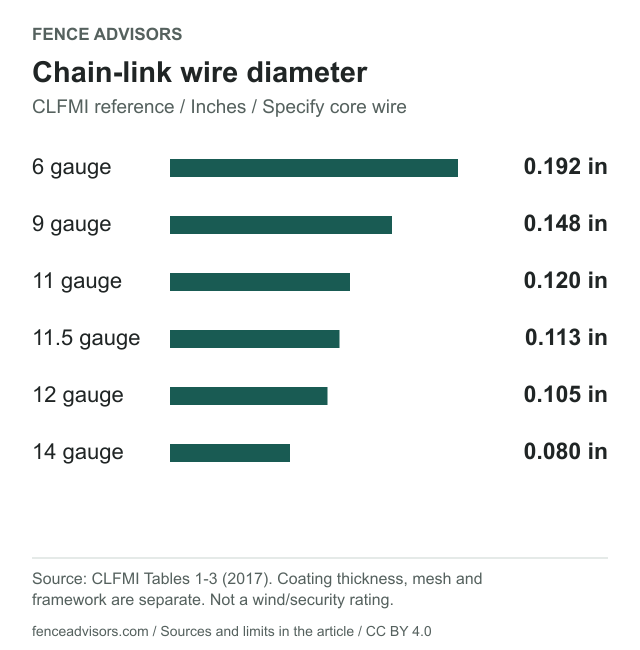
9-gauge chain-link wire is listed at 0.148 inch; 11 gauge at 0.120 inch in the CLFMI Product Manual revised March 2017. The lower gauge number denotes thicker wire in this table. Gauge is one fabric specification, not a complete fence strength, wind, pool-code or security rating. CLFMI manual.
Use the table to check a written fabric specification, then verify the rest of the assembly separately. For general material selection use the chain-link guide; for a supplier order use the RFQ template.
What Is Wire Gauge?
Download or embed this graphic
<figure>
  <a href="https://fenceadvisors.com/blog/chain-link-fence-gauge-guide"><img src="https://fenceadvisors.com/media/research/chain-link-wire-reference.svg" alt="CLFMI wire diameters: 6 gauge 0.192 inch, 9 gauge 0.148, 11 gauge 0.120, 11.5 gauge 0.113, 12 gauge 0.105 and 14 gauge 0.080. Polymer-coated fabric is specified by core wire." width="640" height="650" loading="lazy" style="max-width:100%;height:auto"></a>
  <figcaption>Graphic: <a href="https://fenceadvisors.com/blog/chain-link-fence-gauge-guide">Fence Advisors</a>. Source, period and limitations are in the linked article. Original graphic: CC BY 4.0.</figcaption>
</figure>| Gauge | Listed wire diameter | Listed millimeters | Table 1 wire breaking force |
|---|---|---|---|
| 6 | 0.192 in | 4.88 mm | 2,170 lbf |
| 9 | 0.148 in | 3.76 mm | 1,290 lbf |
| 11 | 0.120 in | 3.05 mm | 850 lbf |
| 11.5 | 0.113 in | 2.87 mm | 750 lbf |
| 12 | 0.105 in | 2.67 mm | 650 lbf |
| 14 | 0.080 in | 2.03 mm | 380 lbf |
Source: CLFMI manual, Table 1, Breaking Strength of Steel Wire, with mesh/coating context in Tables 2-3. Preserve the edition and units. The breaking-force column describes listed individual wire values, not the installed fence's resistance to impact, cutting, climbing or wind. Millimeter values are retained as published rather than silently substituting a different rounding.
The 9-versus-11 diameter difference is 0.028 inch. On equal lengths of circular wire, the cross-sectional-area ratio is (0.148 / 0.120) squared, approximately 1.52. That is original geometry, not proof of 52% better fence security or an installed-price increase; mesh, coating, framework and assembly remain separate.
Residential vs. Commercial
The manual's suggested usage table lists several combinations, including 11-gauge 2-inch mesh for residential/light commercial and 9-gauge 2-inch mesh for residential/commercial/industrial. Those are reference use descriptions, not a survey showing what every installer uses or approval for a particular property.
Have the actual scope and required performance determine the assembly. Framework, fabric height, mesh, fittings, post spacing, foundations and gates all participate in the installed system. A heavier fabric attached to unsuitable framework is not a complete specification.
Mesh Size
CLFMI defines mesh size using the minimum clear distance between wires forming parallel sides of the mesh. It is not the diagonal corner-to-corner opening. Keep the measuring convention with the number when comparing products. Manual terminology and Table 3.
Smaller mesh may be specified for an intended containment or security use, but a chosen mesh alone does not establish compliance. A pool enclosure also has barrier, gate and local requirements. Start with the pool requirement guide and verify the actual jurisdiction instead of treating any 11-gauge fence as automatically pool-compliant.
Coatings
Request the coating type and applicable product specification, not only a color. Galvanized, aluminum-coated and polymer-coated fabrics have different specification details. For polymer-coated fabric the manual's gauge note refers to core wire; the coating's outside dimension should not disguise a thinner core.
The CLFMI table distinguishes polymer-coating classes and thicknesses. Confirm the actual class/product with the supplier. We do not infer a universal coating lifespan or a fixed 30-50% premium from the finish name. Site exposure and documented product requirements matter; see the corrosion reference for the separate material-compatibility questions.
Cost Impact
Obtain local bids on the same complete assembly. Wire diameter, mesh, height, finish, framework, gates, removal and site work can all change the quoted total. This guide does not present a generic $5-per-foot gauge premium as a measured market result.
Use the cost guide for explicitly labeled planning ranges and the buyer worksheet for actual bids. For materials only, normalize the selling unit, roll length, delivery and charges in the supplier RFQ.
Which Gauge Do You Need?
Start with the required assembly and intended use rather than selecting gauge in isolation. Ask the contractor or project designer what fabric, mesh, framework and footing detail meet the project's actual requirements, including height and exposure. DOT, sports, security and pool specifications cannot be replaced by one universal residential-versus-commercial chart.
A reference table is useful for checking whether the quote describes the intended wire. It does not make every listed option interchangeable, prescribe a security minimum or certify current ASTM compliance.
What to Ask Your Contractor
- What core wire diameter and gauge are specified?
- What mesh opening, measurement convention, height and roll length are quoted?
- What coating material/class and product documentation apply?
- What top/bottom selvage and fittings are included?
- What are the framework's outside diameter, wall thickness, material/grade and coating?
- What approved post spacing, foundation detail and gate scope apply?
- What specification edition and substitutions are being used?
For framework, a shorthand gauge or schedule label is not enough to describe every tube product. Request the actual dimensions and product specification. Use the supplier directory for purchasing candidates or local contractors for installed work.
Methodology and downloads
Fence Advisors checked the first 12 pages of the publicly available March 2017 CLFMI manual in October 2026, including Tables 1-3 and the mesh definition. The downloadable compilation retains the edition, diameter and individual-wire force units. We have not reviewed the full current text of every ASTM standard, tested these products or rated an installed system.
Frequently Asked Questions
Is 9 gauge thicker than 11 gauge?
Yes in the listed CLFMI reference: 0.148 versus 0.120 inch. Thickness is one specification, not a complete fence performance rating.
Is mesh measured diagonally?
Not under the cited definition. CLFMI uses the minimum clear distance between the parallel wires forming the mesh sides.
Does a vinyl coating change the core gauge?
The cited polymer-coated fabric note specifies core wire. Confirm the core diameter and coating class separately; an outside coated diameter is not the same measure.
Sources and Downloads
Original Fence Advisors graphics, data compilations and worksheet are available under CC BY 4.0. Retain source, period and scope when reusing data. This license does not relicense third-party documents or trademarks.
Corrections: editorial@fenceadvisors.com.
Related Research
Put your research to work
Estimate your budget, then compare fence companies in your area.
Get the next guide in your inbox
Fence costs, rankings, and what AI is telling homeowners — researched, no fluff.