Original quote comparison worksheet, October 2026
A blank scope comparison template. No prices are collected. Not a contract, engineering specification or substitute for local requirements.
Worksheet reviewed .
This checklist covers every step of a fence project from initial planning through post-installation inspection. It's organized in chronological order — work through it top to bottom and you'll avoid the most common (and expensive) mistakes homeowners make.
Based on the AFA's Fence Installation School site preparation and installation modules.
Compare Written Quotes
Download the original spreadsheet-compatible comparison worksheet or printable sheet. Use one column per written bid. Unconfirmed items stay unknown; a blank line does not mean the item is included.
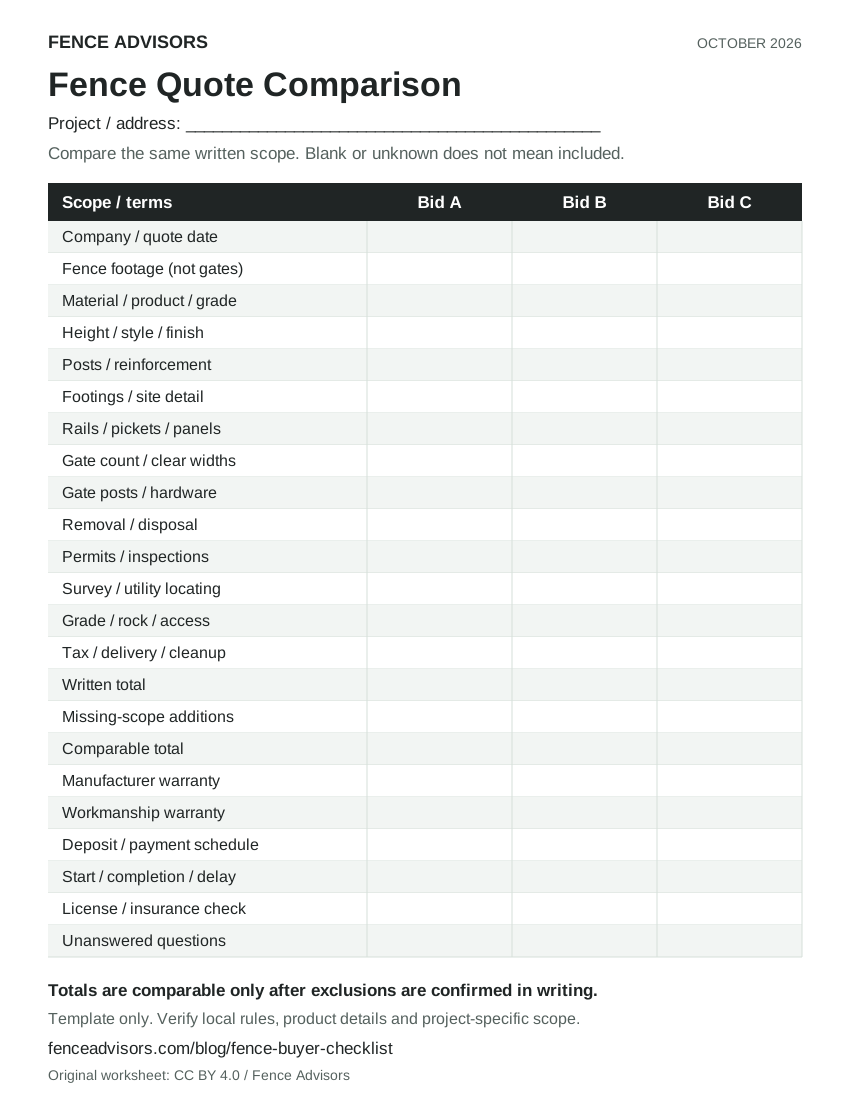
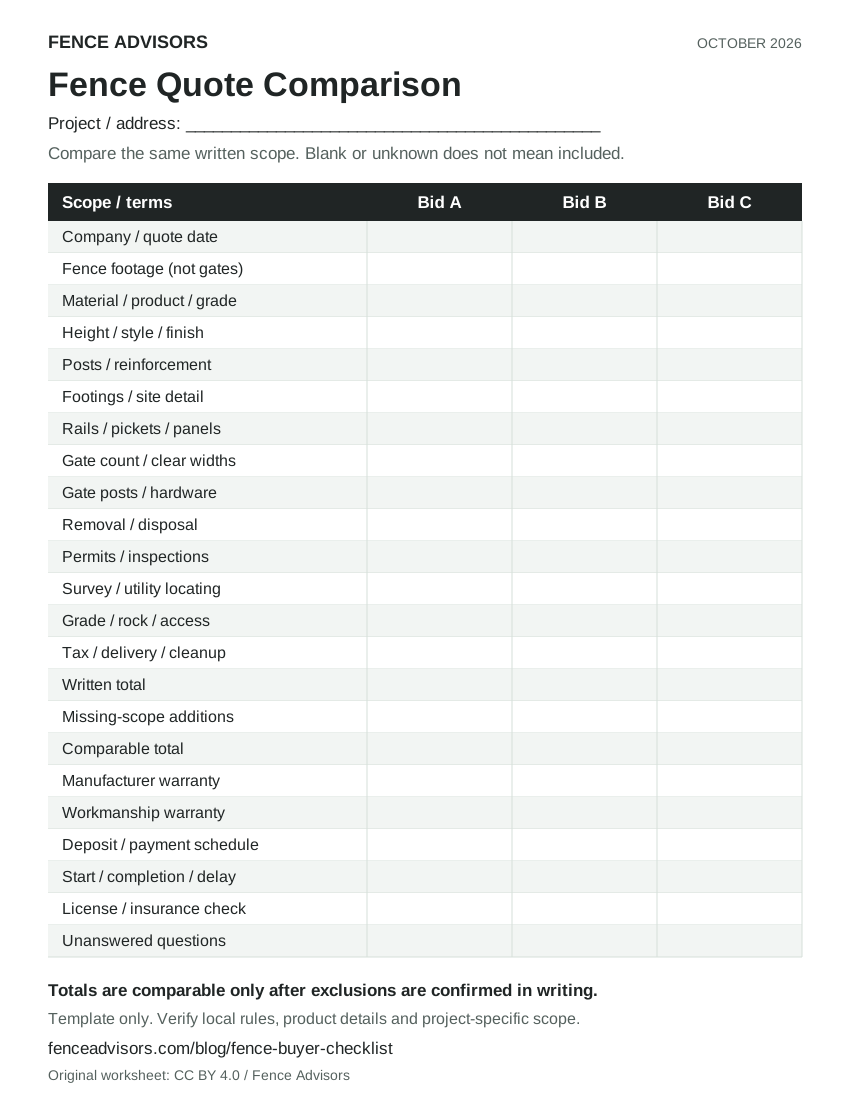
Download or embed this graphic
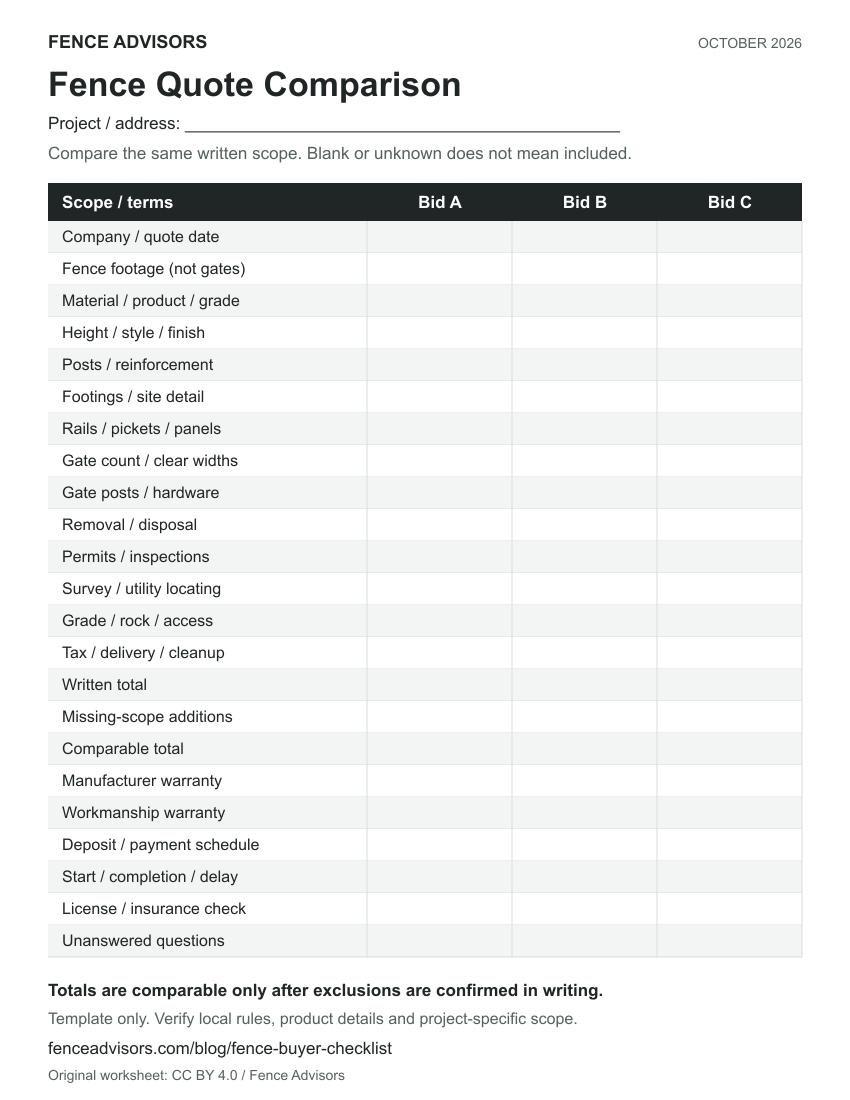
<figure>
  <a href="https://fenceadvisors.com/blog/fence-buyer-checklist"><img src="https://fenceadvisors.com/media/research/fence-quote-comparison-worksheet.svg" alt="Printable worksheet with three bid columns for footage, materials, posts, gates, removal, permits, exclusions, warranties and payment terms." width="850" height="1100" loading="lazy" style="max-width:100%;height:auto"></a>
  <figcaption>Graphic: <a href="https://fenceadvisors.com/blog/fence-buyer-checklist">Fence Advisors</a>. Source, period and limitations are in the linked article. Original graphic: CC BY 4.0.</figcaption>
</figure>
Compare the same fence footage, material grade or exact product, height, style, posts, foundation detail and gate configuration. Keep gate widths separate from fence runs, and itemize removal, disposal, permits, tax, delivery and site-condition charges. Compare manufacturer and workmanship warranties separately.
Comparable total = written quote total + confirmed prices for missing scope. If an exclusion has no written price, the bid is not yet comparable. Ask for clarification before choosing it as the cheapest.
An illustrative example, not market-price data
| Item | Bid A | Bid B |
|---|---|---|
| Written quote | $5,200 | $5,800 |
| Same specified gate | Excluded; written addition $600 | Included |
| Same removal and disposal | Excluded; written addition $400 | Included |
| Total for the same agreed scope | $6,200 | $5,800 |
The lower headline bid becomes $400 more expensive after the confirmed exclusions are added. These amounts are an arithmetic example, not observed contractor quotes or a national cost benchmark. If material or installation details differ, normalize that scope before comparing totals.
Use the cost calculator for a preliminary budget and the contractor questions when confirming scope. Local rules, manufacturer instructions and project-specific engineering take precedence over general checklist suggestions.
Phase 1: Planning (2–4 Weeks Before Installation)
Property Research
- ] Get a **property survey** or locate existing survey pins ($300–$600). [Why it matters →
- ] Check your **property plat** for easements (utility, drainage, access). [Easement guide →
- ] Review **HOA CC&Rs** for material, height, style, and color restrictions. [HOA guide →
- ] Check **local building codes** for height limits and setback requirements. [Height regulations →
- ] Determine if a **fence permit** is required. [Permit guide by state →
Design Decisions
- ] Choose **fence style** based on your needs (privacy, security, decorative, pet containment). [Privacy styles →
- ] Choose **material** based on climate, budget, and maintenance tolerance. [Cost per foot guide →
- [ ] Determine height (check code limits and HOA rules)
- ] Plan **gate locations** and sizes (walk-through, vehicle, both?). [Gate guide →
- [ ] Measure the total linear footage needed
- ] Decide: **DIY, professional, or hybrid?** [DIY vs pro →
Budget
- ] Get base cost estimate using our [cost per foot guide
- ] Add **hidden costs**: permit, survey, old fence removal, gates, staining, terrain. [Hidden costs guide →
- [ ] Set a total budget (add 15–20% contingency)
Phase 2: Contractor Selection (1–2 Weeks)
- ] Get **3–5 written quotes** from licensed contractors. [Find contractors →
- ] Verify **license and insurance** (general liability + workers' comp). [Questions to ask →
- [ ] Ask about post depth, concrete cure time, and 811 process
- [ ] Check references and photos of recent similar projects
- [ ] Compare quotes for what's included vs. excluded
- [ ] Review the workmanship warranty (1–5 years is standard)
- [ ] Sign a written contract that includes: materials, timeline, payment schedule, warranty, and what's excluded
- [ ] Pay deposit (25–35% is standard — never 100% upfront)
Phase 3: Pre-Installation (1–2 Weeks Before)
- [ ] Pull the fence permit (you or the contractor)
- ] **Call 811** for utility marking — minimum 2 business days before digging, per AFA standards. [811 guide →
- ] **Notify your neighbor** if building on or near the property line (required in California, recommended everywhere). [Property line guide →
- [ ] Remove the old fence (if DIY) or confirm it's included in the contract
- [ ] Clear the fence line — move furniture, toys, planters, and trim overhanging branches
- [ ] Mark sprinkler heads and invisible dog fence wires (811 doesn't mark these)
- [ ] Confirm the start date with the contractor
Phase 4: During Installation (Verify These)
Day 1: Post Holes and Setting
- ] Post holes are **at least one-third of total post length** deep. [Post depth guide →
- [ ] Post holes are 3× the post diameter wide (10–12" for 4×4 posts, 14–16" for gate posts)
- [ ] Posts are plumb in two directions (check with a level)
- [ ] Posts are aligned with each other along the string line
- [ ] Concrete is crowned above grade (slopes away from the post for drainage)
- [ ] Gate posts are set deeper and wider than line posts
- [ ] No fence work on posts until concrete cures 48–72 hours
Day 2–3: Rails and Panels
- [ ] Rails are level and securely fastened
- [ ] Pickets/panels are evenly spaced and consistently attached
- [ ] Bottom clearance is consistent (2" above grade is typical)
- [ ] Screws are used (not nails — nails work loose over time)
- [ ] All end grain (board tops/bottoms) is treated or sealed
Gates
- [ ] Gate swings freely without dragging or binding
- [ ] Gate latches positively every time
- [ ] Gate post is not leaning under the gate weight
- ] **Self-closing mechanism** works (if required for pool barrier). [Pool fence guide →
- [ ] Gate clearance is adequate on all sides
Phase 5: Post-Installation Inspection
Before making final payment:
- [ ] Walk the entire fence line checking for consistency
- [ ] Verify all posts are plumb (not leaning)
- [ ] Check panel alignment — are boards straight and even?
- [ ] Test every gate — open, close, latch, repeat
- [ ] Verify cleanup — concrete spills, debris, old materials removed
- [ ] Confirm the fence matches the permit (height, location, material)
- [ ] Schedule city inspection if required by your permit
- [ ] Obtain the workmanship warranty in writing
- [ ] Make final payment only after inspection and satisfaction
Phase 6: After Installation
Within 30 Days
- ] **Schedule staining** for wood fences (wait 3–6 months for new wood to dry, but schedule now). [Staining guide →
- [ ] Submit HOA completion notice if required
- [ ] Close the permit with your city (some require a final inspection sign-off)
Ongoing Maintenance
- ] **Annual inspection** — check posts, panels, hardware, gates. [Maintenance schedule →
- [ ] Stain/seal wood every 2–3 years (cedar) or 1–2 years (treated pine)
- ] **Clean vinyl** once or twice yearly. [Vinyl maintenance →
- ] **Touch up metal** fence chips/scratches immediately. [Rust prevention →
Frequently Asked Questions
How long does the entire process take?
Planning: 2–4 weeks. Contractor selection: 1–2 weeks. Pre-installation: 1–2 weeks. Installation: 1–3 days. Total: 4–8 weeks from decision to finished fence.
What's the most commonly skipped step?
Property survey and easement check. Homeowners assume they know where the line is. Assumption + fence = potential forced removal. The $300–$600 survey is the cheapest insurance in this entire checklist.
Can I use this checklist for DIY?
Yes — skip the contractor selection section and apply everything else. The installation verification phase is especially important for DIY: check your own work against these standards before considering the project complete.
Find a Fence Contractor Near You
- Dallas fence companies
- Tampa fence companies
- Phoenix fence companies
- Atlanta fence companies
- Charlotte fence companies
- Browse all fence companies →
Are you a fence contractor? Apply for FA Verified status →
*Checklist based on American Fence Association Fence Installation School site preparation, post setting, and concrete modules.*
Sources and Downloads
Original Fence Advisors graphics, data compilations and worksheet are available under CC BY 4.0. Retain source, period and scope when reusing data. This license does not relicense third-party documents or trademarks.
Corrections: editorial@fenceadvisors.com.
Related Research
Put your research to work
Estimate your budget, then compare fence companies in your area.
Get the next guide in your inbox
Fence costs, rankings, and what AI is telling homeowners — researched, no fluff.