
Chicago, IL / Fence permit planning
Ordinary residential fences within incorporated Chicago, not suburban municipalities or unincorporated Cook County. Permit and zoning guidance follows Titles 14A/14B and Title 17, not old Title 13 or an unamended model code; the publisher's 2026 S-74 is current through June 17, 2026, with no cited fence change listed in its advance service through September 29, 2026. Express terms effective November 6, 2023 and revised September 16, 2024 are guidance; enacted code controls conflicts. Landmark/proposed-landmark, public-way, pool, retaining, powered-gate, unusual zoning and structural conditions need applicable review. No parcel approval, engineering design, exact total invoice or guaranteed turnaround is supplied.
Sources and scope checked .
Chicago generally exempts a fence from a building permit only when it is not more than five feet above ground on both sides and complies with zoning. A taller fence requires a permit. A permit exemption is not permission to ignore front-yard opacity, landmark review, property boundaries or public-way requirements. This guide addresses ordinary fences inside the City of Chicago, not suburban municipalities or unincorporated Cook County. Chicago adopted permit exemptions and fence provisions; Chicago fence work not requiring a building permit.
Start by confirming the responsible city and actual zoning yards. A Chicago-area postal address is not enough. The Chicago fence-contractor directory serves the hiring stage; this guide addresses the approval scope to put in a contract, not contractor rankings or installed-price estimates.
Quick reference
| Question | Source-checked answer |
|---|---|
| When is a building permit exempt? | A fence not more than 5 feet above ground on both sides and conforming to zoning is generally exempt. Over 5 feet requires a permit. Landmark and public-way approvals can still apply; exemption does not waive other code requirements. Chicago adopted permit exemptions and fence provisions; Chicago fence work not requiring a building permit |
| Required front setback | The zoning table allows fences up to 4.5 feet if more than 20% opaque, or up to 6 feet if no more than 20% opaque, in required front setbacks. A zoning allowance does not change the 5-foot building-permit threshold. Chicago adopted setback measurement provisions; Chicago adopted permit exemptions and fence provisions |
| Required side and rear setbacks | The same zoning table allows fence/wall rows up to 6 feet in required side and rear setbacks. This does not establish a universal taller-fence allowance or authorize encroachment onto neighboring property or the public way. Chicago adopted setback measurement provisions; Chicago adopted permit exemptions and fence provisions |
| Current base fees | The enacted table lists $75 for nonmasonry fences up to 6 feet, $300 for fences over 6 feet and $300 for freestanding masonry walls. The $25 electronic review fee applies where authorized; zoning and other applicable charges can be additional. No universal total is quoted. Chicago enacted stand-alone fee tables; Chicago stand-alone fee payment provisions |
| Drawings and contractor information | Most ordinary Express fence applications need no uploaded documents. Over-6-foot work requires a recent official survey and scaled dimensioned site plan. Permit-required masonry work needs the listed Illinois architect or structural engineer; do not read the page's inconsistent document wording as a waiver. Chicago Express fence application instructions |
| Repair versus replacement | The city lists painting and limited replacement of damaged fence components as exempt maintenance. That is not a blanket exemption for full replacement, a height increase or work with a separate regulated function. Chicago fence work not requiring a building permit; Chicago adopted permit exemptions and fence provisions |
Five feet, six feet and fifteen feet answer different questions
Section 14A-4-402.1 exempts a fence not more than five feet above ground on both sides, provided it conforms to the zoning ordinance. Section 14A-4-404.7 separately requires a permit above five feet. Exactly five feet is within the stated height threshold only when the other conditions also hold. A sloping lot cannot be evaluated from the convenient high side alone. Chicago adopted permit exemptions and fence provisions.
Chicago's Express fence instructions list ordinary six-foot backyard fences and conditionally taller fences as eligible worktypes. Those are application-program limits, not a six-foot no-permit rule. Likewise, the program's upper fifteen-foot eligibility ceiling is not residential zoning permission. Work that violates zoning is expressly ineligible. Chicago Express fence application instructions.
For permit work, the fence terms measure height from the lowest surface within twelve horizontal inches on either side to the fence's highest point, with a stated post exception. Bring an elevation or grade explanation when the two sides differ. Do not use that post exception to conceal an otherwise taller fence or treat this article as an engineering design. Chicago Express fence permit terms.
The city's exemption FAQ also lists painting and limited replacement of damaged fence components. We do not extend that maintenance language to complete replacement, a height increase, substantial structural alteration or another regulated project. Describe the actual scope rather than mark every project as repair. Chicago fence work not requiring a building permit; Chicago adopted permit exemptions and fence provisions.
Required front setbacks depend on opacity
The enacted table in 17-17-0309 separates height and opacity. In a required front setback, a fence or wall more than twenty percent opaque can use the row up to four and one-half feet. The row up to six feet is permitted there only when the fence is no more than twenty percent opaque. The city application page describes that taller front-yard category as at least eighty percent open. These are the Chicago rules, not a neighboring city's open-fence definition. Chicago adopted setback measurement provisions; Chicago Express fence application instructions.
The same table permits the fence/wall rows up to six feet in required side and rear setbacks. That is not a universal rule for every planned development, unusual district, special screening installation or fence elsewhere on a lot. Identify the relevant yard and applicable approvals before selecting the product. We do not publish a universal property-line setback or a taller residential allowance from the separate structural-code material table. Chicago adopted setback measurement provisions.
A permit does not authorize work on someone else's property or in the public way. Keep visibility, alley and gate access, easements and utility access in the location review. An open design is not automatic proof of safe sight distance. Pool barriers, retaining walls and powered gates need their own applicable review; no barrier dimensions or electrical permissions are supplied here. Chicago adopted permit exemptions and fence provisions; Chicago Express fence permit terms.
Landmark and public-way conditions can defeat the simple answer
Section 14A-4-404.7.1 requires a permit for a solid fence or wall of any height visible from a public street on property containing a Chicago Landmark. The public exemption FAQ also flags designated or proposed landmarks and landmark districts. Check the actual designation and proposed work with the city rather than apply the ordinary height exemption mechanically. Chicago adopted permit exemptions and fence provisions; Chicago fence work not requiring a building permit.
Work in or affecting the public way can need separate Business Affairs and Consumer Protection or transportation permissions. A neighbor's agreement, HOA consent or a building-permit exemption does not supply those approvals. Have the contractor identify any sidewalk, alley, street-storage or excavation component separately. Chicago fence work not requiring a building permit.
What to collect for the Express application
Use the official Express Permit Program entry and its Apply Online link. Select the Fence or Trash Enclosure instructions, then keep an ordinary fence separate from a roofed enclosure or other structure. The city entry allows application, status checks, payments and inspection-result review online. Chicago Express Permit Program and official application entry.
Collect the address, property identification information, owner and emergency-contact details, building information requested by the worktype, fence scope and exact licensed-contractor information. The instructions say most applications need no uploaded documents. Do not impose a full-house plan package on an ordinary fence just because other building work requires one. Chicago Express fence application instructions.
For work over six feet, the city lists an official survey by an Illinois licensed land surveyor, no more than five years old, and a scaled, dimensioned site plan. Other listed conditions include condominium approval and documentation for an eligible owner acting as contractor. Those conditions do not mean every owner automatically qualifies to act as a contractor. Chicago Express fence application instructions.
The masonry subsection has an inconsistent heading and document sentence. Its explicit Required Design Professionals section nevertheless requires an Illinois architect or structural engineer for masonry fence/wall work in the program, and the enacted fee table identifies drawings for freestanding masonry walls. For permit-required masonry work, confirm the actual drawing package; do not infer a waiver from the page's wording mismatch. Chicago Express fence application instructions; Chicago enacted stand-alone fee tables.
Chicago-licensed general-contractor information is normally required, with a limited owner exception described by the city. Masonry work has its own licensed-mason requirements. Where an owner or expediter names a licensed contractor, the contractor must complete the city's email acceptance before issuance. Make that responsibility explicit in the written scope. Chicago Express fence application instructions; Chicago Express Permit Program and official application entry.
Current fee rows are base charges, not one universal total
The enacted Table 14A-12-1204.2 lists $75 for installation of a nonmasonry fence up to six feet, any length. It lists $300 for a fence over six feet, any material, and $300 for a freestanding masonry wall, any height or length. These are permit-fee classifications, not a statement that every otherwise exempt short fence must be permitted. Chicago enacted stand-alone fee tables.
The table marks zoning fees separately for taller fences and freestanding masonry walls. Section 14A-4-412.1 also authorizes an electronic review fee where review before issuance is required; the current table lists $25. Where applicable, that review fee is additional to the base fee and replaces the deposit, rather than being a credit against the base. Multiple scopes and other applicable charges can change the invoice. We therefore do not promise a universal total of either seventy-five or one hundred dollars. Chicago stand-alone fee payment provisions; Chicago enacted stand-alone fee tables.
Obtain issued approval before permit-required work and follow the portal/certificate inspection instructions. The city shows inspection results through the Express portal. No fixed review time, automatic approval, universal inspection schedule or permit-expiration calculation is promised here. Arrange the applicable utility-location process before digging, not after post holes are open. Chicago Express Permit Program and official application entry; Chicago general Express permit conditions.
Before-you-build checklist
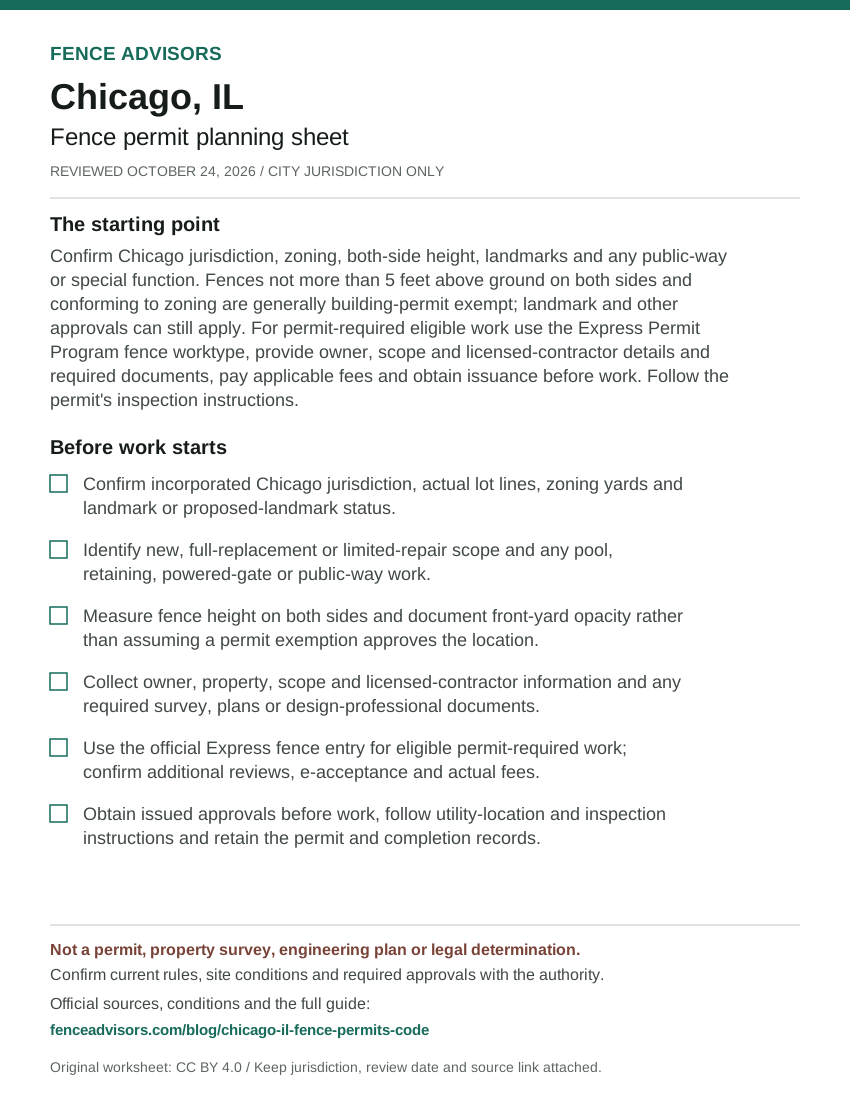
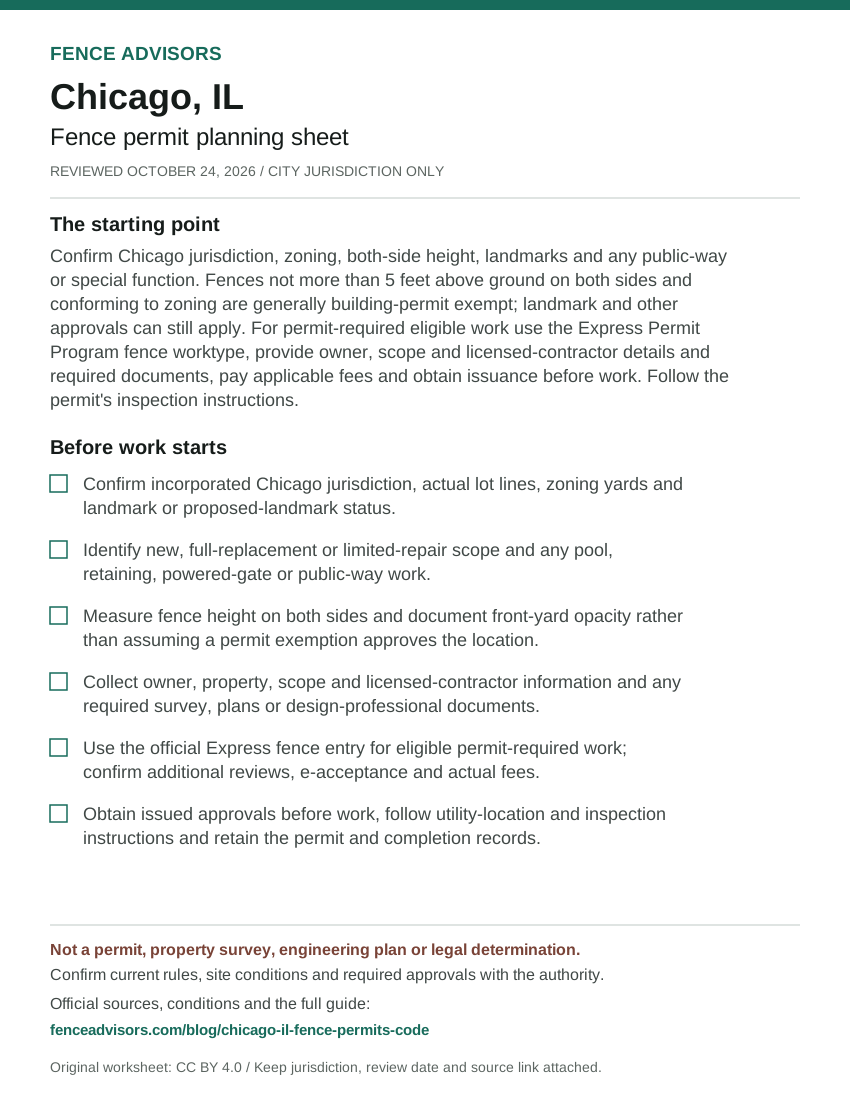
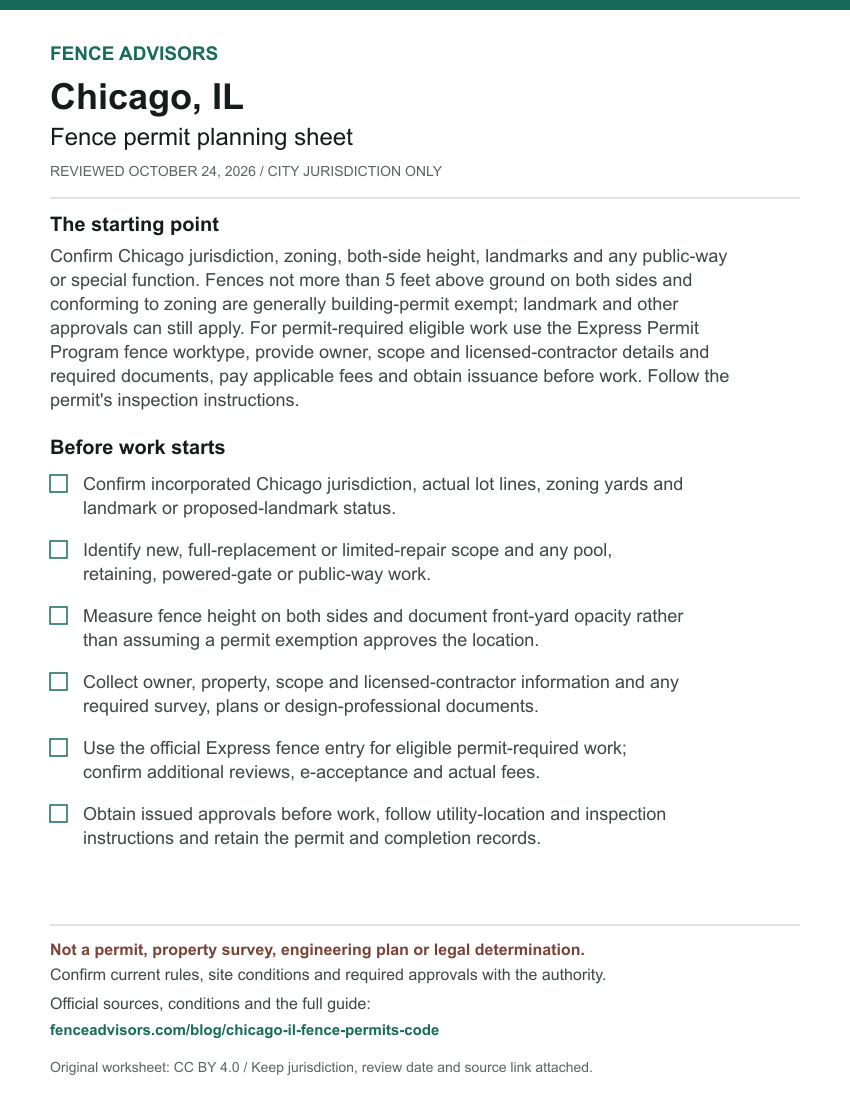
- Confirm incorporated Chicago jurisdiction, actual lot lines, zoning yards and landmark or proposed-landmark status.
- Identify new, full-replacement or limited-repair scope and any pool, retaining, powered-gate or public-way work.
- Measure fence height on both sides and document front-yard opacity rather than assuming a permit exemption approves the location.
- Collect owner, property, scope and licensed-contractor information and any required survey, plans or design-professional documents.
- Use the official Express fence entry for eligible permit-required work; confirm additional reviews, e-acceptance and actual fees.
- Obtain issued approvals before work, follow utility-location and inspection instructions and retain the permit and completion records.
Download or embed this graphic
<figure>
  <a href="https://fenceadvisors.com/blog/chicago-il-fence-permits-code"><img src="https://fenceadvisors.com/media/research/chicago-il-permit-cheat-sheet.svg" alt="Chicago fence permit planning sheet: Conditional: five-foot exemption requires both-side measurement and zoning compliance. Six preparation checks; the complete accessible checklist and source-checked rules are in this article." width="850" height="1100" loading="lazy" style="max-width:100%;height:auto"></a>
  <figcaption>Graphic: <a href="https://fenceadvisors.com/blog/chicago-il-fence-permits-code">Fence Advisors</a>. Source, period and limitations are in the linked article. Original graphic: CC BY 4.0.</figcaption>
</figure>
Chicago and Illinois planning links
Compare permit responsibilities using the Chicago contractor directory, explore other places in the Illinois contractor directory, and use the national contractor directory for broader geographic navigation. The national permit navigator, setback and easement guide and buyer checklist organize additional planning without substituting for Chicago's rules.
For property in Aurora, use the separate Aurora, Illinois fence application guide. Its marked-survey and city-approval process is different from Chicago's Express route.
Frequently Asked Questions
Does a six-foot privacy fence need a Chicago building permit?
Yes, a fence over five feet requires a permit. Separately verify that its location, opacity and design comply with zoning; permit-program eligibility is not zoning approval. Chicago adopted permit exemptions and fence provisions; Chicago adopted setback measurement provisions.
Is a five-foot solid front fence automatically exempt?
No. The exemption requires zoning compliance, and the required-front-setback table has a four-and-one-half-foot row for fences more than twenty percent opaque. Landmark and public-way conditions can also change the answer. Chicago adopted setback measurement provisions; Chicago fence work not requiring a building permit.
Are these old Title 13 or unamended model-code rules?
No. This guide uses city-linked Titles 14A/14B and Title 17. The municipal publisher identifies 2026 S-74 through June 17, 2026; its advance legislative list through September 29, 2026 shows no amendment to the ordinary fence provisions cited here. Publication lag still requires confirming current requirements for an actual application. Chicago current construction-code entry; Chicago municipal code publication status; Chicago advance legislative service.
Sources and reuse
We checked the linked government guidance on October 24, 2026. The scope above and source notes identify what was verified and what still needs confirmation. This article is not an ordinance, survey, engineering design, legal opinion or permit approval. The downloadable fact sheet records each finding's source and section. Confirm current rules, fees and submission instructions with the responsible authority before ordering materials or starting work.
You may reuse our original cheat sheet with attribution to this article. Keep the review date, jurisdiction and limitations attached. Government documents remain with their original publishers. Send corrections with a source link to editorial@fenceadvisors.com.
Sources and Downloads
- Chicago current construction-code entry - Titles 14A and 14B and official full-code links. Full city page read October 24, 2026; Title 14A effective July 1, 2019; 2019 Title 14B applies to most applications started on/after August 1, 2020.
- Chicago adopted permit exemptions and fence provisions - 14A-4-402.1 exterior item 2; 402.2-402.3; 404.7-404.7.1; 401.3.3 and 401.5. Full current Chapter 14A-4 retrieved October 24, 2026; publisher 2026 S-74, current through June 17, 2026.
- Chicago fence work not requiring a building permit - Installation/removal; painting and limited damaged-component repairs; Landmark and public-way exceptions. Full official FAQ read October 24, 2026; checked against current Title 14A.
- Chicago adopted setback measurement provisions - 17-17-0309 Features Allowed in Required Setbacks, complete fence/wall rows and front/side/rear columns. Full current 17-17-0300 read October 24, 2026; section history includes September 25, 2025 amendments.
- Chicago Express fence application instructions - Eligible/Not Eligible; Required Documents; Required Contractors; Required Design Professionals. Full current page read October 24, 2026; masonry document heading/body ambiguity qualified using explicit design-professional requirement, not treated as a waiver.
- Chicago Express fence permit terms - Height measurement; zoning compliance; electrical exclusion and masonry conditions. Effective November 6, 2023, revised September 16, 2024; full text read October 24, 2026; code controls.
- Chicago enacted stand-alone fee tables - Table 14A-12-1204.2 Fences, freestanding walls and trash enclosures; Table 14A-12-1204.1 review fee. Full current tables read October 24, 2026; amendment history includes December 19, 2025; base fees not an all-in project quote.
- Chicago stand-alone fee payment provisions - 14A-4-412.1 through 412.1.2: combined scope charges, electronic review fee and drawing-dependent payment. Full current chapter read October 24, 2026; review fee where applicable is additional to base and in lieu of deposit.
- Chicago Express Permit Program and official application entry - Apply Online; Fence or Trash Enclosure; licensed-contractor e-acceptance; Inspections. Full current city entry read October 24, 2026; program launched November 6, 2023, expanded September 16, 2024; no account/submission tested.
- Chicago general Express permit conditions - Main/additional applicants; licensed trades; fees; approved scope and inspections. Effective November 6, 2023, revised September 16, 2024; full current text read October 24, 2026.
- Chicago municipal code publication status - 2026 S-74; Current through Council Journal of June 17, 2026; New Legislation link. Full publisher overview read October 24, 2026; publication date is not a guarantee of no later ordinance.
- Chicago advance legislative service - Complete current three-page list; no listed amendment to cited fence exemption, fee, structural or setback provisions. Current through Council Journal of September 29, 2026; full PDF text read October 24, 2026.
Original Fence Advisors graphics, data compilations and worksheet are available under CC BY 4.0. Retain source, period and scope when reusing data. This license does not relicense third-party documents or trademarks.
Corrections: editorial@fenceadvisors.com.
Related Research
Plan your Chicago fence project
Confirm the approvals for your property, then compare written contractor scopes.
Get the next guide in your inbox
Fence costs, rankings, and what AI is telling homeowners — researched, no fluff.