
Columbus, OH / Fence permit planning
Ordinary one-, two- and three-family residential fence planning within Columbus, not every Columbus mailing address or another Central Ohio municipality. The current BA 4/26 handout and building application agree on the six-foot residential building threshold; zoning guidance uses 3321.19 enacted by ordinance 2526-2025, not a verified complete current code consolidation. No universal front-yard limit or complete 3321.05 corner/driveway geometry is supplied. Pool barriers, retaining work, powered gates, private covenants, historic/design review and specific repair classifications need applicable review. Listed fee components are not an all-in invoice or a promise of issuance.
Sources and scope checked .
In the City of Columbus, an ordinary fence serving a one-, two- or three-family dwelling does not need a building permit at six feet or less. Over six feet needs building review and zoning clearance. Shorter fences still must meet location, visibility and other applicable rules, and certain access, parking or required-screening changes need zoning clearance regardless of height. Columbus Fences information sheet; Columbus Building Permit Application; Incorporated fence standards in ordinance Exhibit A.
This is a residential application-planning guide, not a universal front-yard height chart. Confirm city jurisdiction and dwelling count before applying the threshold. Use the Columbus contractor directory to compare the installation scope after deciding which drawings and approvals belong in the contract.
Quick reference
| Question | Source-checked answer |
|---|---|
| Ordinary residential building permit | For one-, two- and three-family dwellings, ordinary fences six feet or less do not require a building permit. Over six feet requires building review; shorter fences still must satisfy applicable zoning and visibility rules. Columbus Fences information sheet; Columbus Building Permit Application; Columbus adopted commercial and residential codes; Ohio current-linked residential administration rule |
| Zoning clearance triggers | Enacted 3321.19 requires zoning clearance above six feet on lots with dwellings containing fewer than four units. Fences altering parking, restricting site access or satisfying required screening must be shown for clearance regardless of height. Passed Columbus ordinance 2526-2025; Incorporated fence standards in ordinance Exhibit A |
| Measure the complete fence | Enacted 3321.19 measures fence height from finished grade to the highest point and includes attachments such as lattice. Its requirements also include gates, bollards and pylons. Incorporated fence standards in ordinance Exhibit A |
| Rear yard versus street frontage | The city handout allows ordinary fences six feet or less at rear property lines, but separately restricts front yards having or abutting driveway access and corner lots. Rear-yard permission does not waive those visibility restrictions. Columbus Fences information sheet |
| Which side faces the neighbor? | Columbus says it does not regulate which fence side faces inward or outward. Private covenants or agreements are separate from that municipal statement. Columbus Fences information sheet |
| Posted residential fence fee | The current-linked 2026 schedule lists $300 for a one-, two- or three-family dwelling fence permit, including two inspections. This row is not a required fee for every exempt fence or an all-in total for special approvals. Columbus 2026 combined development fee schedule |
| Separate zoning-only fee | The posted Zoning Clearance Only row, expressly for no associated building permit, is $100 for one to four dwelling units. Do not automatically add it to the fence building-permit row or assume every short fence needs this service. Columbus 2026 combined development fee schedule; Incorporated fence standards in ordinance Exhibit A |
Building approval and zoning clearance are separate tests
The current city code-adoption page lists the 2019 Residential Code of Ohio for one-, two- and three-family buildings. The current state administration rule's actual fence exemption is not over six feet. Columbus's BA 4/26 handout and building application agree. Do not use a commercial fee row or another municipality's seven-foot threshold for this residential scope. Columbus adopted commercial and residential codes; Ohio current-linked residential administration rule; Columbus Building Permit Application.
For zoning, passed ordinance 2526-2025 incorporated Exhibit A and enacted section 3321.19, Fences and walls. That text requires clearance above six feet for lots with dwellings containing fewer than four units. It also requires a site-plan clearance showing fences that alter parking, restrict site access or satisfy screening requirements, regardless of height. A short fence is not automatically review-free merely because it needs no building permit. Passed Columbus ordinance 2526-2025; Incorporated fence standards in ordinance Exhibit A.
Measure the whole proposed installation. The enacted section uses finished grade to the highest point, including attachments such as lattice; it also includes gates, bollards and pylons. A panel sold as six feet does not establish the final installed height. Fences above the applicable threshold are subject to the underlying district's building setback lines, not an assumed universal side-yard distance. Incorporated fence standards in ordinance Exhibit A.
Do not transfer a rear-yard rule to a driveway or corner
The city's handout says ordinary fences six feet or less can stand at rear property lines without a setback. That is not a boundary survey, permission to encroach, or a rule for every street-facing segment. The same handout separately addresses front yards where the lot or an abutting lot has driveway access to the street, and separately addresses corner-lot height, location and opacity. Columbus Fences information sheet.
For a fence in a front yard, contact Zoning before selecting the design. For a corner lot, bring a site plan so staff can check the actual street and access conditions. The handout's driveway-related opacity discussion and its corner diagram do not describe identical geographic scopes or supply one universal triangle or setback formula. The complete current vision-clearance section 3321.05 was not verified for this guide; obtain the applicable text and site-specific direction from Zoning.
Columbus also says it does not regulate which fence face points inward or outward. Do not import a neighboring city's finished-side-out rule. Deed restrictions, subdivision covenants and easements may impose separate conditions that the city does not enforce; review those without mistaking them for the public permit decision. Columbus Fences information sheet.
Prepare the actual application and site plan
Start by verifying jurisdiction through the zoning map linked in the city's homeowner FAQ. A Columbus postal address is not sufficient by itself. Check any historic or architectural-review area at this stage; a Certificate of Appropriateness, where required, is separate from merely uploading a fence sketch. Columbus Building and Zoning Services FAQ.
The current Zoning Review Application asks for the review type, certified site address, parcel, existing use, proposed scope, owner and applicant contact. It expressly requires a site plan illustrating and dimensioning the project and distances from property lines. It says payment instructions will be emailed to the applicant. Ask Zoning whether your fence needs formal clearance or the staff consultation encouraged by the handout; these are not automatically the same service. Columbus Zoning Review Application.
When building approval is required, use the current Building Permit Application. It has an actual Fence or Retaining Wall selection and separate residential height questions, including attachments. Identify the permit holder correctly; its property-owner route calls for the separate owner affidavit. The Plan Exam Only selection expressly does not result in a building permit. Columbus Building Permit Application.
The city FAQ says eligible applications may use Citizen Access, while complete application packages can also be delivered to the office. Use its current submission instructions and PDF standards, and confirm the route for the particular record rather than assume every fence can be initiated online. Plan approval and permit issuance are distinct; obtain the required issued approval before construction. Columbus Building and Zoning Services FAQ.
Posted fees are components, not a universal fence invoice
The current-linked 2026 Combined Development Related Fee Schedule lists a $300 residential fence permit, including two inspections, in the one-, two- and three-family section. That is not a fee automatically owed for a building-exempt fence. The same schedule lists $100 for Zoning Clearance Only for one to four dwelling units, expressly where there is no associated building permit. Do not simply add the two rows together. Columbus 2026 combined development fee schedule.
The fee document says applicable fees are due at submission and are generally nonrefundable subject to stated code exceptions. Confirm classification, additional reviews and the current invoice with BZS. The posted 2026 schedule is not a project-specific quote, and its precise effective date was not separately established.
Keep special functions and replacement explicit
Describe a full replacement, relocation, extra height or limited repair honestly. No blanket component-repair exemption was established in this review. Pool barriers, retaining walls and powered gates have additional safety or construction questions that an ordinary fence height exemption does not answer. Do not use this article to determine pool openings, gate hardware, wiring or wall engineering.
Multifamily and nonresidential projects have a different building-code scope. The city handout specifically directs multifamily, commercial, office, manufacturing and institutional projects to Final Site Compliance Plan review. Those projects are not covered by this ordinary homeowner workflow. Columbus Fences information sheet; Columbus adopted commercial and residential codes.
Before-you-build checklist
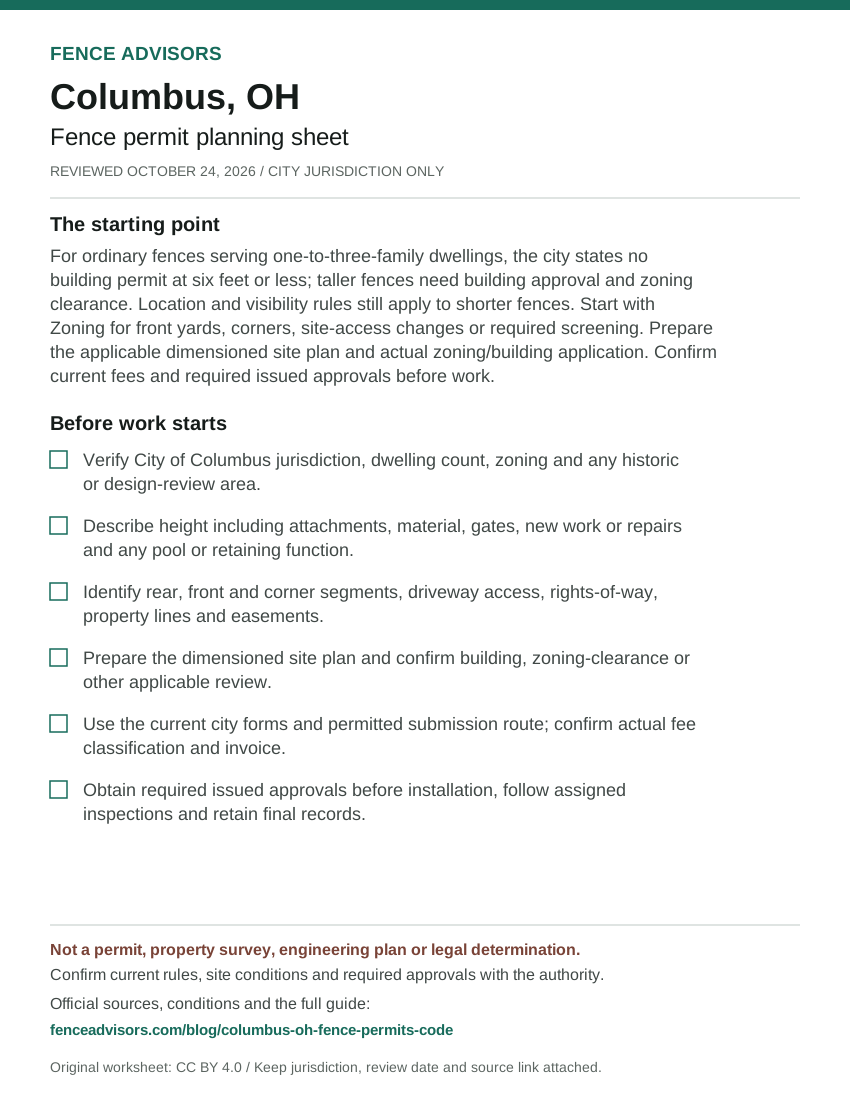
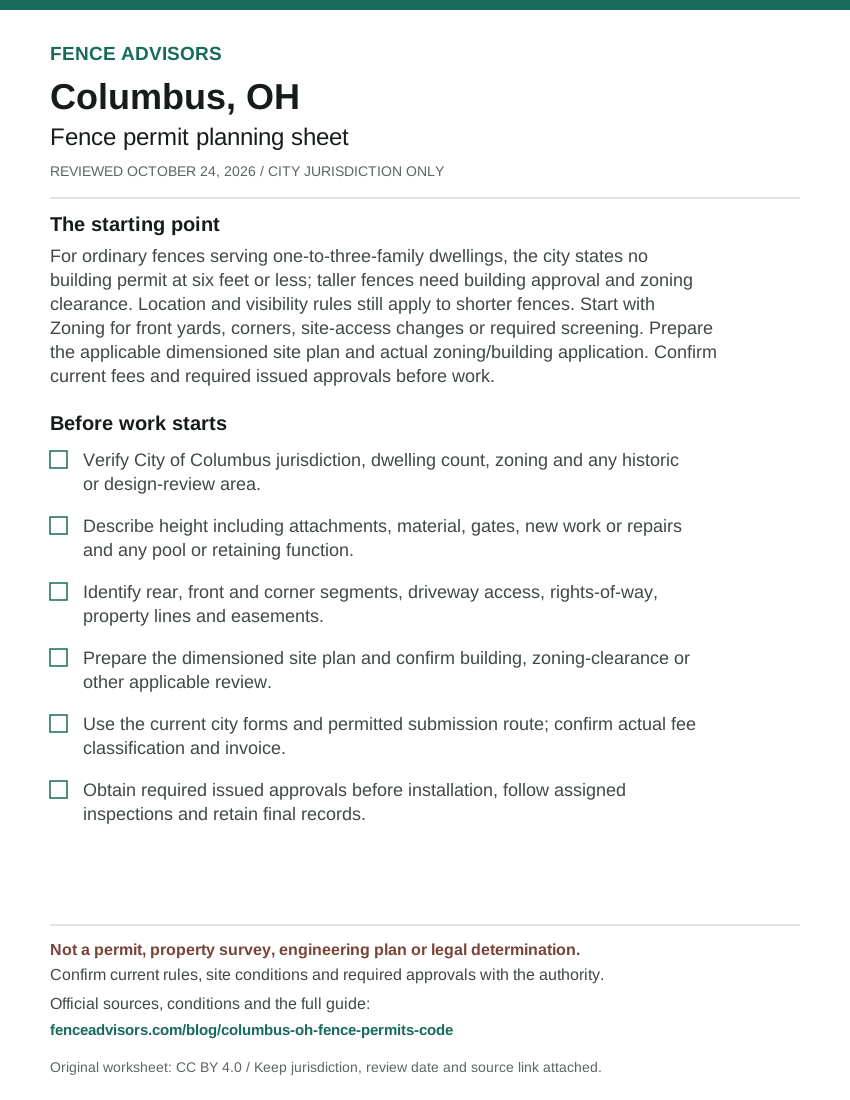
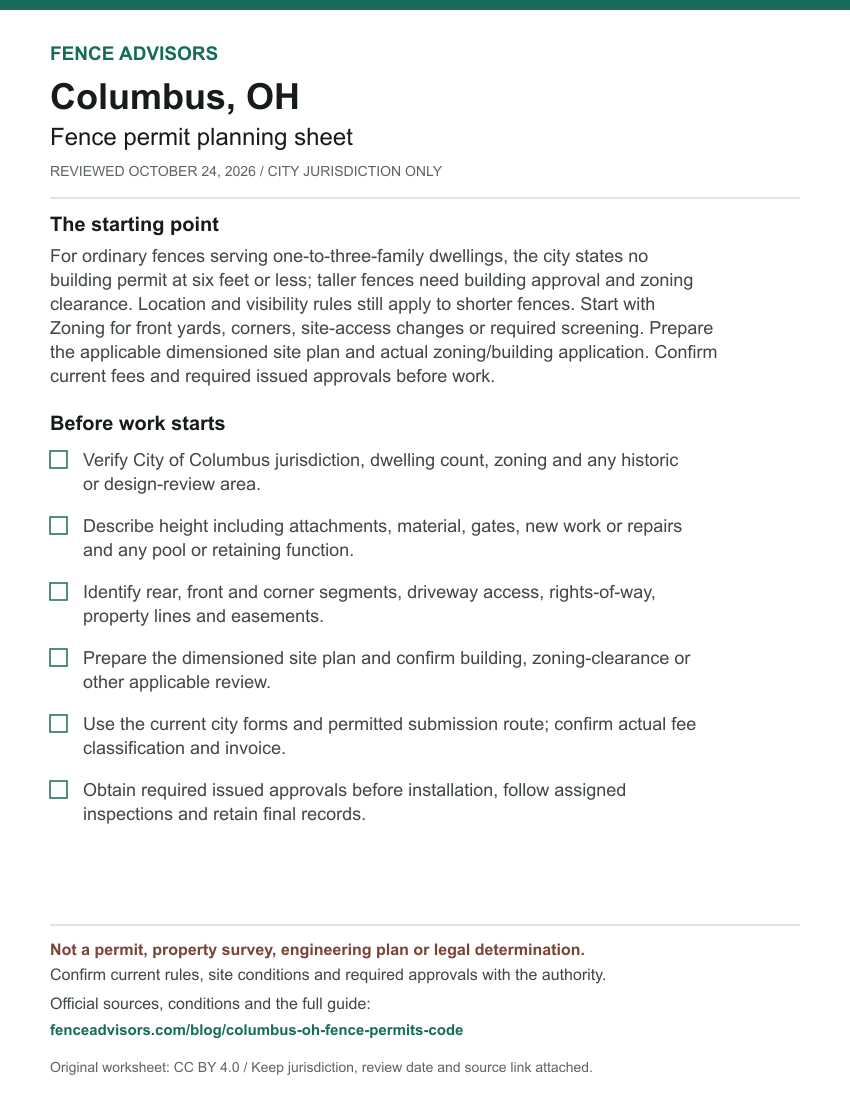
- Verify City of Columbus jurisdiction, dwelling count, zoning and any historic or design-review area.
- Describe height including attachments, material, gates, new work or repairs and any pool or retaining function.
- Identify rear, front and corner segments, driveway access, rights-of-way, property lines and easements.
- Prepare the dimensioned site plan and confirm building, zoning-clearance or other applicable review.
- Use the current city forms and permitted submission route; confirm actual fee classification and invoice.
- Obtain required issued approvals before installation, follow assigned inspections and retain final records.
Download or embed this graphic
<figure>
  <a href="https://fenceadvisors.com/blog/columbus-oh-fence-permits-code"><img src="https://fenceadvisors.com/media/research/columbus-oh-permit-cheat-sheet.svg" alt="Columbus fence permit planning sheet: Conditional: over six feet needs residential building and zoning review. Six preparation checks; the complete accessible checklist and source-checked rules are in this article." width="850" height="1100" loading="lazy" style="max-width:100%;height:auto"></a>
  <figcaption>Graphic: <a href="https://fenceadvisors.com/blog/columbus-oh-fence-permits-code">Fence Advisors</a>. Source, period and limitations are in the linked article. Original graphic: CC BY 4.0.</figcaption>
</figure>
Columbus and Ohio links
Compare Columbus contractors using a written assignment of site-plan, application, fee and inspection responsibilities. The Ohio directory, national contractor directory and national permit navigator provide geographic parents.
For work in Toledo, use the Toledo zoning-certificate and fence application guide; its any-height certificate requirement is not a statewide rule. The setback and easement guide helps organize private-boundary and access questions alongside Columbus's zoning review.
Sources and reuse
We checked the linked government guidance on October 24, 2026. The scope above and source notes identify what was verified and what still needs confirmation. This article is not an ordinance, survey, engineering design, legal opinion or permit approval. The downloadable fact sheet records each finding's source and section. Confirm current rules, fees and submission instructions with the responsible authority before ordering materials or starting work.
You may reuse our original cheat sheet with attribution to this article. Keep the review date, jurisdiction and limitations attached. Government documents remain with their original publishers. Send corrections with a source link to editorial@fenceadvisors.com.
Sources and Downloads
- Columbus Fences information sheet - BA 4/26 p.1 items 1-7 and review instructions; p.2 Vision Clearance. Complete two-page current-linked handout read October 24, 2026; redirect serves current city v/5/bzs/zoning/fences.pdf; prior recorded p.2 visual check reused.
- Passed Columbus ordinance 2526-2025 - Passed status/history; sections 1, 2, 4 and 6 incorporating Exhibit A and enacting 3321.19. Final amended record read October 24, 2026; council approved November 24, 2025, mayor signed November 25, clerk attested November 26; earliest-period-allowed-by-law effective clause, no invented calendar effective date.
- Incorporated fence standards in ordinance Exhibit A - PDF p.22, 3321.19 A-E; incorporated by passed ordinance 2526-2025. Complete 41-page incorporated exhibit retrieved October 24, 2026; enacted additions distinguished from surrounding redlined/deleted material; not claimed to be complete current code consolidation.
- Columbus Building and Zoning Services FAQ - Homeowner steps 1, 4-5; residential Fences; fees; jurisdiction; Citizen Access. Full current page read October 24, 2026; fence review encouragement is not universal mandatory clearance or guaranteed same-day approval.
- Columbus adopted commercial and residential codes - Residential One, Two and Three Family Buildings; commercial/four-family-and-greater distinction. Current city page read October 24, 2026; lists 2019 RCO for residential and 2024 OBC effective March 1, 2024 for separate nonresidential scope.
- Ohio current-linked residential administration rule - 102.10 Building item 2; 101.2 scope; 102.2 other laws. Complete current-linked rule read October 24, 2026; effective July 1, 2019, matching city-listed residential cycle; not a generic IRC exemption.
- Columbus Zoning Review Application - One-page form: review type; site address/parcel; scope; dimensioned site plan; owner/applicant and emailed payment. Current 2026-linked form fully read October 24, 2026; no form completed or submitted.
- Columbus Building Permit Application - p.2 Fence or Retaining Wall and height/attachment questions; p.3 permit holder/owner affidavit; Plan Exam Only option. Complete current-linked four-page form read October 24, 2026; explicitly separates six-foot one-to-three-family and seven-foot larger/commercial scopes.
- Columbus 2026 combined development fee schedule - p.1 payment terms; p.2 residential Fence row; p.9 Zoning Clearance Only row. Complete 12-page current-linked 2026 schedule read October 24, 2026; no precise new effective date inferred from filename or stale link label. Main visually verified p.2/p.9 after storage recovery; fees have separate scopes.
Original Fence Advisors graphics, data compilations and worksheet are available under CC BY 4.0. Retain source, period and scope when reusing data. This license does not relicense third-party documents or trademarks.
Corrections: editorial@fenceadvisors.com.
Related Research
Plan your Columbus fence project
Confirm the approvals for your property, then compare written contractor scopes.
Get the next guide in your inbox
Fence costs, rankings, and what AI is telling homeowners — researched, no fluff.