
Philadelphia, PA / Fence permit planning
City of Philadelphia ordinary residential fence planning, based on posted code current through October 8, 2026; confirm later legislation before applying. Commercial and industrial districts, overlays, historic properties, flood protection areas, pools, retaining structures, decks and electrical gates need their applicable checks. This guide is not a boundary survey, engineering design or approval for a particular property.
Sources and scope checked .
Philadelphia's ordinary building-permit exemptions include non-masonry fences no higher than six feet and masonry fence walls no higher than two feet. That is not an exemption from zoning, historic-property or flood-area requirements. A short, opaque front fence can need zoning review even when it does not cross the ordinary building threshold. Check material, location and property classification before ordering the panels. Philadelphia administrative permit code; Philadelphia fence permit service.
This guide concerns the City of Philadelphia, not every municipality in the metropolitan area. Use the legal property address and the city's zoning classification, then compare Philadelphia fence contractors with the same written design and approval responsibilities. It is not a contractor ranking, installation-price quote or approved drawing.
Quick reference
| Question | Source-checked answer |
|---|---|
| Building permit: exactly six or two feet | A-301.2.1 exempts non-masonry fences that do not exceed 6 feet and masonry fence walls that do not exceed 2 feet. Exactly those heights are included in the ordinary building test; zoning, historic and flood requirements are not waived. Philadelphia administrative permit code; Philadelphia fence permit service |
| Residential front position | On an intermediate residential lot, a fence nearer the front lot line than the greater of the required building setback or actual building distance is limited to 4 feet and 50% opacity. It is not a rule measured only from the curb. Philadelphia fencing and wall zoning standards |
| Residential sides, rear and corner lots | Residential side/rear fences at or behind that front-position boundary may be no more than 6 feet. Street-facing sides of a corner lot follow the front rule; non-street-facing sides follow the side/rear rule, subject to overlays and other applicable standards. Philadelphia fencing and wall zoning standards |
| Historic property or flood protection | The city service requires a building permit for fences on Philadelphia Historic Registry properties or in the 100-year floodplain. The administrative exemptions preserve historic requirements and include a separate flood-protection-area exception. Philadelphia fence permit service; Philadelphia administrative permit code |
| Posted one/two-family fee components | The city posts a $25 nonrefundable filing fee, $50 zoning fee and $69 building fee for the relevant one/two-family categories. Building surcharges, record retention and other applicable charges are separate; these are not one combined flat project price. Philadelphia fence permit service |
| What the fence zoning plan must show | The fence plan instructions require scaled professional-quality drawings showing legal property lines, building footprints, fence heights and opacity, materials, setbacks, relevant streets, easements and access. Freehand sketches are not accepted for that zoning-plan submission. Philadelphia fence zoning plan instructions; Philadelphia plan-requirement resources |
Building permits and zoning are different decisions
The current administrative code resolves the endpoints that overlap in the service page's table headings. Non-masonry fences that do not exceed six feet are included in the ordinary building exemption; masonry fence walls that do not exceed two feet are included in their separate exemption. Exactly six or two is not automatically above the respective threshold. The exemption does not waive other code obligations. Philadelphia administrative permit code.
Zoning is another question. A-301.2.5 lists fences at or below the height allowable by the Zoning Code among the zoning-permit exceptions, while section 14-706 also governs opacity, location and special districts. The city's service page specifically flags front fences more than fifty percent opaque for zoning review. Do not read a height-only exemption as permission to ignore opacity. A zoning application is also not permission to exceed the rules: a refusal and appeal may be necessary for a noncompliant proposal. Philadelphia administrative permit code; Philadelphia fencing and wall zoning standards; Philadelphia fence permit service.
Philadelphia's applicable-code page identifies a July 1, 2026 transition to the 2021 ICC family with local amendments. This guide uses the actual local administrative exemptions, not an assumed model-code threshold from another city. The electronic code identifies coverage through October 8, 2026. Confirm later changes with L&I before relying on a borderline design. Philadelphia applicable construction codes; Philadelphia codifier version.
Residential front yards and corner lots
On an intermediate residential lot, establish the greater of the required building setback or the building's actual distance from the front lot line. A fence nearer the front lot line than that boundary must be no more than four feet tall and fifty percent opaque. Side/rear fencing at or behind that boundary may be no more than six feet under the general residential rule. The city's code illustrations match this distinction; the test is not simply the sidewalk edge or the location of an old panel. Philadelphia fencing and wall zoning standards.
On a corner lot, each building side facing a street follows the front rule. A side not facing a street follows the side/rear rule. Do not call the street-facing side a backyard to obtain the rear allowance. Overlay districts and use-specific standards can impose different requirements. Commercial and industrial sites have their own classifications; the residential six-foot zoning rule should not be copied onto every business property. Philadelphia fencing and wall zoning standards.
Integrated architectural fence/gate posts have limited separate allowances: up to four and a half feet at the front or six and a half feet at sides/rear under the cited provision. Those allowances do not raise the entire panel height. Within a sight triangle, the code restricts fences and walls that are both over four feet and more than fifty percent opaque. Confirm the actual sight-triangle area instead of borrowing an intersection diagram from another municipality. Philadelphia fencing and wall zoning standards.
Masonry, retaining work and sensitive properties
Masonry is not treated like wood, vinyl or metal in the building-permit test. A three-foot masonry wall can cross the ordinary two-foot building threshold even though a similarly sized wood fence would not. A front masonry wall can also need zoning review. Describe both the materials and the location when asking L&I which applications are required. Philadelphia administrative permit code; Philadelphia fence permit service.
The zoning rule counts the portion of a retaining wall above the higher grade with the fence on top for the applicable combined fence-height limit, subject to stated alternative standards. That zoning calculation is not a structural design or the retaining-wall building exemption. We do not publish footing, reinforcement or drainage specifications. Deck guards, pool barriers and powered gates need their own applicable review. Philadelphia fencing and wall zoning standards.
The service page says a building permit is required for fence work on a property on the Philadelphia Historic Registry or in the hundred-year floodplain. Historic work needs Historical Commission approval; right-of-way encroachment can need Department of Streets review. An owner or neighbor's consent does not substitute for those approvals. Philadelphia fence permit service.
For repairs, the administrative ordinary-repair exemption is limited by its maintenance purpose and exclusions for structural, egress and safety-affecting work. We have not established a blanket percentage-of-panels or same-location replacement exemption. Show what is removed, retained, relocated or made taller, and ask the city to classify the actual scope. Philadelphia administrative permit code.
Prepare the right plan and legal address
Apply under the legal address established by the Office of Property Assessment, not a convenient alternative street number. Use the city's Atlas tool, linked from the permit service, to research zoning and relevant property information. Maps help identify the authority and classification; they do not establish ownership boundaries or replace a survey. Philadelphia fence permit service.
The current city resource index links a fence-specific zoning-plan instruction sheet dated September 2024. It requires professional-quality scaled drawings, not a freehand sketch. Include the project address, zoning/code summary, deed property lines, alleyways, driveways, easements, existing building footprints, setbacks and proposed fence heights, materials and opacity. Add elevations/details to establish height and opacity. Street frontage requires street names, relevant right-of-way information and curb cuts. Philadelphia plan-requirement resources; Philadelphia fence zoning plan instructions.
Paper plan-copy and sheet-size requirements are not the online upload rules. Follow the city's ePlan standards for eCLIPSE; ask which building drawings or engineering are required for the specific masonry, structural or special-site scope. Our downloadable worksheet is a preparation aid, not the city's required scaled drawing or a substitute for preapproval.
What Philadelphia posts for fees
The service page separates the following one/two-family categories: a twenty-five-dollar nonrefundable filing fee, a fifty-dollar zoning fee and a sixty-nine-dollar building fee when each application is required. Building permits also carry the posted city and state surcharges; record retention, payment processing, accelerated review and other applicable charges are separate. Other properties use different categories. Do not add every listed row automatically or describe any one row as the entire bill. Philadelphia fence permit service.
Ask L&I which records and charges apply to the scope, including whether both zoning and building approvals are needed. Posted review periods are review targets, not a guaranteed date to start construction. Corrections, preapprovals and contractor association can affect issuance.
Apply through eCLIPSE and finish inspections
- Confirm jurisdiction, the legal OPA address, zoning and historic/flood conditions.
- Define material, height, opacity, location and the complete replacement/repair scope.
- Assemble the applicable plans and agency preapprovals, identifying the responsible contractor.
- Use the official service page's eCLIPSE link, or the city appointment route for in-person filing; submit the required application and filing fee.
- Respond to review comments, complete contractor association and pay the actual balance after approval. An uploaded application or fee receipt is not an issued permit.
- Arrange the inspections listed on the permit when the contractor is ready, complete conditions and retain final approval documents.
The service distinguishes who may apply from who may perform the work. Existing one/two-family homes have specified resident-owner and registered Pennsylvania Home Improvement Contractor alternatives; that is not a blanket owner exemption for every property. Confirm license, tax and insurance requirements rather than assuming a submitted agent name settles eligibility. Philadelphia fence permit service.
Before-you-build checklist
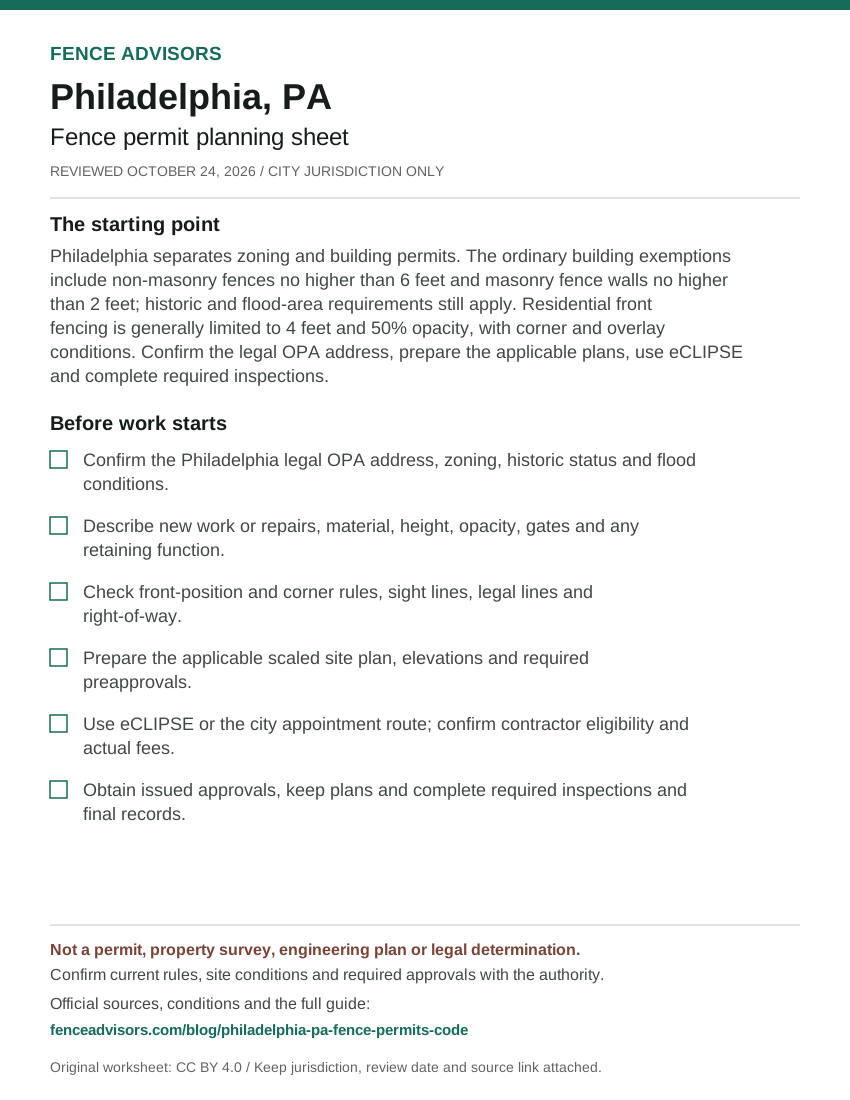
- Confirm the Philadelphia legal OPA address, zoning, historic status and flood conditions.
- Describe new work or repairs, material, height, opacity, gates and any retaining function.
- Check front-position and corner rules, sight lines, legal lines and right-of-way.
- Prepare the applicable scaled site plan, elevations and required preapprovals.
- Use eCLIPSE or the city appointment route; confirm contractor eligibility and actual fees.
- Obtain issued approvals, keep plans and complete required inspections and final records.
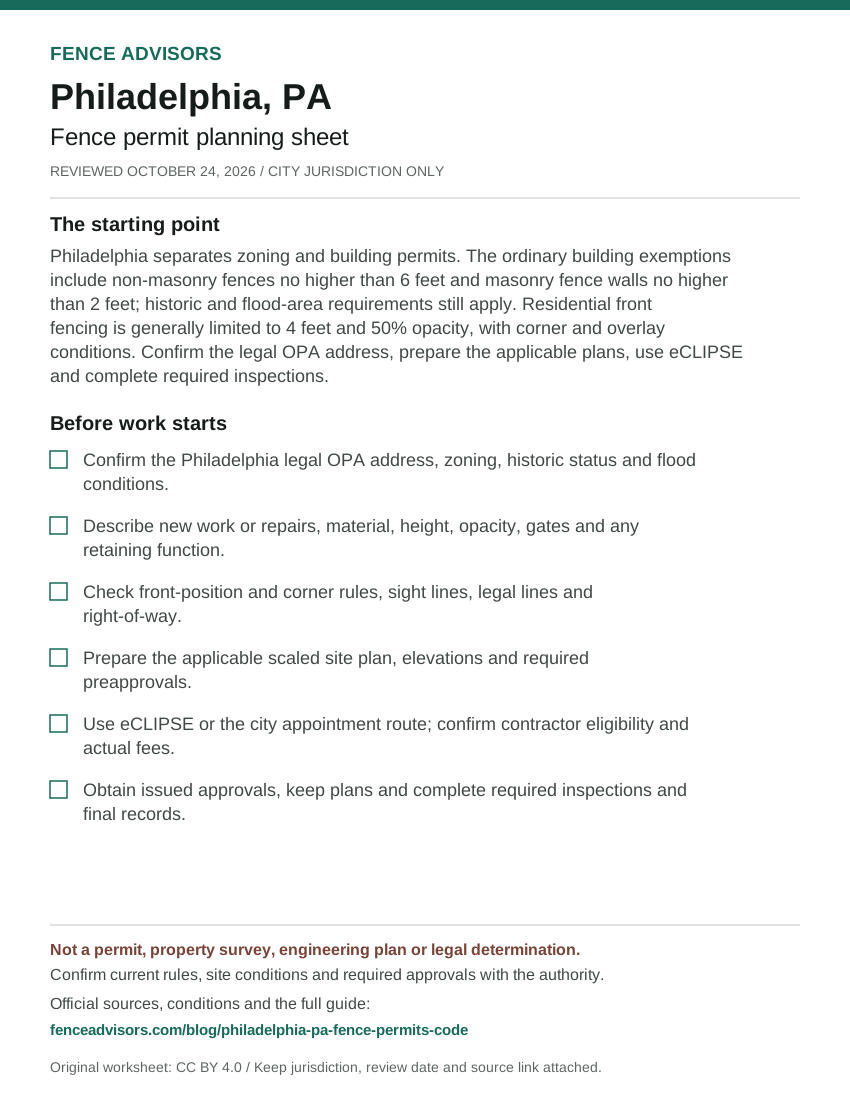
Download or embed this graphic
<figure>
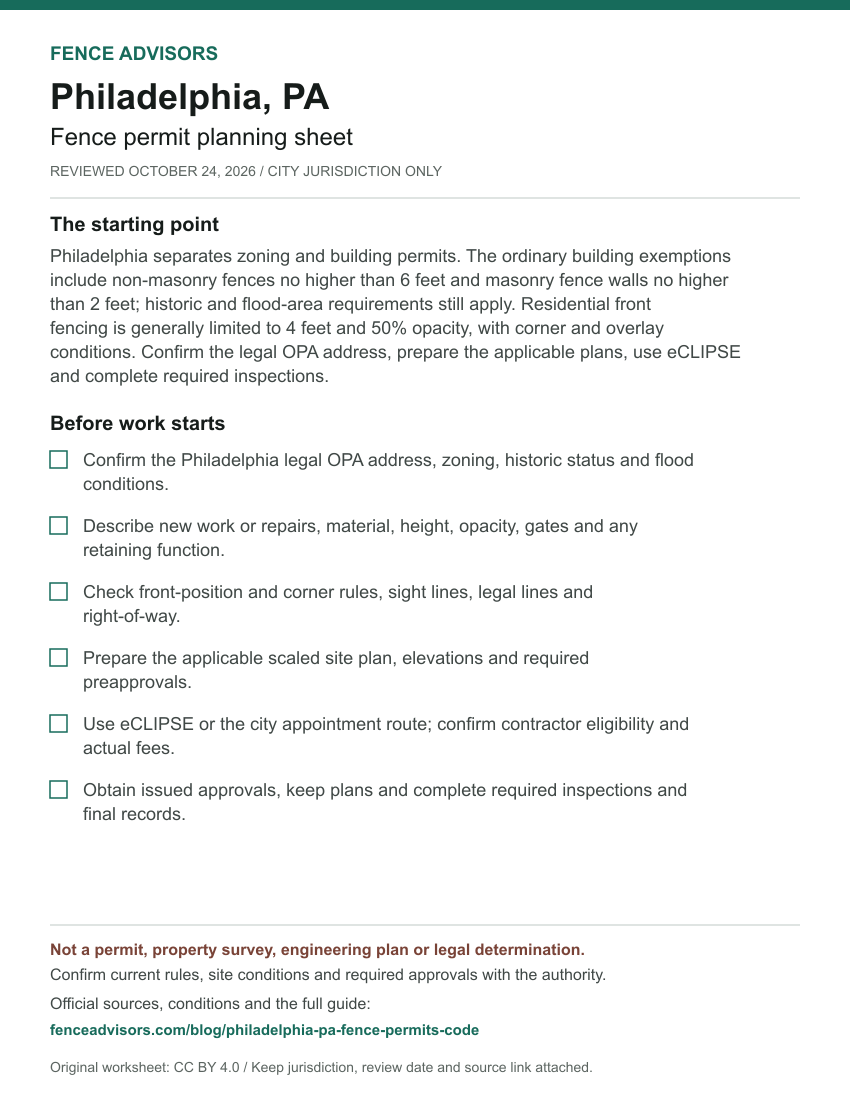
  <a href="https://fenceadvisors.com/blog/philadelphia-pa-fence-permits-code"><img src="https://fenceadvisors.com/media/research/philadelphia-pa-permit-cheat-sheet.svg" alt="Philadelphia fence permit planning sheet: Conditional: masonry, height, zoning and special sites. Six preparation checks; the complete accessible checklist and source-checked rules are in this article." width="850" height="1100" loading="lazy" style="max-width:100%;height:auto"></a>
  <figcaption>Graphic: <a href="https://fenceadvisors.com/blog/philadelphia-pa-fence-permits-code">Fence Advisors</a>. Source, period and limitations are in the linked article. Original graphic: CC BY 4.0.</figcaption>
</figure>
Philadelphia and Pennsylvania project links
Return to Philadelphia's contractor directory once the approval scope is clear. The Pennsylvania contractor hub covers other locations without implying their codes are identical. Use the national fence-permit navigator, setback and easement guide and buyer checklist for related planning questions.
For a project in Allentown, use the Allentown fence application guide. Its zoning and construction-permit checks belong to that jurisdiction, not Philadelphia.
Sources and reuse
We checked the linked government guidance on October 24, 2026. The scope above and source notes identify what was verified and what still needs confirmation. This article is not an ordinance, survey, engineering design, legal opinion or permit approval. The downloadable fact sheet records each finding's source and section. Confirm current rules, fees and submission instructions with the responsible authority before ordering materials or starting work.
You may reuse our original cheat sheet with attribution to this article. Keep the review date, jurisdiction and limitations attached. Government documents remain with their original publishers. Send corrections with a source link to editorial@fenceadvisors.com.
Sources and Downloads
- Philadelphia administrative permit code - A-301.2 flood exception; A-301.2.1 items 1, 3-5; A-301.2.5 item 7. 2026 current codifier; relevant complete sections read October 24, 2026.
- Philadelphia fencing and wall zoning standards - 14-706(1)-(3), including corner lots, architectural posts, retaining walls and decks; front and corner illustrations visually checked. Posted 2026 code read October 24, 2026; residential amendment note identifies bill 210075, approved March 29, 2021.
- Philadelphia fence permit service - Permit tables, historic/flood scope, OPA address, contractor, preapprovals, costs and eCLIPSE steps. Current city page read October 24, 2026; posted fee components and review targets, not an all-in quote or guaranteed timeline.
- Philadelphia applicable construction codes - July 1, 2026 transition to 2021 ICC codes with local amendments; official administrative and zoning code links. Current city page read October 24, 2026; local administrative exemptions read separately, not imported from model code.
- Philadelphia codifier version - Electronic code coverage and official printed-copy limitation. Read October 24, 2026; electronic code current through October 8, 2026.
- Philadelphia plan-requirement resources - Zoning permit for fencing plan requirements; separate Building/ePlan resources. Current city index read October 24, 2026; fence instructions dated September 9, 2024.
- Philadelphia fence zoning plan instructions - Overview, acceptable scales, minimum requirements and prerequisite approvals. Current-linked September 2024 instructions read in full text October 24, 2026; direct visual PDF download returned 403, no sample-plan geometry relied upon.
Original Fence Advisors graphics, data compilations and worksheet are available under CC BY 4.0. Retain source, period and scope when reusing data. This license does not relicense third-party documents or trademarks.
Corrections: editorial@fenceadvisors.com.
Related Research
Plan your Philadelphia fence project
Confirm the approvals for your property, then compare written contractor scopes.
Get the next guide in your inbox
Fence costs, rankings, and what AI is telling homeowners — researched, no fluff.