Tacoma, WA / Fence permit planning
Ordinary residential yard-fence planning inside Tacoma city limits, not unincorporated Pierce County. Current adopted building and zoning provisions, rather than the May 2020 G-325 handout, inform the guide. The handout's conflicting sight-triangle diagram and prose are not construction permission; obtain the applicable visibility requirements from Traffic Engineering. Pool barriers, retaining structures, powered gates, historic, shoreline/critical-area conditions and unusual designs need applicable review. This guide is not a parcel approval, survey or engineering design.
Sources and scope checked .
In Tacoma, an ordinary fence not over seven feet is exempt from a residential building permit; a taller residential fence uses the Residential Alteration permit type, BLDRA. Exactly seven feet is included in that building test. Zoning, street visibility, right-of-way work and other applicable reviews remain independent requirements. Tacoma current residential permits; Tacoma adopted Building Code.
This guide applies inside Tacoma city limits, not all of Pierce County. It answers the public-approval and application-planning question. Use the separate Tacoma fence contractor directory to find installers, then give each bidder the same approved or review-ready scope. A contractor comparison is not a substitute for establishing which authority regulates the property.
Quick reference
| Question | Source-checked answer |
|---|---|
| Ordinary building exemption | Tacoma's current residential service exempts ordinary fences not over 7 feet from a residential building permit. Exactly 7 feet is included in that permit test. Taller fences use Residential Alteration (BLDRA); zoning and other applicable approvals remain separate. Tacoma current residential permits; Tacoma adopted Building Code |
| Current adopted code | TMC 2.02.010 adopts the state-amended construction codes by reference. Current WAC 51-51-003 adopts the 2021 IRC. Tacoma's R105.2 amendment changes other listed Building items, not the ordinary fence exemption. Tacoma adopted Building Code; Washington adopted residential code |
| Street-facing residential zoning | TMC 13.06.090K.5.b generally allows 4 feet above sidewalk grade between a street and a building in UR districts, versus 3 feet in R-4/R-5. Taller decorative options have their own transparency, planting and other conditions; transition and visibility restrictions still apply. Tacoma current zoning chapter |
| Materials and location | The residential fence subsection prohibits barbed/razor wire and electric fences and restricts street-facing chain link, with specified exceptions. Alley and required-screening rules differ from ordinary yard fencing. Identify the actual location and zone before choosing a design. Tacoma current zoning chapter |
| Visibility number withheld | The May 2020 G-325 sight-triangle diagram and prose disagree. This guide does not endorse either number or publish a universal triangle geometry. Obtain Traffic Engineering's applicable visibility and right-of-way requirements before selecting a street/corner fence line. Tacoma G-325 fence handout, qualified historical details; Tacoma current residential permits |
| Required application | Use the city's BLDRA scope and applicable site/construction documents for permit-required residential fences. Tacoma directs applications, document uploads and status tracking to Accela. An application or upload is not an issued permit. Tacoma current residential permits; Tacoma Residential Alteration tip sheet; Tacoma Apply for Permits |
| Fee basis | The current Fee Code bases required building permit fees on work valuation and plan review on the applicable permit fee, with dedicated or other charges where applicable. The city estimator is informational. No universal fence total or guaranteed review time was verified. Tacoma current Fee Code; Tacoma Apply for Permits |
Start with the building exemption, not a universal height limit
Tacoma's current residential permitting page gives both sides of the answer: fences not over seven feet appear in its building-exempt work, while taller fences appear under BLDRA. The current adopted code incorporates the state-amended construction codes by reference. Washington's current residential adoption identifies the 2021 IRC, and Tacoma's local R105.2 amendment changes other Building items without replacing the ordinary fence item. This is not a rule borrowed from a neighboring county or a future code proposal. Tacoma current residential permits; Tacoma adopted Building Code; Washington adopted residential code.
The exemption answers whether the ordinary project needs that building permit. It does not establish the lawful height everywhere on a lot. A seven-foot solid fence near the street can raise a different zoning issue even though it falls within the ordinary building exemption. Conversely, the existence of a taller-fence application category does not promise that Planning will approve the proposed location or design.
Use the current residential zoning district
The current adopted fence provisions are in TMC 13.06.090K. They distinguish Urban Residential districts from the R-4/R-5 provisions. In UR districts, the ordinary street-to-building rule is four feet above sidewalk grade. The R-4/R-5 subsection generally uses three feet in that location. Both contain qualified decorative options; those options carry their own transparency, planting-strip and other conditions. Do not combine the height from one exception with the landscaping or openness requirement from another. Tacoma current zoning chapter.
Have Planning identify the actual zone, the public-street/building relationship and any Building Transition standard. Alley fencing, required screening and residential fencing are not interchangeable categories. The adopted residential subsection also restricts street-facing chain link and prohibits ordinary residential electric, barbed-wire and razor-wire fences, with the scope and exceptions stated in the code. A product sold as residential fencing is not proof it fits every frontage. Tacoma current zoning chapter.
This article does not give one numerical rear-yard zoning maximum. The seven-foot permit exemption must not be relabeled as that missing zoning answer. Obtain the applicable location-specific standard for a nonstandard rear, alley, sloping or mixed-condition proposal before ordering panels.
Resolve street visibility without relying on the old drawing
The city still links G-325, internally dated May 2020. Its sight-triangle diagram and accompanying prose do not agree. Neither number is reliable construction guidance until the conflict is resolved; do not choose the larger allowance or average the labels. The older handout is also not a replacement for the current UR zoning language. Tacoma G-325 fence handout, qualified historical details; Tacoma current zoning chapter.
For a street-facing or corner project, show Traffic Engineering the proposed fence run, access points, grade and legal street boundary. Ask for the applicable visibility limits before fixing the design. Ordinary fence height and visibility are separate tests. A transparent panel, a setback shown on an old diagram or a neighbor's existing fence does not independently establish compliance. Work in public right-of-way has its own approval scope. Tacoma G-325 fence handout, qualified historical details; Tacoma current residential permits.
Legal property and right-of-way lines matter even when no building application is required. Approximate aerial parcel lines are planning aids, not a boundary survey. Resolve a genuinely uncertain line using reliable property records and appropriate professional help; do not infer ownership from a curb, hedge or existing fence. Tacoma G-325 fence handout, qualified historical details.
Prepare a scope-appropriate BLDRA application
For required residential work, the current service identifies Residential Alteration. Its linked G-150 packet includes fences in miscellaneous structures and calls for a written scope and applicable site plan. Provide the construction information the city needs for the proposed assembly; do not attach every interior-remodel document merely because it appears elsewhere in the same packet. The packet is dated February 2021 and is not an engineering approval for a new tall fence. Tacoma current residential permits; Tacoma Residential Alteration tip sheet.
Tacoma's current Apply for Permits page directs applicants to Accela for applications, documents, status tracking and communication. Review its electronic file standards and the required application materials before submission. Address review corrections, confirm the actual charges and obtain issued approvals before permit-required construction. Arrange the required inspections while the work remains available to inspect. Tacoma Apply for Permits.
Fees, repairs and combined work
The current Fee Code uses the work's valuation for building permit fees and the applicable plan-review basis, with dedicated or other charges as appropriate. The city's estimator is informational, not a final invoice. This guide therefore does not quote a flat Tacoma fence price or promise a review duration. Ask for the assessment tied to the actual BLDRA and any separate reviews. Tacoma current Fee Code; Tacoma Apply for Permits.
Describe replacement and repair honestly. The current residential page has ordinary-repair provisions, but this review did not verify a blanket rule based on replacing a particular percentage of fence panels. Nor does a short new fence automatically settle repair work on an unsafe or specially regulated assembly. Tacoma current residential permits.
Pool barriers, retaining structures, powered gates and historic, shoreline or critical-area conditions require their own classification. Do not remove a required barrier or assume that a freestanding yard-fence exemption approves a combined retaining wall. Identify these functions at the start so the city can assign the appropriate review, documents and inspection scope.
Before-you-build checklist
- Confirm Tacoma city jurisdiction, current zone and any historic, shoreline or critical-area conditions.
- Describe new, replacement or repair work, full height, material and any retaining, pool or powered-gate function.
- Locate legal lot/right-of-way lines, easements, grades, street frontage and access points.
- Check the building exemption separately from zoning, Traffic Engineering visibility and ROW approvals.
- Prepare the applicable site plan and construction documents; use Accela for required BLDRA work.
- Confirm the current assessment, issued approvals and inspection sequence; retain final records.
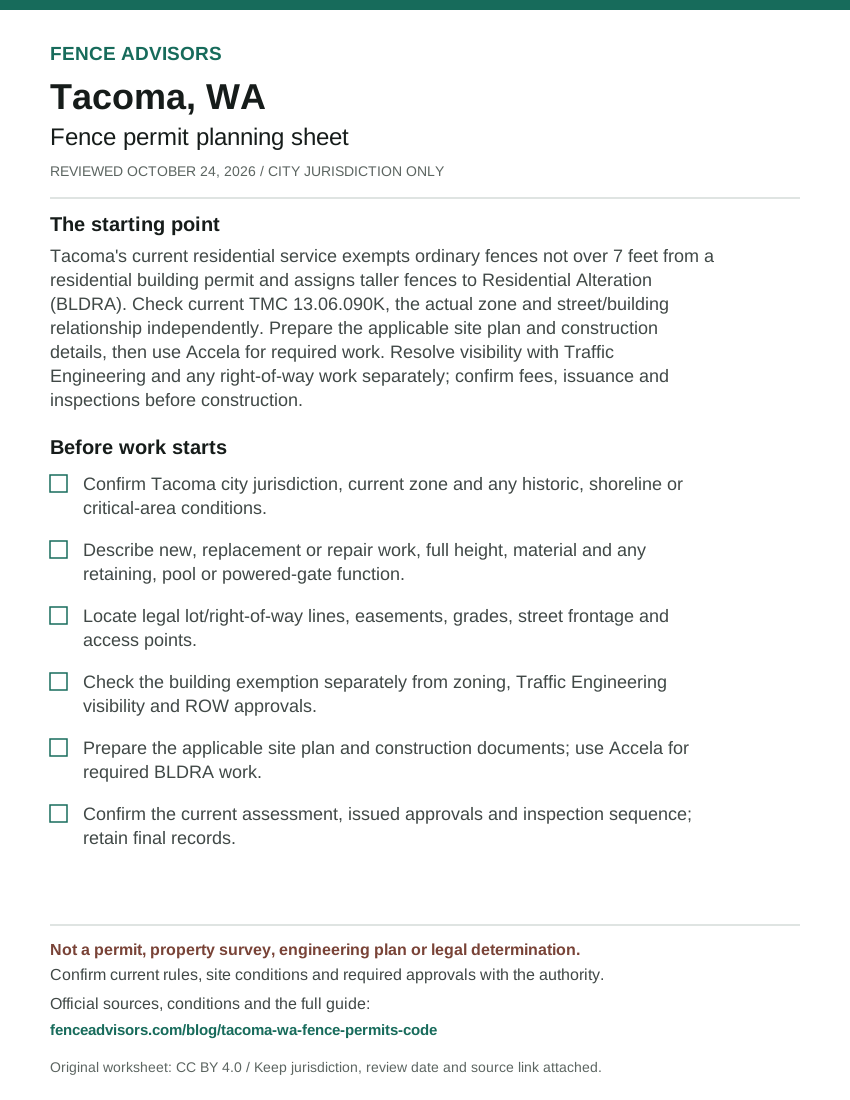
Download or embed this graphic
<figure>
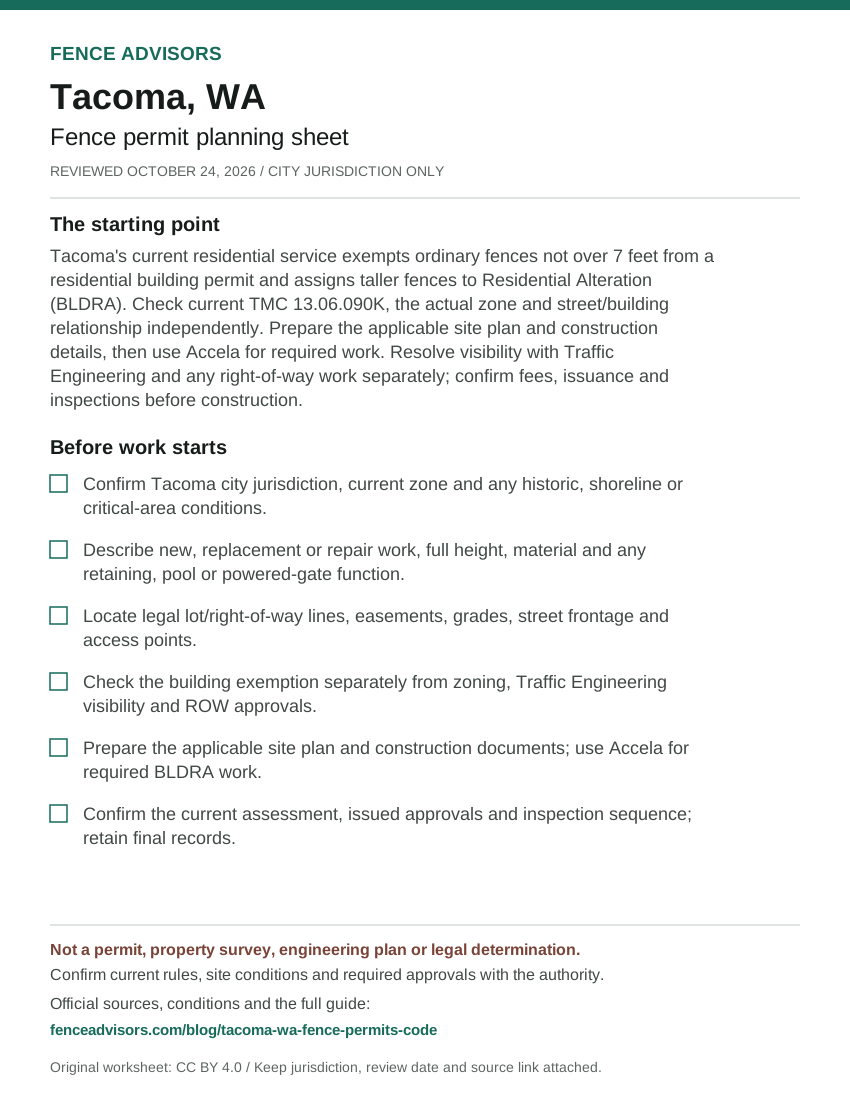
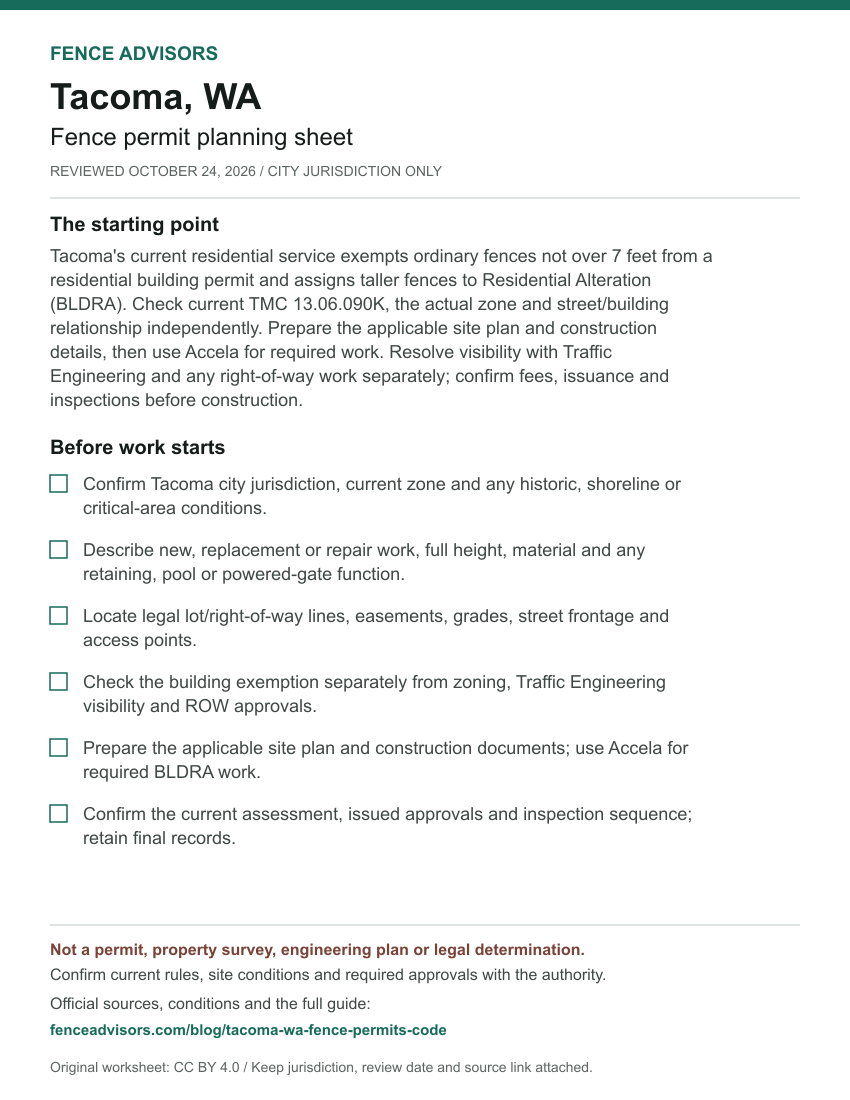
  <a href="https://fenceadvisors.com/blog/tacoma-wa-fence-permits-code"><img src="https://fenceadvisors.com/media/research/tacoma-wa-permit-cheat-sheet.svg" alt="Tacoma fence permit planning sheet: Ordinary fences not over 7 feet are building-exempt; zoning and other approvals remain. Six preparation checks; the complete accessible checklist and source-checked rules are in this article." width="850" height="1100" loading="lazy" style="max-width:100%;height:auto"></a>
  <figcaption>Graphic: <a href="https://fenceadvisors.com/blog/tacoma-wa-fence-permits-code">Fence Advisors</a>. Source, period and limitations are in the linked article. Original graphic: CC BY 4.0.</figcaption>
</figure>
Tacoma and Washington planning links
For a property actually in Vancouver, use the Vancouver WA permit and ePlans guide. Its local administrative threshold differs from Tacoma's; neither city's exemption supplies the other's zoning permission.
Use Tacoma fence companies, the Washington directory, the national contractor directory and the national permit navigator for the next planning step. These geographic links do not import another jurisdiction's rules.
Sources and reuse
We checked the linked government guidance on October 24, 2026. The scope above and source notes identify what was verified and what still needs confirmation. This article is not an ordinance, survey, engineering design, legal opinion or permit approval. The downloadable fact sheet records each finding's source and section. Confirm current rules, fees and submission instructions with the responsible authority before ordering materials or starting work.
You may reuse our original cheat sheet with attribution to this article. Keep the review date, jurisdiction and limitations attached. Government documents remain with their original publishers. Send corrections with a source link to editorial@fenceadvisors.com.
Sources and Downloads
- Tacoma current residential permits - BLDRA scope; What Does Not Require a Residential Permit, R105.2 Building item 2; repairs and separate ROW scope. Full current city service read October 24, 2026; exact-seven-foot endpoint retained.
- Tacoma adopted Building Code - 2.02.010 adoption by reference; 2.02.540 modifies Building items 5/11, not the ordinary fence item. Official eCode version September 30, 2026; complete applicable adoption/amendment bodies read October 24, 2026.
- Washington adopted residential code - WAC 51-51-003, 2021 IRC adoption and amendment history. Current state rule read October 24, 2026; adopted 2021 edition, not a proposed future cycle.
- Tacoma current zoning chapter - 13.06.090K.1-5, especially K.5.b UR versus R-4/R-5; K.4 alleys and K.5 materials/transition cross-reference. Full current official chapter retrieved October 24, 2026; eCode version September 30, 2026. Older handout is not substituted for current UR standards.
- Tacoma Apply for Permits - Getting Started with Accela; Electronic File Standards; Permit Fee Estimator; permit-counter guidance. Page labels content current September 3, 2026; full page and expanded application/fee instructions read October 24, 2026; no account created or application submitted.
- Tacoma Residential Alteration tip sheet - Both pages: miscellaneous fence scope, written scope, site plan and applicable construction documents. Currently linked G-150, February 2021; corroborated for BLDRA classification by current residential page; not treated as a current engineering design.
- Tacoma current Fee Code - 2.09.040 dedicated charges; 2.09.050A-B building valuation and plan-review fee basis. Official eCode version September 30, 2026; full applicable sections read October 24, 2026. Actual PDS assessment/estimate is not a fixed fence quote.
- Tacoma G-325 fence handout, qualified historical details - May 2020 footer; p.2 sight-triangle drawing versus prose, ROW/Traffic Engineering and approximate parcel mapping warnings. Existing local copy reused and p.2 visually checked October 24, 2026; conflicting visibility numbers and prescriptive footing detail not approved for publication.
Original Fence Advisors graphics, data compilations and worksheet are available under CC BY 4.0. Retain source, period and scope when reusing data. This license does not relicense third-party documents or trademarks.
Corrections: editorial@fenceadvisors.com.
Related Research
Plan your Tacoma fence project
Confirm the approvals for your property, then compare written contractor scopes.
Get the next guide in your inbox
Fence costs, rankings, and what AI is telling homeowners — researched, no fluff.