2016 meta-analysis; included research through April 2015; FHWA 2008 context
Historical road-mitigation research. Large-mammal and all-taxa effects are different subsets; not a guarantee for a product, backyard deer fence or every road.
Sources and scope checked .
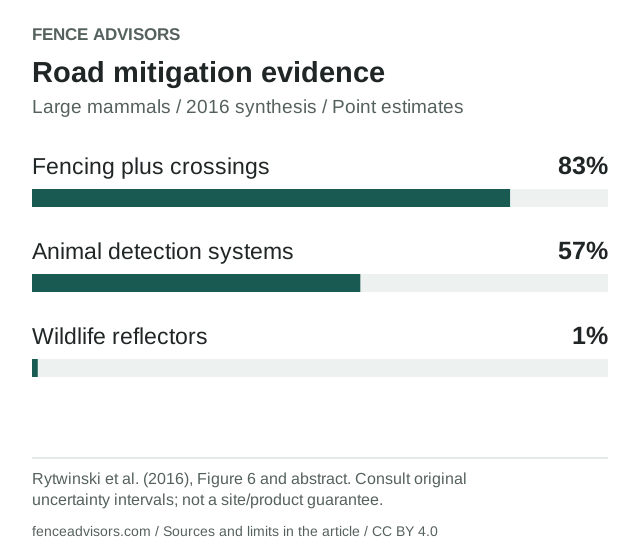
A 2016 meta-analysis reported an 83% large-mammal road-kill reduction for fencing combined with crossings. The same large-mammal comparison reported 57% for animal detection systems and 1% for reflectors. These are historical synthesized point estimates with uncertainty, not performance guarantees or a ranking that proves statistical superiority in every setting. Rytwinski et al., PLOS ONE.
The evidence is useful because it tests a system: roadside exclusion needs to work with movement routes, escape, fence ends and maintenance. It is not a statistic about how well a backyard deer fence protects a garden. For livestock containment, see the farm fence guide; the road-mitigation outcomes below cannot be transferred directly to that different use.
Wildlife fencing statistics at a glance
Download or embed this graphic
<figure>
  <a href="https://fenceadvisors.com/blog/wildlife-fencing-statistics"><img src="https://fenceadvisors.com/media/research/wildlife-mitigation-evidence.svg" alt="The 2016 meta-analysis reports large-mammal road-kill reductions of 83% for fencing plus crossings, 57% for animal detection and 1% for reflectors. These are point estimates with uncertainty, not a significance ranking." width="640" height="550" loading="lazy" style="max-width:100%;height:auto"></a>
  <figcaption>Graphic: <a href="https://fenceadvisors.com/blog/wildlife-fencing-statistics">Fence Advisors</a>. Source, period and limitations are in the linked article. Original graphic: CC BY 4.0.</figcaption>
</figure>| Measure | Published value | Population and period |
|---|---|---|
| Studies in the full meta-analysis | 50 | Multiple mitigation types; research searched through April 2015 |
| Effect sizes in the full analysis | 99 | Not 99 separate fencing projects or 99 independent studies |
| Studies in North America | 41 | Geographic distribution of the full included study set |
| Fencing plus crossings | 83% reduction | Large-mammal comparison in the 2016 paper |
| Animal detection systems | 57% reduction | Large-mammal comparison in the 2016 paper |
| Wildlife reflectors | 1% reduction | Large-mammal comparison in the 2016 paper |
| Fencing with or without crossings | 54% reduction | Separate all-taxa comparison, not the same subset as 83% |
Source: paper abstract, methods, study overview and Figure 6. The full set includes several interventions and study designs; do not attach all 50 studies to the specific 83% estimate. The downloaded CSV retains the separate populations and historical period.
Why 83% and 54% are not contradictory
The 83% figure concerns large mammals and fencing combined with crossings in the stated comparison. The 54% figure describes fencing with or without crossing structures across the broader taxa comparison. Different populations and intervention groupings can produce different estimates. They are not two estimates of the identical installed fence.
Nor should the 83%, 57% and 1% bars be treated as equally precise observations. The paper reports uncertainty and heterogeneous conditions. Read the original confidence intervals and statistical comparisons before asserting that one intervention is definitively better than another; our simple chart shows published point estimates, not their complete inferential analysis.
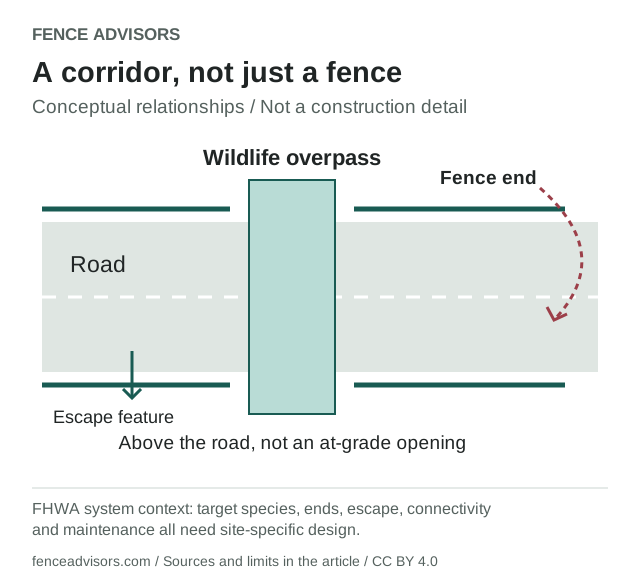
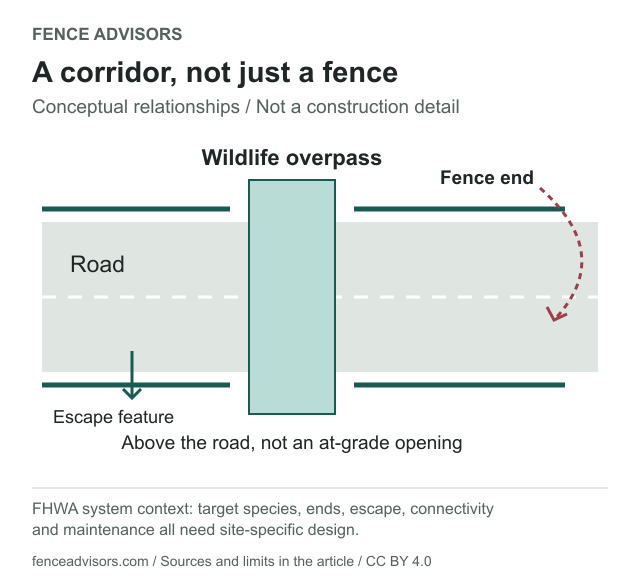
Fencing and crossings must be considered together
Download or embed this graphic
<figure>
  <a href="https://fenceadvisors.com/blog/wildlife-fencing-statistics"><img src="https://fenceadvisors.com/media/research/wildlife-fence-crossing.svg" alt="Original road-corridor schematic with roadside exclusion fencing, a grade-separated wildlife crossing, fence-end risk and an escape opportunity. Not a site design or dimensional specification." width="640" height="580" loading="lazy" style="max-width:100%;height:auto"></a>
  <figcaption>Graphic: <a href="https://fenceadvisors.com/blog/wildlife-fencing-statistics">Fence Advisors</a>. Source, period and limitations are in the linked article. Original graphic: CC BY 4.0.</figcaption>
</figure>
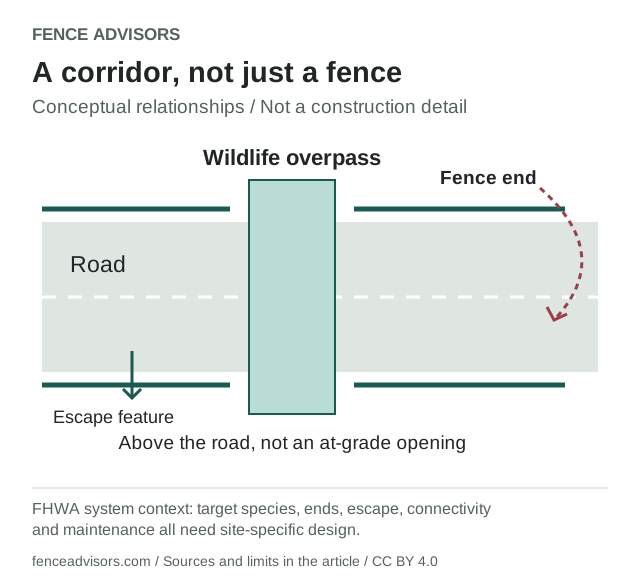
Exclusion fencing can keep animals away from a road while also disrupting movement. Appropriate crossing opportunities and site-specific approaches matter. In its studied sample, the meta-analysis did not detect a road-kill reduction from crossing structures without fencing; that does not mean crossings have no connectivity value or that every fencing-only design works.
The FHWA 2008 review describes fence ends, entry/escape issues and the relationship to crossing structures. The FHWA 2011 handbook overview is additional design context, not a new 2026 product test. Both are historical references, not permission to prescribe a corridor from a generic online drawing.
Our schematic intentionally gives no fence height, mesh, road setback or crossing dimensions. Those details require the site, target species, terrain, road conditions and qualified design. It is a visual explanation of system relationships, not a construction detail.
Failure modes worth documenting
- Ends: whether a fence ends where animals can re-enter a hazardous corridor.
- Openings: gates, culverts, drainage or damaged sections that interrupt exclusion.
- Escape: what happens if an animal is trapped within the road-side corridor.
- Movement: whether target species can reach suitable crossing opportunities.
- Maintenance: who inspects breaches, repairs damage and records changed conditions.
- Evidence: whether monitoring measures mortality, animal movement, maintenance or another outcome.
This checklist is a set of questions informed by the cited system evidence, not a universal engineering specification. A material supplier's tensile data alone cannot answer all of them.
Do not export road evidence into backyard promises
An estimate about road-kill in a studied large-mammal corridor cannot establish that a particular residential fence will exclude every deer, improve garden yields, or reduce every kind of collision by 83%. It also does not measure current U.S. collision totals, nationwide financial loss or the installed price of a wildlife fence in 2026.
For a procurement request, document intended outcome, target species, approved design, exact product and maintenance responsibilities in the supplier RFQ. For construction candidates, use the contractor directory and verify project-relevant capability. Do not mistake a directory listing or an attractive photo for wildlife-corridor design experience.
Methodology and how to cite this reference
Fence Advisors checked the primary meta-analysis and public FHWA context in October 2026. The numerical excerpt remains dated 2016, with research searched through April 2015. We have not performed a new meta-analysis or claimed this is an exhaustive current evidence review. Original charts, the schematic and the source-attributed CSV/JSON are downloadable below.
Suggested citation: Fence Advisors, Wildlife Fencing Statistics, October 3, 2026, summarizing Rytwinski et al. (2016), PLOS ONE, DOI 10.1371/journal.pone.0166941. Preserve the intervention, population and historical period; cite the underlying paper rather than presenting these estimates as Fence Advisors field testing.
Frequently Asked Questions
Do wildlife fences reduce collisions by 83%?
The cited 2016 paper reports an 83% large-mammal road-kill reduction for fencing combined with crossings in its synthesis. It is not a universal collision, product or site guarantee, and uncertainty matters.
Is the 54% number for the same group of projects?
No. It concerns fencing with or without crossings in the paper's broader all-taxa comparison. It should not replace or be averaged with the separate large-mammal 83% estimate.
Can these statistics prove a backyard deer fence will work?
No. Road-mitigation evidence does not establish the outcome of a residential deer fence. Evaluate the actual species, site, product, installation and relevant local requirements.
Sources and Downloads
- Rytwinski et al., PLOS ONE (2016), DOI 10.1371/journal.pone.0166941
- FHWA Wildlife-Vehicle Collision Reduction Study (2008), Chapter 8
- FHWA Wildlife Crossing Structure Handbook (March 2011)
Original Fence Advisors graphics, data compilations and worksheet are available under CC BY 4.0. Retain source, period and scope when reusing data. This license does not relicense third-party documents or trademarks.
Corrections: editorial@fenceadvisors.com.
Related Research
Put your research to work
Estimate your budget, then compare fence companies in your area.
Get the next guide in your inbox
Fence costs, rankings, and what AI is telling homeowners — researched, no fluff.