
Atlanta, GA / Fence permit planning
Ordinary residential fence application planning inside City of Atlanta limits, not every Atlanta postal address or all Fulton/DeKalb County property. General R-1 through R-5 and R-G yard standards are not universal historic, SPI, overlay or site-specific permissions. Pool barriers, retaining structures, powered gates and tree/land disturbance need their applicable reviews. Not parcel approval, legal advice, a survey or engineering design.
Sources and scope checked .
A new fence in the City of Atlanta needs a permit under the local construction-administration rule unless the city identifies a specific applicable exemption. Do not use the general repair valuation exception as permission for a new fence, or import a model-code seven-foot exemption. Zoning height and special-district review are separate tests. The codified fence fee rows are minimums, not guaranteed all-in prices. Atlanta AppendixA Section103: application for permit; Atlanta getting started with Zoning, Development and Permitting; Georgia 2026 amendments to the 2024 IRC; Atlanta AppendixA Section104: permits and fees.
This guide covers City of Atlanta limits, not every address using Atlanta as its postal city or all property in Fulton and DeKalb counties. It explains ordinary homeowner application planning. The separate Atlanta contractor directory is for comparing installers after defining the same location, material and approval scope for each quote.
Quick reference
| Question | Source-checked answer |
|---|---|
| Does a new fence need a permit? | Atlanta's local administration requires a permit to construct or install a structure unless specifically exempt, and the current city service lists fences. Georgia's current IRC amendments delete model Chapter1 in favor of local administrative procedures; the model seven-foot exemption is not an Atlanta permit waiver. Atlanta AppendixA Section103: application for permit; Atlanta getting started with Zoning, Development and Permitting; Georgia 2026 amendments to the 2024 IRC |
| Repair is a qualified category | Local section 103.4 defines repair as reconstruction/renewal of an existing structure for maintenance and exempts otherwise-lawful repair work valued below $10,000. Historic Chapter 20 exterior/site work has different treatment. A new fence or changed layout is not made exempt merely by staying below that valuation. Atlanta AppendixA Section103: application for permit; Atlanta getting started with Zoning, Development and Permitting |
| Ordinary residential front yards | In R-1 through R-5, where no retaining wall is constructed, fences in required front and half-depth front yards ordinarily may not exceed 4 feet. Retaining combinations, district-specific rules and approved special exceptions are separate questions. Atlanta Code16-28.008: required yards and visibility |
| Side/rear zoning differs by district | In R-1 through R-5, fences or walls in required side/rear yards without a retaining wall ordinarily may reach 6 feet. The general R-G provision allows 8 feet in side/rear yards, with a 4-foot front rule. These are zoning allowances, not permit-exemption thresholds. Atlanta Code16-28.008: required yards and visibility |
| Intersections and special sites | Dwelling-district street-intersection restrictions can require a lower fence than the normal yard limit. Section 16-28.008(9) also protects street and driveway sight areas. Historic, SPI and overlay requirements may add review; an open-looking panel or existing fence is not proof of clearance. Atlanta Code16-28.008: required yards and visibility; Atlanta getting started with Zoning, Development and Permitting |
| Fence fee rows are minimums | Codified section 104.2(m) lists a $75 minimum for fences 6 feet or less and $120 above 6 feet, subject to its valuation/minimum qualification. The city service also lists other charges. Obtain the actual assessment; neither row is a guaranteed all-in invoice or a zoning height allowance. Atlanta AppendixA Section104: permits and fees; Atlanta getting started with Zoning, Development and Permitting |
| Current application and jurisdiction | Verify incorporation using the city's City Limits lookup and research zoning/overlays separately. Use the official Accela route and scope-appropriate city application documents, confirming the fence record type and any special review. No fence-specific Express eligibility, logged-in workflow or guaranteed turnaround was verified. Atlanta Department of City Planning GIS; Atlanta online permitting instructions; Atlanta applications, forms and checklists; Atlanta Office of Buildings current implementation notices |
Local administration controls the new-fence permit question
Atlanta's Appendix A, section 103.1 requires a permit before constructing or installing a structure unless specifically exempted. The current city service independently includes fences among commonly permitted projects. Section 103.4 provides defined exceptions and allows written policies for additional classes; that is not a reason to assume an unverified fence exemption exists. Confirm any proposed exception with the responsible office. Atlanta AppendixA Section103: application for permit; Atlanta getting started with Zoning, Development and Permitting.
The current technical code cycle is 2024 IRC/IBC and related codes with Georgia amendments. Atlanta's adoption notice implements that cycle for 2026 and requires it for new applications beginning February 1 after the stated transition. Importantly, Georgia's 2026 IRC amendments delete Chapter 1 Scope and Administration without substitution, retaining it only as a reference for local administrative procedures. The model IRC's height exemption therefore is not itself an Atlanta permit waiver. Atlanta current Georgia minimum construction codes; Georgia 2026 amendments to the 2024 IRC.
The current publisher's local administration remains the relevant permit source. An older technical-code list inside a general application packet is not the current code cycle, and the old technical-adoption language elsewhere in the municipal compilation does not override the city's current state-code implementation notice. Keep the technical design code and the local administrative permit rules distinct.
Maintenance repair is different from new construction
Section 103.4 defines repair work as reconstruction or renewal of an existing structure for maintenance. It exempts otherwise-lawful repair work below $10,000 under its stated scope. That is not a blanket exemption for a new fence, a relocated enclosure, an increase in height or a changed property layout simply because the construction price is below that figure. Describe the actual work and existing lawful condition before asking for the exemption. Atlanta AppendixA Section103: application for permit.
The same section treats exterior or site work governed by historic Chapter 20 differently and contains its own limited repair qualification. Do not generalize the ordinary repair rule to a historic or landmark property. New fences and altered designs may need a Certificate of Appropriateness, special administrative review or other district-specific approval before the building application can proceed. The current FAQ identifies historic, SPI and overlay review as separate workstreams. Atlanta AppendixA Section103: application for permit; Atlanta getting started with Zoning, Development and Permitting.
We have not verified a general same-location or panel-percentage fence replacement waiver. A city determination that work qualifies as lawful maintenance is different from a contractor merely labelling it repair on an estimate. Keep the written scope and any applicable city determination with the project records.
Required-yard height depends on the zoning district
In R-1 through R-5, section 16-28.008(5)(a) ordinarily permits a fence up to four feet in required front and half-depth front yards where no retaining wall is constructed. In required side and rear yards without a retaining wall, the ordinary fence/wall limit is six feet. Those conditions matter: a street-facing side of a corner lot may involve a half-depth front yard rather than an interior side-yard assumption. Atlanta Code16-28.008: required yards and visibility.
The general R-G provision differs, allowing an eight-foot side/rear fence with a four-foot front rule. That does not make eight feet Atlanta's universal backyard height. Other districts, special overlays, historic regulations, adopted site conditions and approved exceptions require their actual standards. Do not use a neighboring lot's fence as proof that the same district or exception applies. Atlanta Code16-28.008: required yards and visibility; Atlanta getting started with Zoning, Development and Permitting.
The section separately addresses retaining-wall combinations and driveway-related retaining conditions. Its retaining-wall measurement language should not be repurposed as a generic rule for every freestanding fence. Show nearby grades and any soil-retaining function, and ask which measurement and review apply. This guide does not supply retaining-wall design, stepped-wall spacing instructions or permission to build a taller combined assembly.
Visibility and special functions must be resolved first
Section 16-28.008(5)(c) imposes a lower street-intersection restriction in dwelling districts, and subsection (9) separately protects visibility at streets and driveways. Have those areas identified on the proposed layout before selecting panel height and opacity. A normal front-yard maximum, an open-looking rail or an existing tall hedge does not establish visibility compliance. This guide does not convert the code text into a universal curb offset or a DIY triangle plan. Atlanta Code16-28.008: required yards and visibility.
Pool barriers are not ordinary yard-fence advice. Atlanta's current technical-code implementation includes the swimming-pool/spa code with Georgia amendments. Identify a fence serving that safety function before altering or removing it, and obtain the applicable review. Powered gates, electrical work, retaining structures and tree or land disturbance likewise need their applicable scope checks rather than an assumption that the fence permit covers everything. Atlanta current Georgia minimum construction codes; Atlanta Office of Buildings current implementation notices.
Use the current Accela route and requested documents
The city's online instructions distinguish Building/Trade/Tree submissions from Planning/Historic submissions. They link the current Accela Citizen Access portal and describe application, document upload, completeness processing, corrections and record handling. Confirm the fence's record type and any prerequisite district review with staff; this review did not establish automatic Express eligibility for every fence. Atlanta online permitting instructions.
Use the current applications index for scope-appropriate forms, file-naming standards and applicant-role documents. A useful project description identifies new work or the proposed maintenance repair, complete height and material, fence and gate locations, legal lot/right-of-way lines, required yards, nearby access and relevant site conditions. Prepare the drawings and supporting details the city actually requests. Do not treat a general new-building checklist as proof that every fence needs a complete house-plan package. Atlanta applications, forms and checklists; Atlanta AppendixA Section103: application for permit.
The general Express application packet is not a verified fence-specific checklist and contains an older technical-code list. Use the current adoption notice for the code cycle and ask staff to confirm the correct application route and documents for the actual assembly. Obtain issued approvals before permit-required work and follow the applicable inspections through completion. Atlanta current Georgia minimum construction codes; Atlanta applications, forms and checklists; Atlanta online permitting instructions.
Budget the codified minimum, not a promised invoice
Appendix A, section 104.2(m) lists a $75 minimum for fences six feet or less and $120 above six feet. Its opening language qualifies minimum fees with valuation treatment. The current city FAQ repeats the fence rows but also lists other charges, including a technology fee. A taller fee category is not permission to exceed the allowed zoning height, and the listed minimum is not necessarily the total assessment. Atlanta AppendixA Section104: permits and fees; Atlanta getting started with Zoning, Development and Permitting.
Ask for the actual invoice for the defined work and any related reviews. The Office of Buildings directs customers to official invoices and Accela or the city cashier rather than informal payment requests. No universal all-in fence total or guaranteed approval time was verified. Assign responsibility for applications, corrections, payments, inspections and final records before agreeing to a construction start date. Atlanta Office of Buildings current implementation notices; Atlanta online permitting instructions.
Before-you-build checklist
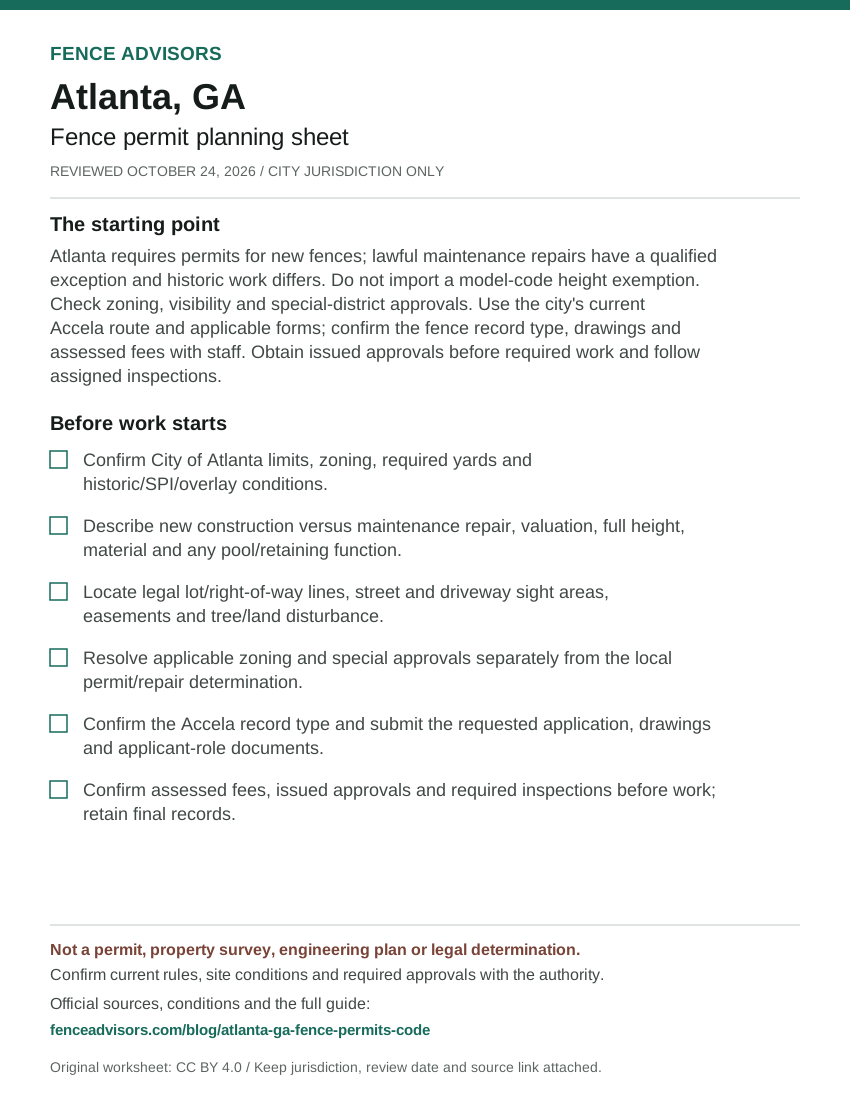
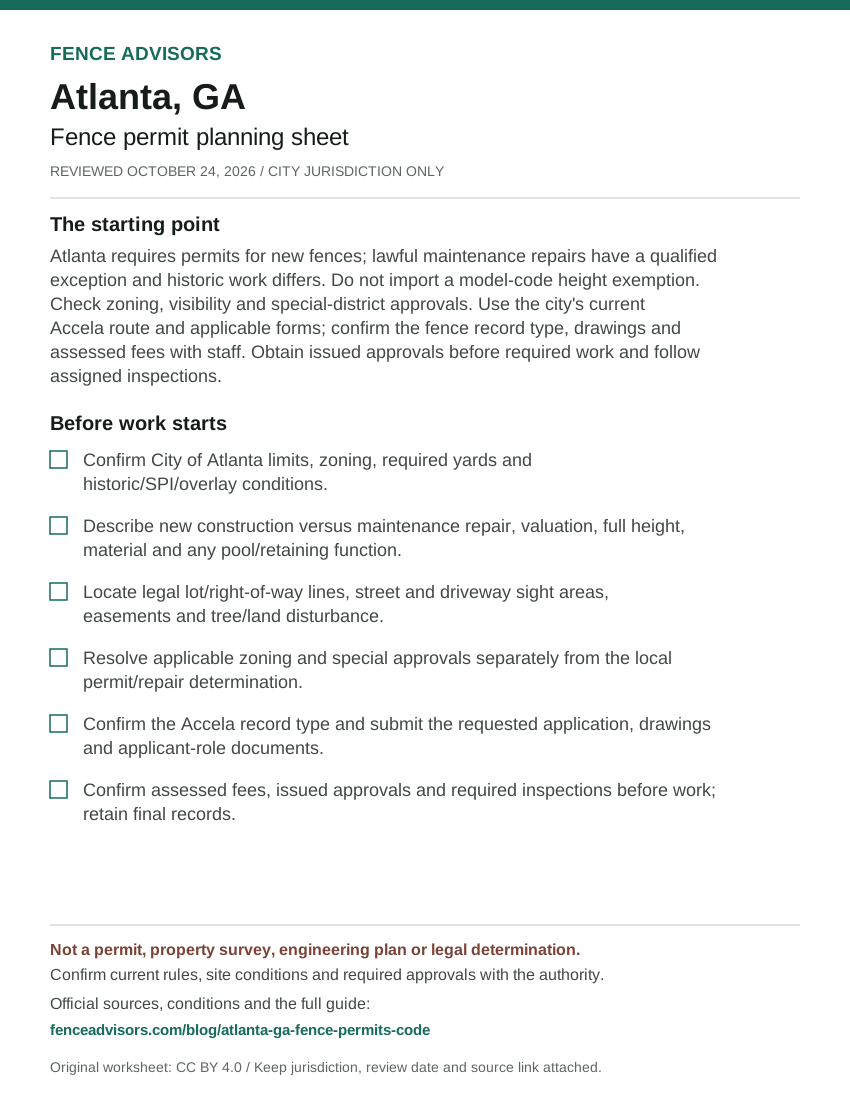
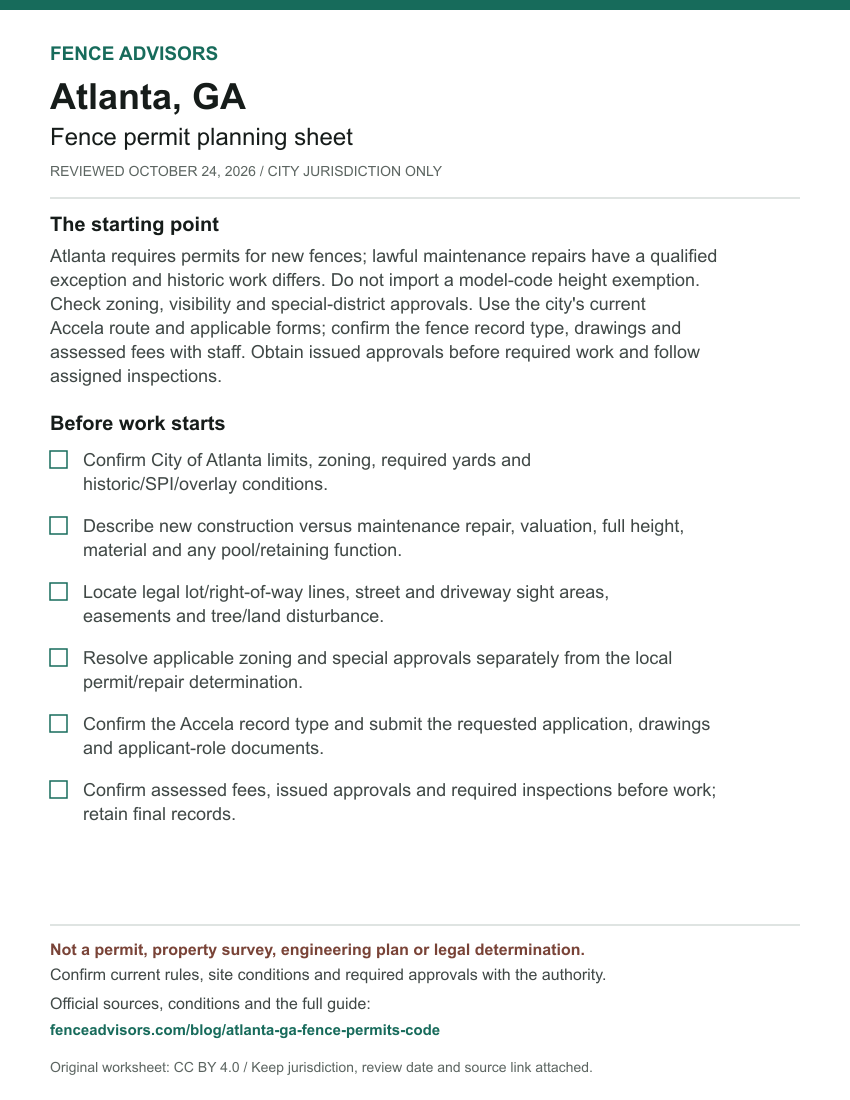
- Confirm City of Atlanta limits, zoning, required yards and historic/SPI/overlay conditions.
- Describe new construction versus maintenance repair, valuation, full height, material and any pool/retaining function.
- Locate legal lot/right-of-way lines, street and driveway sight areas, easements and tree/land disturbance.
- Resolve applicable zoning and special approvals separately from the local permit/repair determination.
- Confirm the Accela record type and submit the requested application, drawings and applicant-role documents.
- Confirm assessed fees, issued approvals and required inspections before work; retain final records.
Download or embed this graphic
<figure>
  <a href="https://fenceadvisors.com/blog/atlanta-ga-fence-permits-code"><img src="https://fenceadvisors.com/media/research/atlanta-ga-permit-cheat-sheet.svg" alt="Atlanta fence permit planning sheet: New fences require permits; lawful maintenance repairs have a qualified exemption. Six preparation checks; the complete accessible checklist and source-checked rules are in this article." width="850" height="1100" loading="lazy" style="max-width:100%;height:auto"></a>
  <figcaption>Graphic: <a href="https://fenceadvisors.com/blog/atlanta-ga-fence-permits-code">Fence Advisors</a>. Source, period and limitations are in the linked article. Original graphic: CC BY 4.0.</figcaption>
</figure>
Atlanta and Georgia planning links
The city's GIS directory includes a City Limits Address Lookup and separate Property Info, zoning and district tools. Verify incorporation first, then the property's applicable zoning and overlays; a county tax record or Atlanta mailing address alone does not answer both questions. Mapping is not a boundary survey or property-specific approval. Atlanta Department of City Planning GIS.
Return to Atlanta fence companies with a consistent written approval scope. Use the Georgia directory, national directory and national permit navigator to choose the authority for work elsewhere. Atlanta's local administrative and zoning rules do not apply automatically in another Georgia city.
For work in those cities, consult the separate Lawrenceville permit guide or Savannah permit guide. They explain different local approval tests rather than extending Atlanta's new-fence rule statewide.
Sources and reuse
We checked the linked government guidance on October 24, 2026. The scope above and source notes identify what was verified and what still needs confirmation. This article is not an ordinance, survey, engineering design, legal opinion or permit approval. The downloadable fact sheet records each finding's source and section. Confirm current rules, fees and submission instructions with the responsible authority before ordering materials or starting work.
You may reuse our original cheat sheet with attribution to this article. Keep the review date, jurisdiction and limitations attached. Government documents remain with their original publishers. Send corrections with a source link to editorial@fenceadvisors.com.
Sources and Downloads
- Atlanta AppendixA Section103: application for permit - 103.1 new structures; 103.2-.3 applications/documents; 103.4 repair definition, lawful work, policies and historic qualification. Current publisher October21,2026, Supplement108 Update1 through Ordinance2026-37 enacted September30,2026; full section read in official rendered publisher October24.103.4 history: Ordinance2017-33(17-O-1307), June28,2017.
- Atlanta Code16-28.008: required yards and visibility - 16-28.008(5)(a)-(e), retaining/fence distinction and dwelling-district intersection limit; (9) street/driveway visibility. Current October21,2026 publisher text fully read October24; section history includes Ordinance2025-43(25-O-1498), December10,2025. No particular district waiver is generalized.
- Atlanta AppendixA Section104: permits and fees - 104.2(m), opening valuation/minimum qualification and fence rows l-m; fee/payment conditions. Current October21,2026 code read October24; fee section history includes Ordinance2017-33(17-O-1307), June28,2017; values are codified minimums, not a new 2026 flat-fee adoption.
- Atlanta getting started with Zoning, Development and Permitting - Commonly permitted fences; repair exceptions; special districts; baseline fence fee rows and technology fee. Current full city page read October24,2026; repair valuation is not treated as new-fence exemption or fee rows as a complete invoice.
- Atlanta current Georgia minimum construction codes - 2024 IRC/IBC/ISPSC with Georgia amendments; January1,2026 implementation and February1 new-application transition. Current city adoption instructions fully read October24,2026; older form code lists are superseded for new applications.
- Georgia 2026 amendments to the 2024 IRC - Opening scope/amendment provisions; Chapter 1 Scope and Administration deleted without substitution for local administrative procedures. State DCA current adopted packet, effective January 1, 2026; relevant full text retrieved October 24, 2026. Model permit exemption not imported as Atlanta law.
- Atlanta online permitting instructions - Accela Citizen Access; Building/Trade/Tree versus Planning/Historic submissions; documents, completeness and record conversion. Current full public instructions read October24,2026; no applicant login, terms acceptance, form submission or payment tested.
- Atlanta applications, forms and checklists - Building Permit Submittal Documents, residential/commercial packet, naming standards and applicant-role affidavits. Current full index read October24,2026. No fence-specific packet or automatic Express eligibility verified; general Express packet was read but its older technical-code list is not used as current law.
- Atlanta Office of Buildings current implementation notices - Current technical-code transition; issued invoice payment through Accela; tree-protection review resources. Current full service page read October24,2026; general notices are not exemptions from required design or special review.
- Atlanta Department of City Planning GIS - City Limits Address Lookup, Property Info, zoning and district resources. Current official GIS app directory read October24,2026; no individual parcel tested and no boundary survey inferred.
Original Fence Advisors graphics, data compilations and worksheet are available under CC BY 4.0. Retain source, period and scope when reusing data. This license does not relicense third-party documents or trademarks.
Corrections: editorial@fenceadvisors.com.
Related Research
Plan your Atlanta fence project
Confirm the approvals for your property, then compare written contractor scopes.
Get the next guide in your inbox
Fence costs, rankings, and what AI is telling homeowners — researched, no fluff.