
Chesapeake, VA / Fence permit planning
Ordinary homeowner fence application planning in the City of Chesapeake, Virginia: installation or replacement of more than eight linear feet uses the ordinary zoning route, while pool barriers use a separate building route. Virginia's 2021 code cycle became effective January 18, 2024; its building exemptions do not waive local zoning. Current numerical zoning heights, setbacks and later local amendments could not be independently verified and are not supplied here. The linked fee booklet and conflicting city summaries do not establish an independently verified fee-adoption date or reliable all-in total. Pool safety, pedestrian protection, floodplain, retaining, powered equipment and special-site work need their applicable review; this guide is not a parcel determination, engineering design or approval.
Sources and scope checked .
Chesapeake requires a Zoning / Fence permit to install or replace more than eight linear feet of ordinary fencing. Installing or replacing a fence used as a pool/spa barrier, including sections, uses the separate Building Fence permit route. The ordinary trigger measures length, not permitted height, and must not be applied as a pool-barrier repair exemption. Chesapeake Fence Regulations.
This guide concerns property governed by the City of Chesapeake, Virginia. Confirm jurisdiction, zoning and actual lot records before designing the fence; a nearby city or similarly named regional preservation program is not the authority for this project. When comparing Chesapeake fence contractors, assign responsibility for the site plan, applications, easement documents, corrections, fees and inspections in writing. Chesapeake Zoning Administration and code entry.
Quick reference
| Question | Source-checked answer |
|---|---|
| What ordinary fence work needs a permit? | The city requires a Zoning / Fence permit when installing or replacing more than 8 linear feet of fence not serving as a pool/spa barrier. The wording is more than, not at least, and is a length test rather than a height allowance. Chesapeake Fence Regulations |
| Does a short pool-barrier repair use that test? | No ordinary-length shortcut is stated for pool/spa barriers: installation or replacement, including sections, requires the Building Fence route. The ordinary zoning application is not approval of a pool barrier's safety design. Chesapeake Fence Regulations; Virginia enacted construction-code application rules |
| How does the state building exemption differ? | Virginia 108.2 exempts fences of any height from building application except specified pedestrian-safety fences and pool barriers; it separately treats concrete/masonry and retaining walls and permits a special-flood-hazard exception. Local zoning still matters. Virginia enacted construction-code application rules; Virginia DHCD current codes; Chesapeake Fence Regulations |
| What goes with the application? | The city requests a physical survey or scaled site plan showing the proposed fence, any applicable buffer yard and estimated cost. Use the correct eBUILD category; the linked combined residential application does not make every ordinary fence a building-permit project. Chesapeake Fence Regulations; Chesapeake fence application requirements; Chesapeake actual residential building and zoning application; Chesapeake current eBUILD entry |
| Is the drainage form blanket permission? | No. The specified city public drainage/impoundment easement route requires the owner acknowledgment with the fence application. Its access, bank/facility protection, removal and revocable-license terms do not grant rights in every utility or private easement. Chesapeake Fence Regulations; Chesapeake drainage-easement owner acknowledgment |
| Is the FAQ total reliable? | The fence FAQ's stated total is arithmetically inconsistent, and the separate Zoning Fees page differs. The actual linked booklet separates ordinary and pool fence components; confirm the approved schedule and actual invoice instead of reproducing or silently recalculating that total. Chesapeake Fence Regulations; Chesapeake current-linked fee schedule and permit booklet; Chesapeake Zoning Fees page |
More than eight linear feet is not a fence-height rule
The city's ordinary installation/replacement wording is more than eight linear feet, not at least eight feet. Present the complete work to Zoning, including all proposed runs, gates and replacement sections. No aggregation rule or percentage-based repair exemption is established here. Ask Zoning how to classify separate projects and existing nonconforming work; calling it maintenance does not establish permission. Chesapeake Fence Regulations.
The source gives a different answer for fences used as pool or spa barriers: installation or replacement, including fence sections, needs the Building Fence route. Do not use a short ordinary-fence project as evidence that a pool enclosure can be altered without review. Barrier design, gates, access and the associated inspection requirements need the applicable building review; this article does not provide their safety measurements or construction engineering. Chesapeake Fence Regulations.
Virginia building exemptions do not waive local zoning
Virginia's current statewide cycle is the 2021 Virginia code, effective January 18, 2024, according to DHCD. Its enacted administrative section 108.2 exempts fences of any height from building application except fences required for the specified pedestrian-safety purpose or used as swimming-pool barriers. Concrete or masonry walls and retaining walls have separate exemption conditions, and the section allows a permit requirement for otherwise exempt items in a special flood hazard area. Virginia DHCD current codes; Virginia enacted construction-code application rules.
That is not a universal zoning height allowance, an all-permit exemption or authority to treat a retaining wall as an ordinary panel fence. The city has its own ordinary zoning application trigger and site restrictions. Do not substitute the model residential code's fence threshold, another Virginia city's zoning rule or a draft 2024 state-code development document for the enacted Virginia administrative text and Chesapeake's current instructions. Virginia enacted construction-code application rules; Chesapeake Fence Regulations.
Confirm the current yard and street-facing conditions
The city's full fence guidance distinguishes residential interior property lines, the area between a house and a street, and a secondary front yard on a corner or through lot. Its taller secondary-front-yard exception is conditional: location, setback, height, finished-side orientation and the applicable landscape-buffer or specified ROW alternative must all be satisfied. A diagram showing one corner cannot establish that another fence qualifies. Chesapeake Fence Regulations.
This guide does not publish numerical zoning heights or setbacks. The current operative local text and later amendments could not be independently verified. The department's dimensional summary is useful for planning, but is not confirmed here as the complete current rule. Ask Zoning to identify the operative yard, buffer and exception conditions for the proposed layout. Chesapeake Zoning Administration and code entry; Chesapeake Fence Regulations.
An interior-yard rule is not street-facing permission, and an exception's buffer conditions still matter. Confirm visibility at streets and driveways, public ROW, easements, drainage and any additional environmental or recorded restrictions before ordering materials. No universal safe sight-triangle dimension is supplied here.
Interior lot-line placement still has easement limits
The fence page says fences may extend to interior property lines unless an easement held by the city or a private party affects the location. This does not establish the physical line or allow footings, gate movement or construction to cross onto neighboring land. Use actual property documents and a survey when needed. Municipal approval and private HOA, deed or easement restrictions are separate questions. Chesapeake Fence Regulations.
For a proposed fence within the specified City Public Drainage and/or Impoundment Easement, the city directs applicants to include its owner acknowledgment with the permit application. The actual form protects the bank and underground facilities, preserves maintenance access and city rights, addresses removal/reinstallation and describes a revocable license rather than a permanent property right. Read the complete terms before deciding on that location. Chesapeake drainage-easement owner acknowledgment.
A blank acknowledgment is not permission, and the form does not authorize fences in every private or utility easement. Ask the responsible reviewer and easement holder what applies to the actual corridor. Retain the required approval and documents with the issued permit; do not assume a contractor's sketch or a previous fence supplies the missing rights. Chesapeake Fence Regulations; Chesapeake drainage-easement owner acknowledgment.
Prepare the right eBUILD category and site documents
Use the city's stable eBUILD entry. Its current public launchpad links to Accela, offers Start a New Application, and distinguishes Building and Zoning services. The city's quick-start guide explains searching by keyword, such as fence, and filtering by category. Creating the record and requesting inspections require the appropriate account access. Chesapeake current eBUILD entry; Chesapeake eBUILD quick-start guide.
For ordinary non-pool work meeting the trigger, the detailed fence page expressly names Zoning / Fence. For a required pool barrier, it names Building Fence. The shorter Fences page links a generic Building Permit Application, but that form is actually titled Residential Building & Zoning Application. Its general label does not override the more specific category instructions. Ask Permit Support about uncertain combined scopes instead of choosing a house application by default. Chesapeake Fence Regulations; Chesapeake fence application requirements; Chesapeake actual residential building and zoning application.
The city requests a physical survey or scaled site plan clearly marking the proposed fence and any applicable buffer yard, together with an estimate of construction cost. Make the proposed runs and gates easy to identify and describe their length, height and materials. Include relevant property lines, streets, easements and existing features so staff can review location and scope. The application collects project identification, applicant/owner/contractor contacts, license information where applicable and a description of the work. Chesapeake Fence Regulations; Chesapeake actual residential building and zoning application.
Include the drainage acknowledgment where required, follow the current upload instructions and respond to corrections. An ordinary fence does not automatically require floor plans, HVAC documents or a full pool-engineering package. Submission, payment or an application number is not an issued approval. Obtain the required decisions before work and follow the inspection requirements attached to the actual record. Chesapeake fence application requirements; Chesapeake current eBUILD entry.
The fee sources do not support one reliable all-in total
The fence FAQ has an arithmetically inconsistent total. The separate Zoning Fees page lists different fence amounts and technology wording. The currently linked 49-page Fee Schedule and Permit Information booklet has separate ordinary and pool fence entries on page 32, but does not resolve those conflicting summaries. Chesapeake Fence Regulations; Chesapeake Zoning Fees page; Chesapeake current-linked fee schedule and permit booklet.
That booklet itemizes zoning review, administration, valuation-based permit and technology components for ordinary fences, with separate building-review and levy treatment for pool-barrier fences. However, this review did not establish an independent adoption/effective date resolving all discrepancies among the current public summaries. We therefore publish no numerical permit quote and do not add a building/pool levy to an ordinary zoning application without confirmation. Chesapeake current-linked fee schedule and permit booklet.
Ask Permit Support for the current approved schedule, correct record category and actual invoice, including any payment-processing or additional scope charge. Agree whether the owner or contractor pays and handles corrections. No universal fee, review duration or guaranteed installation date is established here. Confirm the price before committing to work.
Before-you-build checklist
- Confirm City of Chesapeake jurisdiction, zoning, flood or other special conditions and actual lot records.
- Describe the complete installation or replacement length and whether any fence serves as a pool/spa barrier.
- Confirm current yard, street visibility, buffer, material and easement requirements before laying out posts.
- Prepare the scaled site plan with fence/gates, relevant dimensions, buffers and estimated construction cost.
- Include the required city drainage acknowledgment where applicable and select the correct eBUILD fence category.
- Confirm approved fee components, obtain issued approvals before work and follow the record's inspections.
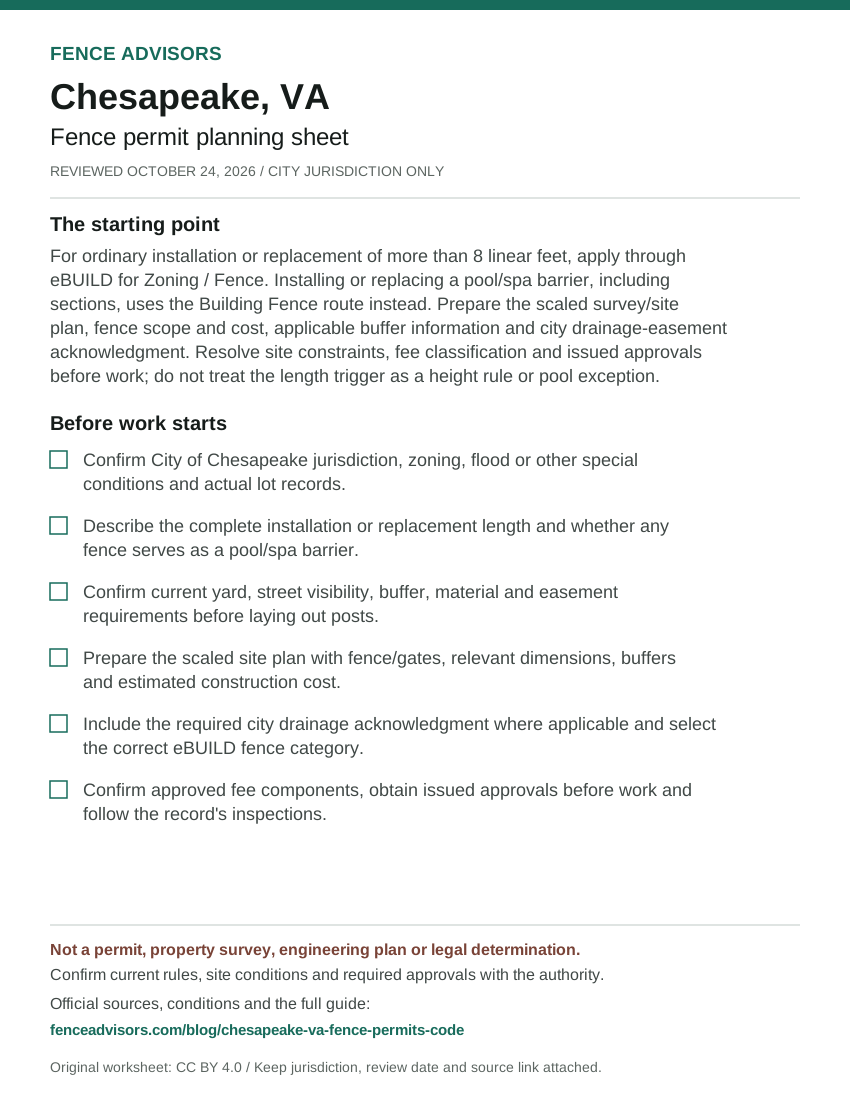
Download or embed this graphic
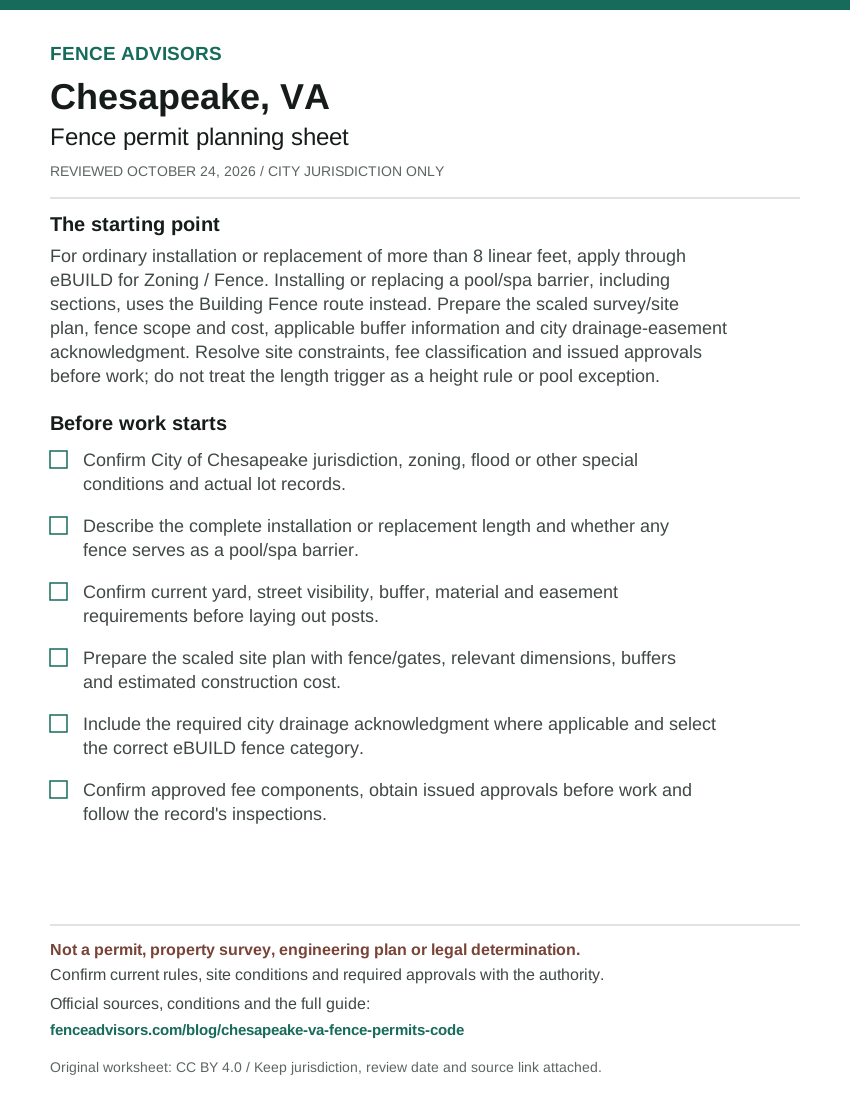
<figure>
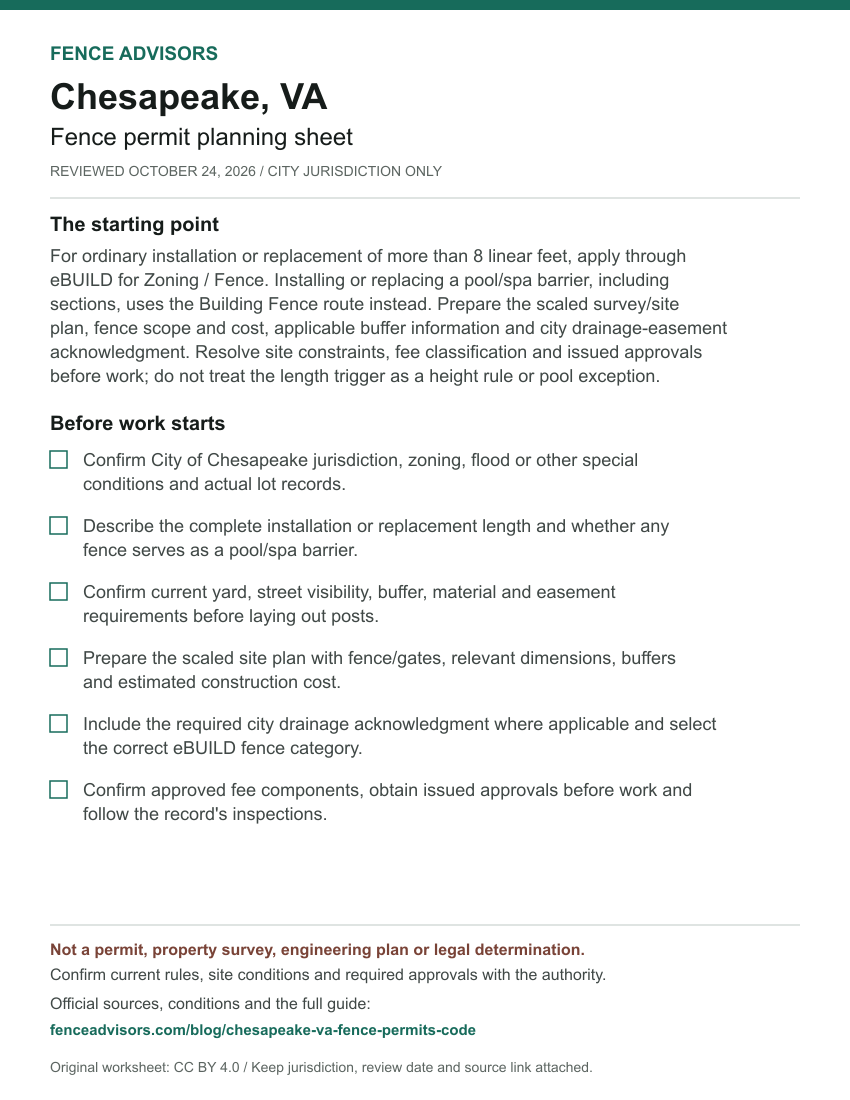
  <a href="https://fenceadvisors.com/blog/chesapeake-va-fence-permits-code"><img src="https://fenceadvisors.com/media/research/chesapeake-va-permit-cheat-sheet.svg" alt="Chesapeake fence permit planning sheet: Ordinary installation/replacement over 8 linear feet; separate pool-barrier building route. Six preparation checks; the complete accessible checklist and source-checked rules are in this article." width="850" height="1100" loading="lazy" style="max-width:100%;height:auto"></a>
  <figcaption>Graphic: <a href="https://fenceadvisors.com/blog/chesapeake-va-fence-permits-code">Fence Advisors</a>. Source, period and limitations are in the linked article. Original graphic: CC BY 4.0.</figcaption>
</figure>
Chesapeake and Virginia planning links
For an ordinary fence strictly within thirty feet of public right-of-way in Virginia Beach, use the Virginia Beach frontage application guide. Its permit scope is a different city's rule, not Chesapeake authority.
Use the Chesapeake contractor directory after assigning the approval work. The Virginia directory and national contractor directory help find the right location for other projects; Chesapeake's rules do not govern neighboring cities.
For broader preparation, use the national permit navigator, setback and easement guide and buyer checklist. They organize questions but do not settle a boundary, confer easement rights or replace the city's permit decision.
Sources and reuse
We checked the linked government guidance on October 24, 2026. The scope above and source notes identify what was verified and what still needs confirmation. This article is not an ordinance, survey, engineering design, legal opinion or permit approval. The downloadable fact sheet records each finding's source and section. Confirm current rules, fees and submission instructions with the responsible authority before ordering materials or starting work.
You may reuse our original cheat sheet with attribution to this article. Keep the review date, jurisdiction and limitations attached. Government documents remain with their original publishers. Send corrections with a source link to editorial@fenceadvisors.com.
Sources and Downloads
- Chesapeake Fence Regulations - Opening ordinary/pool permit scope and eBUILD categories; property lines/easements; residential and secondary-front exceptions; site-plan and fee paragraphs. Full current city body read October 24, 2026. More than eight is not at least eight; erroneous fee total rejected. Numerical zoning standards not independently confirmed in accessible operative code.
- Chesapeake fence application requirements - Requirements: actual application and survey site plan; link back to detailed Fence Regulations; eBUILD. Full current page read October 24, 2026; generic Building Permit Application label does not override detailed Zoning/Fence versus Building Fence categories.
- Chesapeake actual residential building and zoning application - Entire form: address, owner/agent/contractor, contacts/license, Other/Description of Work, dimensions, cost and signature. Full current-linked form read October 24, 2026; no revision date asserted, unrelated house/utility fields not universal ordinary-fence documents.
- Chesapeake drainage-easement owner acknowledgment - Entire form: scope, bank/facility protection, maintenance access, removal, reserved city rights and revocable license. Full current-linked form read October 24, 2026 without signature/submission; only the specified city public drainage/impoundment route, not private or utility easements generally.
- Chesapeake current eBUILD entry - Actual redirected Accela launchpad, Start a New Application, Building/Zoning modules, records, inspections and City Maps & GIS. Full public current entry read October 24, 2026; no applicant account or application disclaimer accepted.
- Chesapeake eBUILD quick-start guide - Launchpad keyword/category search, Create New, account requirement, My Records and inspection functions. December 2023 redesign guide read October 24, 2026 and checked against current public entry; no logged-in field test or successful submission claimed.
- Chesapeake current-linked fee schedule and permit booklet - Full booklet; p.7 code hierarchy, p.8 fee qualifications, p.32 separate ordinary/pool fence components, p.48 general charges. 49-page booklet currently linked by Fee Booklet page, read October 24, 2026; independent adoption/effective date not established. Components not treated as a verified all-in invoice.
- Chesapeake Zoning Fees page - Other Fees: fence valuation rows and review/technology wording; fee-booklet link. Full current page read October 24, 2026; amounts/technology wording differ from fence FAQ and booklet. No automatic preference, addition or adoption date inferred.
- Chesapeake Zoning Administration and code entry - City jurisdiction, original 1969/1993 revision history and official Municode destination. Full current page read October 24, 2026. Historic adoption overview is not proof of current fence-section version; current codifier body/later-law audit not recovered.
- Virginia enacted construction-code application rules - 13VAC5-63-80 / 108.2B items 5-7, special-flood-hazard exception, 108.3 applicant and 108.6 scope; historical notes. Full current state law read October 24, 2026; last listed amendment effective January 18, 2024. Fence, concrete/masonry wall and retaining-wall exemptions are different tests.
- Virginia DHCD current codes - 2021 Virginia Codes effective January 18, 2024; adopted code collections versus development process. Full state page read October 24, 2026. 2024 code-development base documents are not substituted for current enacted law.
Original Fence Advisors graphics, data compilations and worksheet are available under CC BY 4.0. Retain source, period and scope when reusing data. This license does not relicense third-party documents or trademarks.
Corrections: editorial@fenceadvisors.com.
Related Research
Plan your Chesapeake fence project
Confirm the approvals for your property, then compare written contractor scopes.
Get the next guide in your inbox
Fence costs, rankings, and what AI is telling homeowners — researched, no fluff.