FHWA public guidance updated 2021 and historical handbook section updated 2017; checked October 4, 2026
FHWA highway traffic-barrier guidance and original arithmetic, not a tested backyard fence or a universal noise-reduction promise.
Sources and scope checked .
A fence can reduce traffic noise when it works as an acoustic barrier, but a privacy fence is not automatically a sound barrier. FHWA describes 5-10 dB as a typical reduction for effective highway barriers. That number is a reference for the right geometry and assembly, not a warranty for a six-foot backyard fence. FHWA barrier guidance.
The buying question is not simply "which material is quietest?" It is how much lower will the relevant sound level be at the place you actually sit, sleep or work? A barrier that screens a ground-level patio may do much less for an upstairs window overlooking the road. Specify the receiver and the noise source before discussing products.
How many decibels can a barrier reduce?
FHWA says effective highway traffic noise barriers typically reduce noise levels by 5-10 dB; this is not a promised reduction for an ordinary backyard fence. FHWA: Highway Traffic Noise Barriers at a Glance.
| Reference | What it describes | What it does not establish |
|---|---|---|
| 5-10 dB typical reduction | FHWA guidance for effective highway traffic barriers | A guaranteed backyard-fence reduction |
| Approximately half as loud at 10 dB less | FHWA's approximate perceived traffic-loudness description | Silence, a health outcome or a precise annoyance percentage |
| Site-specific insertion loss | Before/after level difference at the receiver, with appropriate controls | A material-only rating that applies everywhere |
Sources: FHWA at-a-glance guidance and handbook Section 15. The public pages were updated in 2021 and 2017 respectively, and checked October 4, 2026. Their fundamental screening and measurement principles are useful; historical software descriptions in the handbook are not recommendations to use obsolete software.
Height, length and openings matter
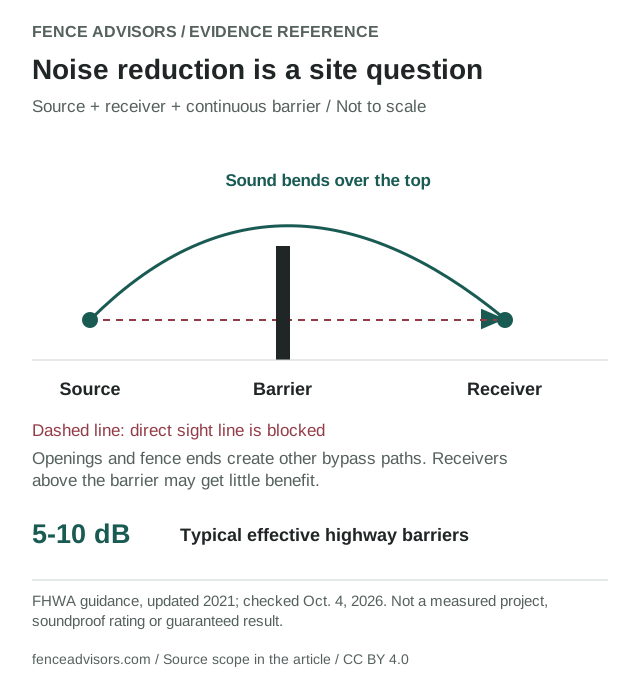
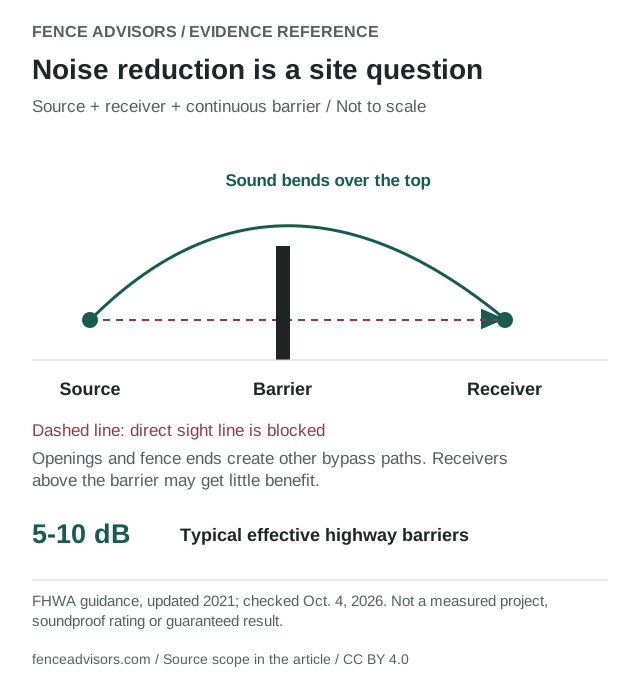
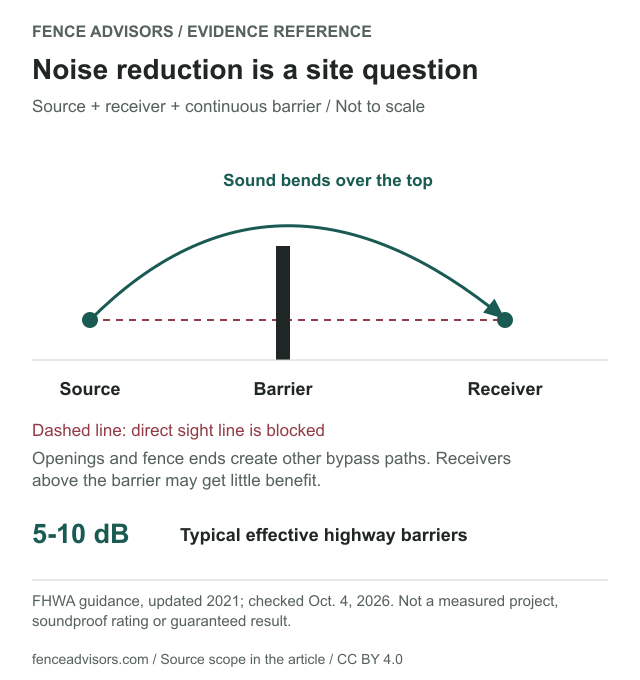
FHWA's guidance requires a barrier to block the source-to-receiver line of sight and be sufficiently tall and long; openings and sound traveling around the ends can undermine its benefit. FHWA: Highway Traffic Noise Barriers at a Glance.
Noise does not stop because a fence conceals the road. Sound can bend over the top, travel around an end or pass through an opening. A visually private panel system can still have open seams or gates. An open-picket or chain-link fence should not be sold as equivalent to a continuous acoustic barrier merely because it marks the same boundary.
FHWA explains that receivers above a barrier or overlooking it may receive little benefit. The height of the source and receiver relative to the terrain matters, not just the fence's height from its own ground line. A road on an embankment, a sloping yard and a raised deck change the question. FHWA barrier effectiveness.
Download or embed this graphic
<figure>
  <a href="https://fenceadvisors.com/blog/fence-noise-reduction"><img src="https://fenceadvisors.com/media/research/fence-noise-paths.svg" alt="Original conceptual diagram shows direct line of sight blocked by a continuous barrier, sound diffracting over the top, and a receiver. FHWA's 5-10 dB range describes effective highway barriers, not any backyard fence." width="640" height="680" loading="lazy" style="max-width:100%;height:auto"></a>
  <figcaption>Graphic: <a href="https://fenceadvisors.com/blog/fence-noise-reduction">Fence Advisors</a>. Source, period and limitations are in the linked article. Original graphic: CC BY 4.0.</figcaption>
</figure>
The diagram shows paths, not a modeled sound field. It intentionally omits a universal height or length. Before making a barrier taller or more solid, check property boundaries, local height limits, visibility, gate access and structural loading. Acoustic performance does not override wind-load design or permit requirements.
What does 10 dB less noise mean?
FHWA describes a 10 dB traffic-noise reduction as approximately halving perceived loudness, not eliminating sound or reducing every listener's annoyance by a measured percentage. FHWA: Highway Traffic Noise Barriers at a Glance.
Keep three ideas separate: sound level, perceived loudness and annoyance. A decibel difference is not a linear percentage of all three. "10 dB lower" is not "10% quieter," and FHWA's approximate half-loudness description is not a promise that a particular listener will be half as bothered.
The remaining level still matters. A substantial reduction can leave a location audibly noisy. A quote should state the target receiver, source, metric and expected result, rather than use "soundproof" as a substitute for evidence. If a manufacturer presents a laboratory material rating, ask how that rating relates to the complete installed barrier and your site; a through-panel measurement does not describe every path over or around the fence.
Measure the result at the receiver
FHWA defines insertion loss as the before-barrier minus after-barrier sound level at the same receiver and calls for equivalent source, site and atmospheric conditions in before/after measurements. FHWA Noise Barrier Design Handbook, Section 15.
In a chosen arithmetic example, 75 dBA before minus 65 dBA after equals a 10 dB level difference; those chosen readings are not measurements of a Fence Advisors project. FHWA Noise Barrier Design Handbook, Section 15.
| Chosen before reading | Chosen after reading | Subtraction | Scope |
|---|---|---|---|
| 75 dBA | 70 dBA | 5 dB | Original illustration, not measured performance |
| 75 dBA | 65 dBA | 10 dB | Original illustration, not measured performance |
The dBA readings use A-weighting; the difference between readings using the same metric is expressed in dB. These examples only demonstrate subtraction. A real assessment needs comparable source operation, site and weather, suitable equipment and a defined measurement period. Changing traffic volume or measuring at a different height can confound a before/after comparison. The handbook addresses those controls. FHWA Section 15.1.2.
A casual phone reading may help describe a complaint, but do not treat an unmatched pair of readings as a certified fence rating. For a significant purchase or disputed performance claim, obtain a qualified acoustic assessment and record what was measured or modeled.
Ask for a site-specific noise proposal
| Question | Evidence to request |
|---|---|
| Where must it be quieter? | Receiver locations and heights, not only a property-line sketch |
| What is making the noise? | Traffic or other source, operating conditions and times of concern |
| Is line of sight blocked? | Elevations of source, fence top and receiver |
| Where can sound bypass it? | Fence ends, gate openings, seams and terrain changes |
| What is the exact assembly? | Panels, joints, gates, installation details and relevant evidence |
| What improvement is proposed? | Metric, modeling/measurement basis and stated uncertainty |
| Is it buildable here? | Permit, boundary, access and structural approvals |
The downloadable CSV is a blank record for those questions, not a performance calculator. Use it alongside our written quote comparison. Find local fence contractors for the installed scope, and ask who will assess the acoustics rather than assume every installer provides that service.
For exposed snowy sites, the objective can be very different: a snow fence needs controlled porosity and drift storage. One fence layout should not be assumed to optimize noise screening, wind effects and snow capture simultaneously.
Methodology and reuse
We reviewed FHWA's public at-a-glance page and selected definition/comparability passages in handbook Section 15. No acoustic field test, health study or product ranking was performed. The 5-10 dB range belongs to highway-barrier guidance; the 75/70/65 dBA examples are chosen arithmetic. The original SVG/PNG is conceptual and not to scale. The citation ledger preserves the source dates, exact findings and stable section links. When quoting a reduction, keep the barrier context and receiver qualification with it.
Frequently Asked Questions
Will a six-foot privacy fence reduce road noise by 10 dB?
That cannot be concluded from height or privacy alone. FHWA's typical 5-10 dB range is for effective highway barriers; source/receiver elevations, length, openings and the assembly determine whether a backyard proposal is effective.
Does 10 dB lower mean the fence blocks all sound?
No. FHWA describes it as approximately half the perceived traffic loudness, not silence. The remaining level and the listener's response are separate questions.
Is a dense hedge a substitute for an acoustic fence?
Do not assume that. FHWA distinguishes substantial dense vegetation from ordinary roadside planting. A narrow hedge's visual screening is not evidence that it matches a continuous noise barrier.
Sources and Downloads
- Blank noise objective and site-evidence recordCSV
- Citable findings, exact sources and evidence boundariesCSV
- Source dates, review scope and original modelsJSON
Original Fence Advisors graphics, data compilations and worksheet are available under CC BY 4.0. Retain source, period and scope when reusing data. This license does not relicense third-party documents or trademarks.
Corrections: editorial@fenceadvisors.com.
Related Research
Put your research to work
Estimate your budget, then compare fence companies in your area.
Get the next guide in your inbox
Fence costs, rankings, and what AI is telling homeowners — researched, no fluff.