University of Minnesota tool uses 1971-2000 climatic inputs; MnDOT guidance checked October 4, 2026
University of Minnesota historical design-tool guidance and MnDOT placement context; not a site prediction, updated climate normal or fixed universal setback.
Sources and scope checked .
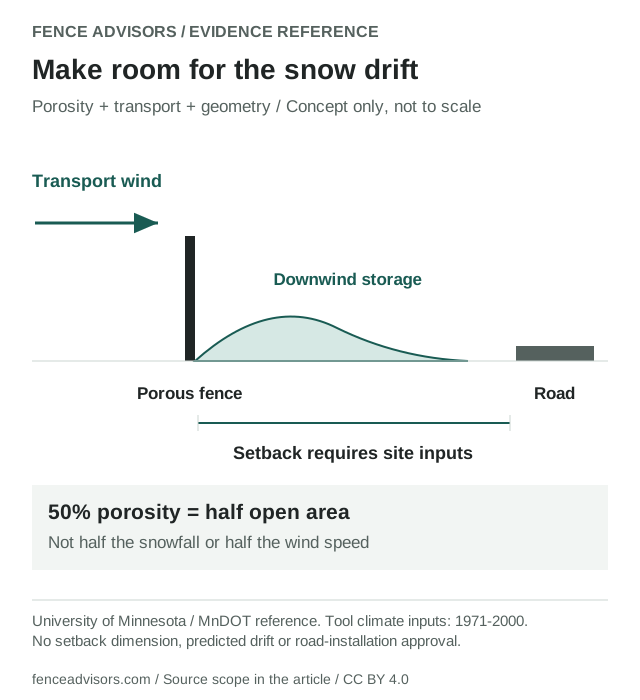
A snow fence works by managing where blowing snow accumulates, not by creating a solid wall that stops all wind. The University of Minnesota's design tool identifies 50% porosity as favorable for snow storage, while height and setback depend on transport and site geometry. Half-open fencing does not mean half the snowfall or a 50% reduction in wind speed. University of Minnesota design tool.
This reference answers the porosity question and explains why a responsible setback answer needs inputs. It does not compute a fence location for an unvisited property or prescribe a highway installation. A useful proposal should identify where the drift will be stored, not only where the fence will stand.
What 50 percent porosity means
The University of Minnesota snow-fence tool describes 50% porosity as maximizing snow storage in its design guidance; 50% porosity means half the fence area is open, not half the snowfall or wind speed. University of Minnesota: Drift-Free Roads Design Tool.
| Selected tool entry | Porosity as a decimal | Percent open area | Scope |
|---|---|---|---|
| Solid fence: reference entry, not recommended snow design | 0.00 | 0% | Source reference, not a complete design |
| Structural snow fence: listed option | 0.25 | 25% | Source reference, not a complete design |
| Structural snow fence: listed option and storage guidance | 0.50 | 50% | Source reference, not a complete design |
Source: University of Minnesota, Fence Height section. We show selected structural entries, not a measurement of installed products or every living fence. The solid-fence row is retained to explain the scale, not to recommend a solid snow barrier. The tool's height input rejects very low porosity; a reference table entry is not necessarily a supported design input.
Porosity describes the open area of the defined fence face. It does not describe the percentage of snowfall caught, the gaps between whole fence sections or the fraction of wind removed. A fence with 50% open area can still be badly located, too short for the transport load, damaged or surrounded by changing vegetation.
Download or embed this graphic
<figure>
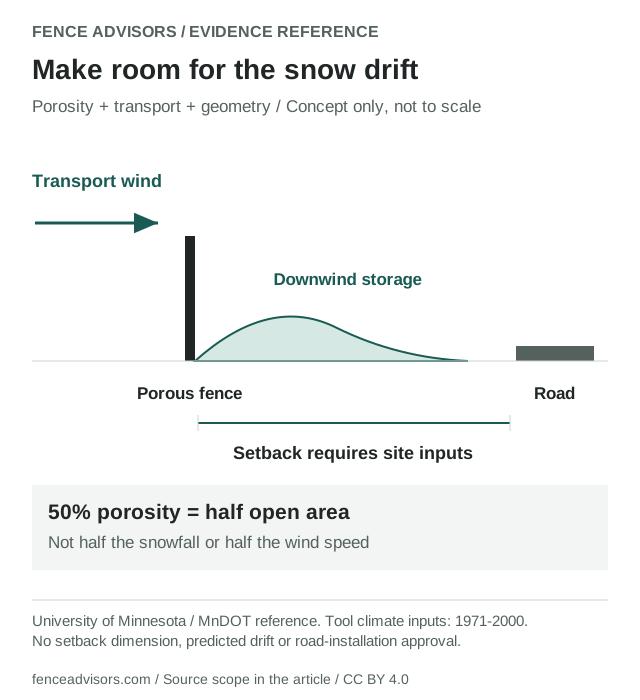
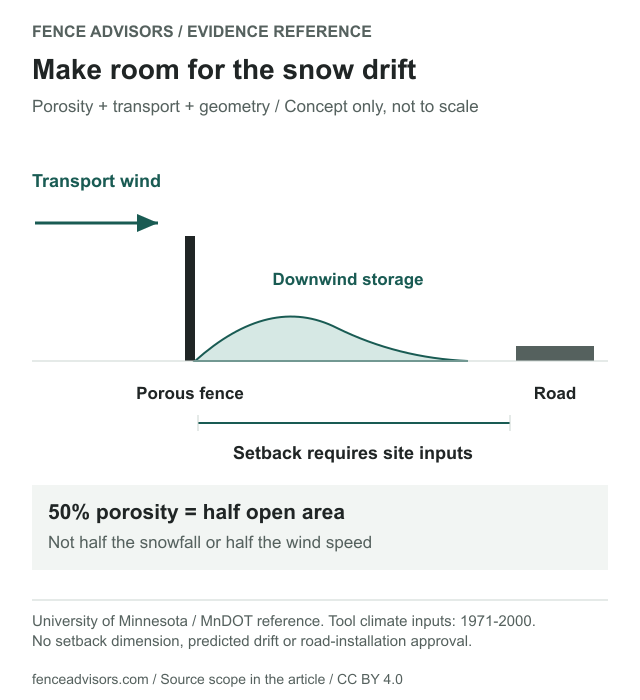
  <a href="https://fenceadvisors.com/blog/snow-fence-porosity-and-setback"><img src="https://fenceadvisors.com/media/research/snow-fence-drift-geometry.svg" alt="Original conceptual diagram shows transport wind through a porous snow fence, a downwind storage zone and a road outside that schematic drift. Fifty percent porosity means half open area, not half snowfall; no setback dimension is provided." width="640" height="700" loading="lazy" style="max-width:100%;height:auto"></a>
  <figcaption>Graphic: <a href="https://fenceadvisors.com/blog/snow-fence-porosity-and-setback">Fence Advisors</a>. Source, period and limitations are in the linked article. Original graphic: CC BY 4.0.</figcaption>
</figure>
Why setback is not one universal number
The University of Minnesota tool bases fence height on porosity and seasonal snow transport and setback on porosity, height and attack angle; a fixed setback cannot be selected from fence height alone using this reference. University of Minnesota: Drift-Free Roads Design Tool. MnDOT: living and structural snow-fence anti-drifting measures.
The snow-storage area is part of the system. MnDOT describes properly placed living barriers as trapping blowing snow before it reaches a road or other protected area. Moving a fence close to the area you want clear is not automatically helpful if the resulting drift occupies that area. MnDOT anti-drifting measures.
| Input | Why it belongs in the design record |
|---|---|
| Direction of greatest snow transport | Identifies the important winter transport path, not just a general wind label |
| Upwind fetch and terrain | Describes the area contributing blowing snow and site geometry |
| Seasonal snowfall and water equivalent | Helps estimate transported snow within the selected model |
| Porosity and effective height | Affects storage and the barrier geometry |
| Attack angle | Relates snow-transport direction to road alignment in the tool |
| Downwind space and clear-area objective | Determines whether modeled storage conflicts with the road or other area |
| Ends, gaps and variable direction | Requires attention beyond one cross-section |
These inputs are described by the university tool; the table is our original record of their purpose. We intentionally do not publish a single height multiplier as a universal setback. The tool itself uses several inputs, and we did not run a selected-site calculation. For a public road, involve the responsible road agency and landowner; MnDOT's guidance describes easements or agreements for its structural installations, not permission for readers to install in a right-of-way.
The climate data period is part of the answer
The University of Minnesota tool labels its seasonal snowfall and snow-water-equivalent climatological inputs as 1971-2000; they are historical reference inputs, not 2026 climate normals. University of Minnesota: Drift-Free Roads Design Tool.
The source page calls these a 30-year climatological mean. Its period label is the important detail: 1971-2000, even when surrounding page wording says "most recent." We retain the stated period rather than silently turn it into a current climate normal because we accessed the tool in 2026.
A designer should decide whether the inputs are suitable for the actual location and current objective and what updated or site-observed information is needed. A statewide reference tool does not establish a nationwide backyard snow-fence result. Keep the climate source, years, location and any site observations with the proposed dimensions so a later reviewer can reproduce the reasoning.
Do not cite empty tool results as observations
The unconfigured University of Minnesota tool displayed zero-valued location/results fields when checked; those defaults are not observed zero snowfall, zero transport or a recommended zero setback. University of Minnesota: Drift-Free Roads Design Tool.
This is an important research trap. A scraped tool can expose every input label and a summary of zeros before a location is selected. A row containing "0 feet" is not automatically a climate record, and a latitude/longitude of zero is not a Minnesota study site. We did not treat those fields as a dataset or publish them as a valid design scenario.
| What a reader sees | What is needed before citing a result |
|---|---|
| Default location/results | An actually configured and validated scenario |
| Historical climate label | The specific period and suitability assessment |
| A height or setback output | Inputs, model, units, geometry and documented calculation |
| A design diagram | Confirmation whether conceptual or an approved project drawing |
For writers, these details prevent the common mistake of citing a calculator's initial state as evidence. For purchasers, they help distinguish a proposal backed by a site assessment from a dimension copied from a generic illustration.
Prepare a snow-fence design request
Document the problem area, where snow must not accumulate, relevant transport observations, available land, access, seasonal maintenance and permissions. Request an explanation of the proposed drift-storage area and the input assumptions. Our blank CSV gives those questions a place to be answered; it is not a calculator or an engineering specification.
If procuring a structural system, specify the actual product, open-area basis, installed height and required supporting design separately in the supplier RFQ. Confirm structural and wind-loading requirements, maintenance and the responsible authority's approval. Find suppliers for exact product documentation and contractors for an actual site scope.
Do not conflate a snow fence with a noise barrier. Noise screening often depends on a continuous barrier; snow-storage design uses controlled porosity and room for drift. Similar-looking fencing can serve very different performance objectives.
Methodology and reuse
We reviewed the University of Minnesota tool's visible instructions, reference table, climate-period labels and unconfigured state, plus MnDOT's placement/site context. No selected-location scenario was executed and no current climate dataset was substituted. The original SVG/PNG deliberately has no setback dimension; its drift shape is conceptual, not predicted. The CSV is a blank input/permission record. Keep porosity, model, climate period and site limitations alongside any reused finding rather than present these references as measured 2026 snow outcomes.
Frequently Asked Questions
Does 50% porosity mean a snow fence stops half the snow?
No. It means half the defined fence face is open area. The cited tool relates porosity to storage; it does not equate 50% openness with a 50% capture rate or wind-speed reduction.
How far from a road should I put a snow fence?
This reference does not prescribe a distance. The university tool uses porosity, height and attack angle for setback, with transport inputs needed for height; road/landowner approval and actual downwind storage space also matter.
Are the university tool's climate inputs current 2026 normals?
The visible seasonal snowfall and water-equivalent instructions identify 1971-2000 inputs. They should be cited as historical reference inputs, not relabeled as 2026 climate observations.
Sources and Downloads
- Blank snow-fence inputs, climate period and permissions recordCSV
- Citable findings, exact sources and evidence boundariesCSV
- Source dates, review scope and original modelsJSON
- University of Minnesota: Drift-Free Roads Design Tool
- MnDOT: living and structural snow-fence anti-drifting measures
Original Fence Advisors graphics, data compilations and worksheet are available under CC BY 4.0. Retain source, period and scope when reusing data. This license does not relicense third-party documents or trademarks.
Corrections: editorial@fenceadvisors.com.
Related Research
Put your research to work
Estimate your budget, then compare fence companies in your area.
Get the next guide in your inbox
Fence costs, rankings, and what AI is telling homeowners — researched, no fluff.