
Gainesville, FL / Fence permit planning
Historic COA preparation for ordinary new non-pool residential fences in Gainesville, Florida local historic districts, not a citywide building-permit answer or Alachua County rule. The city-linked historic instructions, fence guidelines and COA packet are not a current ordinance consolidation; the underlying current codifier was not recovered and legacy section references do not establish current zoning. Ordinary new-fence building duty and eligibility under the conditional 2026 state exemption remain unresolved, with no structural classification, building exemption, numerical zoning or staff-review height/opacity entitlement certified. Maintenance/replacement exceptions, individually listed sites outside districts, pools, retaining/masonry work, powered gates, flood/environmental/ROW conditions and private restrictions need their applicable review. This guide is not parcel approval or an engineering design.
Sources and scope checked .
For an ordinary new residential fence in a City of Gainesville, Florida local historic district, obtain a Certificate of Appropriateness (COA) before work. This guide covers the historic approval, not a citywide building-permit exemption. The city has fence-specific design guidance and a COA packet with an actual historic intake route. Whether the fence separately needs a building permit or qualifies under a state exemption remains unresolved here. Gainesville current Historic Preservation instructions; Gainesville current-linked COA application and owner authorization; Gainesville current-linked Historic Preservation Rehabilitation and Design Guidelines.
Use the separate Gainesville, Florida contractor directory to find installers after identifying the approval responsibilities. This article helps organize a historic application and the resulting construction scope; it does not rank contractors or approve a particular property.
Quick reference
| Question | Source-checked answer |
|---|---|
| Historic approval, not a building exemption | New fencing on a local historic-district property needs a COA. This guide addresses that historic phase only; separate ordinary-fence building-permit classification remains unverified. Gainesville current Historic Preservation instructions; Gainesville current-linked Historic Preservation Rehabilitation and Design Guidelines; Gainesville current-linked COA application and owner authorization |
| Start with the Preservation Planner | The current historic webpage requires a pre-application conference; the form calls it recommended. Follow the webpage's firmer instruction and confirm the packet with the Preservation Planner. Gainesville current Historic Preservation instructions; Gainesville current-linked COA application and owner authorization |
| Use the actual fence COA packet | Select the form's Fence category; identify the parcel, owner/agent and work. Supply its material/product information and applicable agent authorization. Gainesville current-linked COA application and owner authorization |
| Historic fence design guidance | The linked guidelines favor compatible, open, individually detailed designs. Stockade, chain-link and vinyl are not recommended; selected materials may receive case-specific board review. This is historic guidance, not a citywide material ban. Gainesville current-linked Historic Preservation Rehabilitation and Design Guidelines |
| Staff review is still COA review | Fence staff criteria distinguish prominent yards from backyards and consider materials, openness and intersection visibility. Staff eligibility is not no-COA permission; have the planner determine the review level. Gainesville current-linked Historic Preservation Rehabilitation and Design Guidelines; Gainesville current-linked COA application and owner authorization |
| Current historic application route | The linked packet directs email submission to planning@gainesvillefl.gov; completeness review precedes invoicing. Conceptual board feedback is not final authorization. Gainesville current-linked COA application and owner authorization; Gainesville current Historic Preservation instructions |
| Building, fees and final scope | A COA does not approve a building permit. Confirm the applicable assessment and any separate Building determination; no numerical fee, approval deadline or fence-specific state exemption is established here. Gainesville current-linked COA application and owner authorization; Gainesville permit-exemption request guide |
Establish local historic jurisdiction first
Confirm that the property is within the City of Gainesville and one of its local historic districts. A Gainesville mailing address, the age of a house or an Alachua County record alone is not that determination. Start with the Historic Preservation Map linked by the city's historic page, then have the Preservation Planner confirm the applicable designation. Do not treat a public map as a boundary survey or assume that national and local historic listings have identical regulatory consequences. This guide does not classify individually listed properties outside the districts. Gainesville current Historic Preservation instructions.
For your own project folder, keep the address, parcel identifier, available boundary documents and the planner's scope confirmation together. Label the intended new fence clearly so an existing fence in a photograph is not mistaken for the proposed line. Identify streets and driveways without assuming that pavement, a hedge or a neighboring fence establishes the legal lot boundary.
Use the historic conference to settle the review package
Arrange the pre-application conference before submitting. There is a wording difference worth knowing: the current historic webpage makes that conference mandatory, while the linked application recommends it. Follow the firmer webpage instruction rather than promise a conference-free application. Use the meeting to determine the appropriate staff or board route and what supporting documents the city wants for this fence. Gainesville current Historic Preservation instructions; Gainesville current-linked COA application and owner authorization.
Bring a concise proposal, not just a product name. A useful discussion set would show where the fence runs, how it relates to the house, which sections face a street, and the intended height, openness, posts, finish and gates. These are preparation suggestions, not a mandatory drawing standard. Ask the planner to distinguish required documents from helpful illustrations before commissioning additional professional work.
Design for the house and street, not only the catalog
The linked fence guidance emphasizes compatibility with the building and setting, favors light-and-air passage, and discourages stockade, chain-link and vinyl designs. It allows selected materials to receive case-specific board consideration. Its preferred treatments are not all absolute prohibitions; do not turn a recommendation into a Gainesville-wide material ban. Gainesville current-linked Historic Preservation Rehabilitation and Design Guidelines.
For a practical design comparison, ask an installer to illustrate the proposed picket profile, panel rhythm, visible posts and finish beside a photograph of the house. Explain what each alternative would change in the street view. An inexpensive standard panel and a more individually detailed design may need different historic discussions even when their nominal dimensions match. Obtain review of the actual proposal before making a nonreturnable material order.
The guidance separates prominent front or highly visible side/rear situations from backyards and has distinct staff-review criteria. Numerical height, opacity and grade allowances are deliberately not certified here. Have the planner apply the relevant criteria; staff review still produces a COA, not an exemption from historic approval. Corner/intersection visibility remains an independent design concern, not something an open-looking panel automatically satisfies. Gainesville current-linked Historic Preservation Rehabilitation and Design Guidelines.
These are the city's currently linked historic guidelines, not a newly verified compilation of today's zoning ordinance. Their older section references are not proof of a fresh adoption date. This article therefore uses them to prepare meaningful historic review without publishing a universal numerical fence entitlement.
Complete the fence-specific COA package
Use the current-linked COA application, identify the Fence project type and complete the property, party and proposal information. Provide the applicable material/product details and supporting items determined at the conference. An agent acting for the owner needs the packet's authorization; the download includes that separate page. Gainesville current-linked COA application and owner authorization.
Keep the descriptions consistent across the application, illustration, product sheet and contractor quote. If a drawing shows an open picket design while the estimate names a solid panel, resolve that mismatch before submission. Mark alternatives as alternatives rather than leaving the reviewer to guess which version you intend to build. Do not sign an incomplete application or treat a contractor's generic permit allowance as evidence that historic documentation is included.
Submit through the actual historic intake
The packet instructs applicants to email the application and supporting materials to planning@gainesvillefl.gov. Its completeness review comes before the invoice. Sending the package does not establish acceptance or approval; retain the city's response and issued COA. Gainesville current-linked COA application and owner authorization.
Ask the planner which current submission deadline applies if board review is needed. The historic webpage publishes a board calendar; a meeting date is not a guaranteed approval date. No numerical fee or turnaround promise is published here. Confirm the applicable category and assessment rather than assume that every fence follows the same review or payment path. Gainesville current Historic Preservation instructions; Gainesville current-linked COA application and owner authorization.
Keep the submitted package and correction responses organized by version. When the city requests a change, make sure the contractor prices the revised design rather than the earlier sketch. Conceptual board feedback is not final approval, and proposed changes to an approved scope need further approval before that changed work starts. Gainesville current-linked COA application and owner authorization.
Keep the unresolved building question separate
The COA form expressly separates historic approval from any required building permit. The city exemption guide also preserves historic approval, but does not classify an ordinary fence as nonstructural or establish that it qualifies for the conditional state exemption. Neither a small project budget nor a preferred historic material settles that separate question. Gainesville current-linked COA application and owner authorization; Gainesville permit-exemption request guide.
Give Building the same complete scope used for historic review and obtain its applicable permit or exemption determination. Do not call the project ready to build merely because a COA has been issued. Equally, do not describe a generic building application or exemption-request screen as the historic fence approval itself. Citywide new-fence building classification remains unresolved here.
Pool barriers, retaining or masonry structures, powered gates, flood/environmental conditions, public right-of-way work and private easements or covenants need their applicable separate review. This is an ordinary new-fence historic guide, not a maintenance/replacement exemption, visibility design, structural plan or pool-safety specification. Keep legal boundary and utility-location work in the installation preparation, separate from aesthetic approval.
Before-you-build checklist
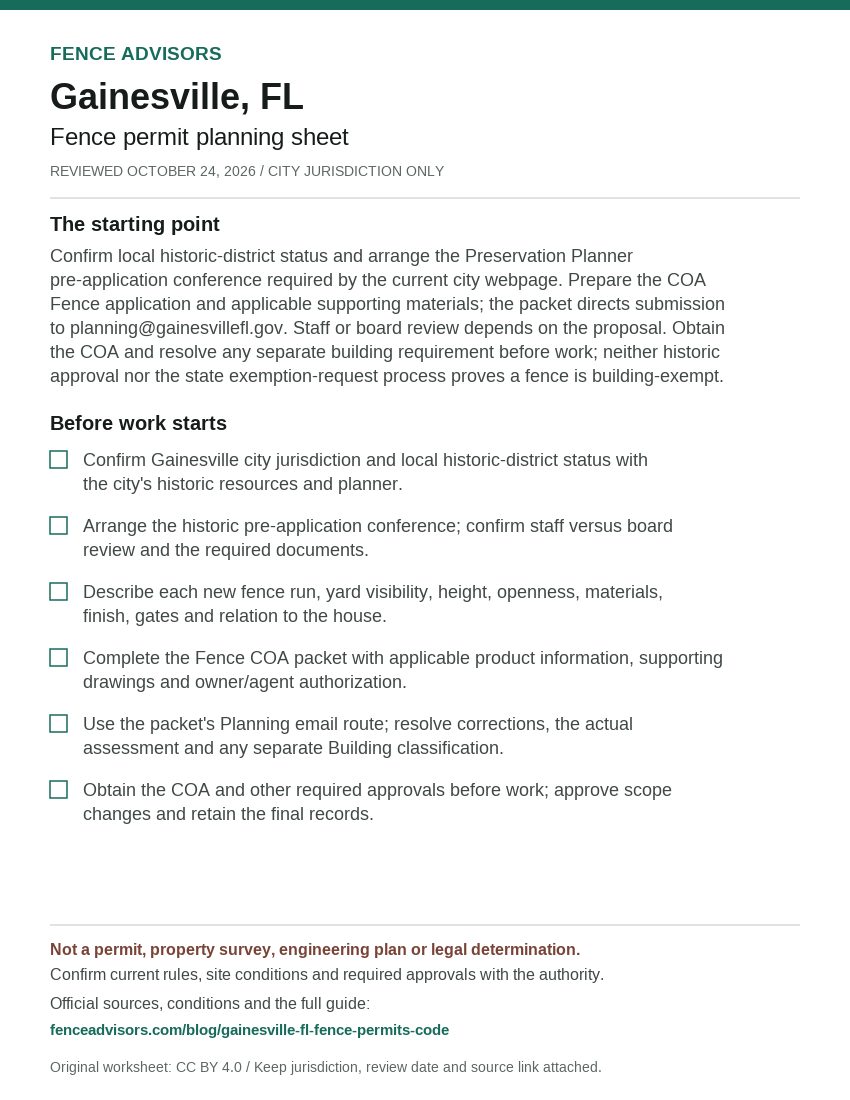
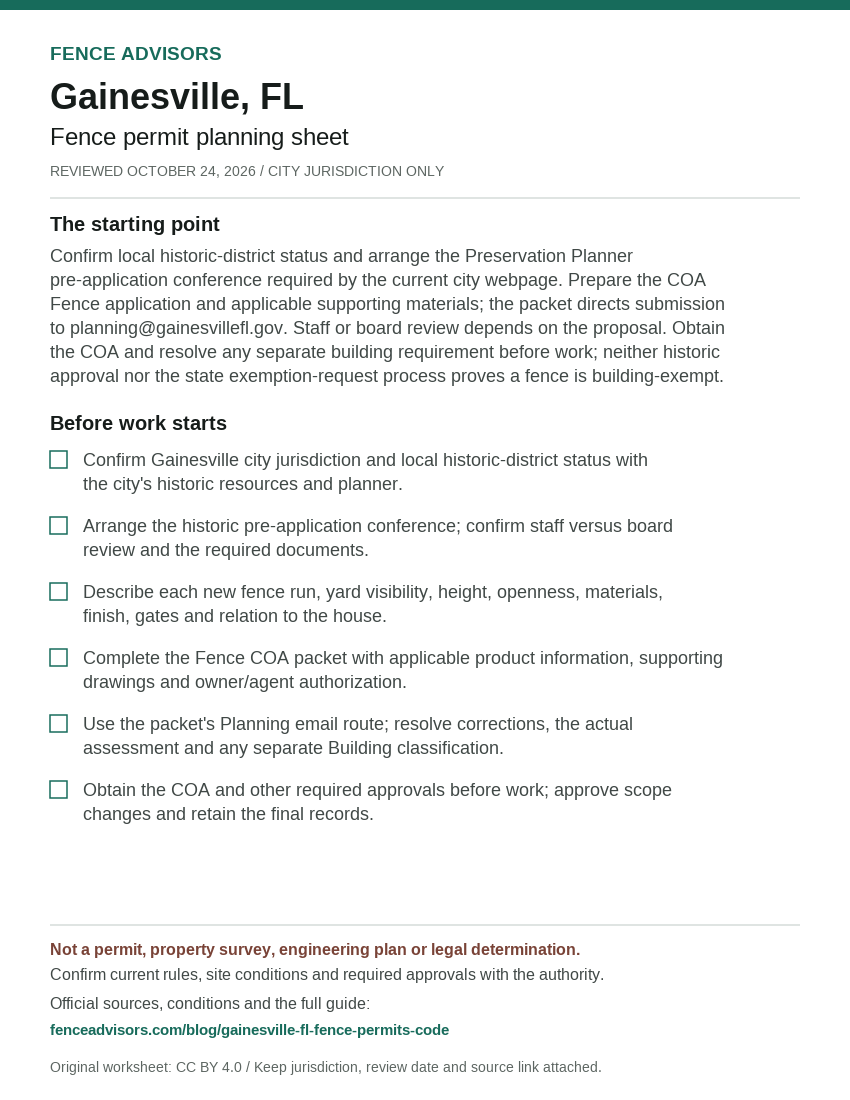
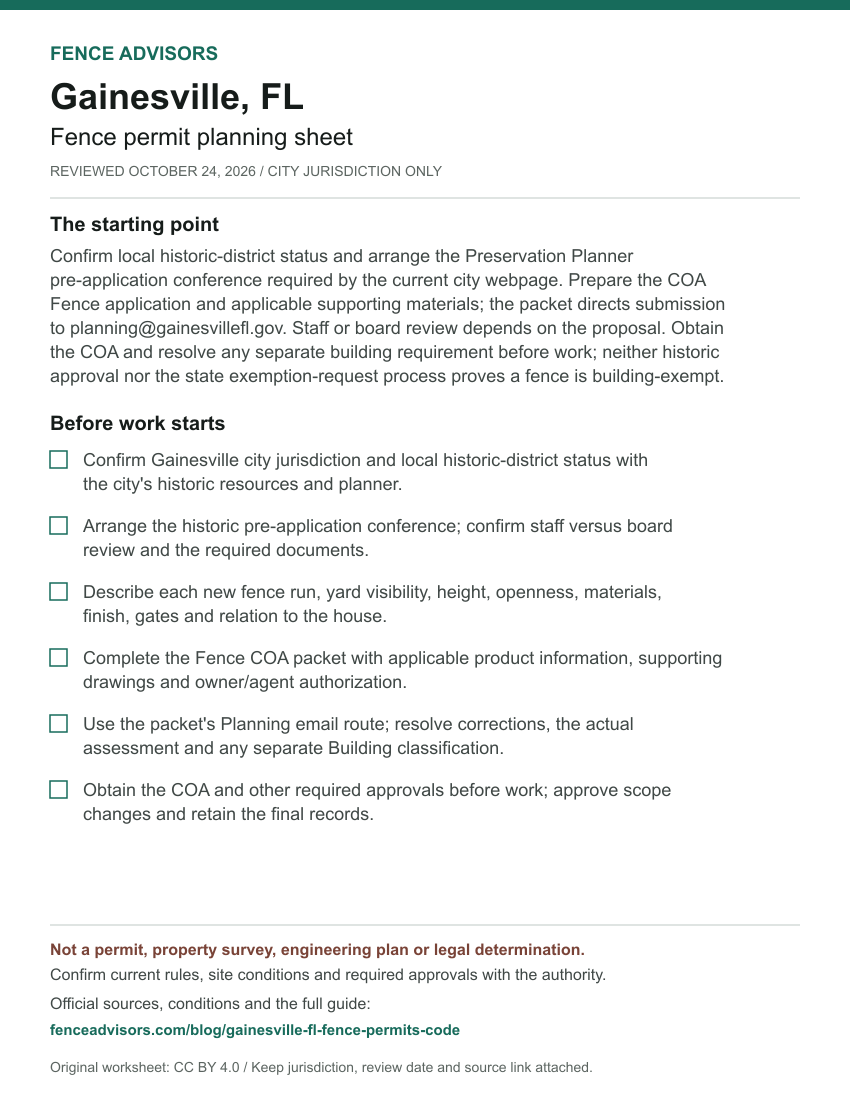
- Confirm Gainesville city jurisdiction and local historic-district status with the city's historic resources and planner.
- Arrange the historic pre-application conference; confirm staff versus board review and the required documents.
- Describe each new fence run, yard visibility, height, openness, materials, finish, gates and relation to the house.
- Complete the Fence COA packet with applicable product information, supporting drawings and owner/agent authorization.
- Use the packet's Planning email route; resolve corrections, the actual assessment and any separate Building classification.
- Obtain the COA and other required approvals before work; approve scope changes and retain the final records.
Download or embed this graphic
<figure>
  <a href="https://fenceadvisors.com/blog/gainesville-fl-fence-permits-code"><img src="https://fenceadvisors.com/media/research/gainesville-fl-permit-cheat-sheet.svg" alt="Gainesville fence permit planning sheet: Historic-district phase: COA required; separate building-permit classification unresolved. Six preparation checks; the complete accessible checklist and source-checked rules are in this article." width="850" height="1100" loading="lazy" style="max-width:100%;height:auto"></a>
  <figcaption>Graphic: <a href="https://fenceadvisors.com/blog/gainesville-fl-fence-permits-code">Fence Advisors</a>. Source, period and limitations are in the linked article. Original graphic: CC BY 4.0.</figcaption>
</figure>
Gainesville and Florida planning links
Compare Gainesville fence companies with the historic application and final design responsibilities explicitly assigned. Use the Florida contractor directory, Florida permit framework and national permit navigator for geographic context. The Ocala permit guide is another Florida jurisdiction, not Gainesville historic law. The setback and easement guide helps organize private-line questions without replacing city review.
The Jacksonville historic-fence guide provides another Florida comparison, not Gainesville authority. Use Gainesville's actual COA packet and Planning intake for this local process.
Sources and reuse
We checked the linked government guidance on October 24, 2026. The scope above and source notes identify what was verified and what still needs confirmation. This article is not an ordinance, survey, engineering design, legal opinion or permit approval. The downloadable fact sheet records each finding's source and section. Confirm current rules, fees and submission instructions with the responsible authority before ordering materials or starting work.
You may reuse our original cheat sheet with attribution to this article. Keep the review date, jurisdiction and limitations attached. Government documents remain with their original publishers. Send corrections with a source link to editorial@fenceadvisors.com.
Sources and Downloads
- Gainesville current Historic Preservation instructions - Complete page; local districts/register and Historic Preservation Map link; 2026 board schedule; Guidelines and Forms; pre-application conference instruction. Full current official page read October 24, 2026. Its mandatory conference wording is firmer than the current-linked form's recommendation. Map link provenance checked, not a parcel determination; legacy code citation not independently recovered.
- Gainesville current-linked COA application and owner authorization - Complete four-page PDF: application pp.1-3 and attached owner authorization; Fence project type, materials, conceptual/final review, certification items 6-7, email submission and completeness/invoice instructions. All four pages' full official text read October 24, 2026 through the live historic page's link. No independent revision/adoption date established. Fee amounts and processing estimates not certified; no form signed, submitted or terms accepted.
- Gainesville current-linked Historic Preservation Rehabilitation and Design Guidelines - Complete relevant text: printed pp.81 and 83, Authority to Review/COA/interpretation; pp.85-87 Setting; pp.135-137 Fences and Garden Walls, recommendations and staff/board criteria (PDF pages 88, 90, 92-94 and 142-144). Relevant full official sections read October 24, 2026; still linked as city historic guidance. Older legacy code references, no new adoption date inferred from hosting/crawl. Numerical criteria and diagrams not republished as current zoning law; screenshot retrieval returned cache miss and was not retried.
- Gainesville permit-exemption request guide - Previously read complete two-page guide: qualification bullets, historic exterior-work COA condition, request/review steps and Exemption Card. Retained full official evidence reused October 24, 2026. It does not establish that an ordinary fence is nonstructural or qualifies for exemption. No threshold, fee or universal building waiver inferred in this historic-phase guide.
Original Fence Advisors graphics, data compilations and worksheet are available under CC BY 4.0. Retain source, period and scope when reusing data. This license does not relicense third-party documents or trademarks.
Corrections: editorial@fenceadvisors.com.
Related Research
Plan your Gainesville fence project
Confirm the approvals for your property, then compare written contractor scopes.
Get the next guide in your inbox
Fence costs, rankings, and what AI is telling homeowners — researched, no fluff.