
Jacksonville, FL / Fence permit planning
Historic COA application planning for ordinary residential fences on Jacksonville locally designated landmarks or within local historic districts, not a citywide building-permit answer or the separate beach/Baldwin authorities. Use the current COA process, 2026 COA Matrix and LUZAP intake with the December 2023 fence supplement; the older linked district appendix supplies base-document guidance, not current counter procedures, deadlines, building-permit premises or a complete modern upload checklist. Citywide Building Inspection duty/exemptions, separate zoning-clearance scope and state HB exemption/work classification remain unresolved and excluded. A COA does not settle pool, retaining, structural, powered-gate, flood, visibility, easement or private-rights questions. This guide is not parcel approval or an engineering design.
Sources and scope checked .
An ordinary fence project on a Jacksonville local landmark or within a locally designated historic district requires Certificate of Appropriateness (COA) review before work. Start from the city's official COA Process page and its File a new COA application link to LUZAP. Prepare the historic review documents, respond to staff's review and obtain the approved COA. This guide does not establish Jacksonville's separate citywide building-permit duty, exemption or HB work classification. Jacksonville current Certificate of Appropriateness Process; Jacksonville Historic Preservation FAQ.
This is a historic-home fence application guide, not a general exemption article. Historic review covers an ordinary homeowner's new or replacement fence on these designated properties. The Jacksonville fence contractor directory handles installer discovery; use this guide to assign the historic application responsibilities before comparing proposals.
Quick reference
| Question | Source-checked answer |
|---|---|
| Historic fence approval phase | Jacksonville's current COA Process and historic FAQ require COA review for fencing/site work within locally designated historic districts or on local landmarks. Obtain approval before starting the covered exterior work. This is a historic-phase duty, not a citywide building-permit answer. Jacksonville current Certificate of Appropriateness Process; Jacksonville Historic Preservation FAQ; Jacksonville adopted historic Fencing and Wall Guidelines |
| Which historic properties? | Use the city's address/RE-number instructions and Local Historic District/Landmark layers. The city says COAs are required regardless of street visibility or non-contributing status. A nationally listed or simply older house is not by itself the local-designation determination made here. Jacksonville historic designation search instructions |
| Actual COA intake | The official historic COA Process page's File a new COA application link leads to LUZAP. Its public instructions require a registered user for submission. Historic public-record search is separate; use the COA page's LUZAP link, not a presumed JaxEPICS historic intake, and confirm the current application fields. Jacksonville current Certificate of Appropriateness Process; City-linked LUZAP public application entry |
| Prepare the supporting documents | The currently linked district guideline's COA appendix describes a written scope, a marked site plan or survey showing the building/lot/street relationship, and context/detail photographs; staff may request a material sample or manufacturer description. These older base-document instructions are not a complete modern upload-field checklist; confirm additional format/scope needs with Historic Preservation. Current-linked Riverside Avondale historic guidelines: COA documentation appendix; Jacksonville current Certificate of Appropriateness Process |
| Administrative or commission review | Staff reviews the submitted scope under the current COA Matrix and emails whether commission review or changes for administrative approval are needed. The 2026 fence row distinguishes guideline-consistent work from inconsistent work, street-visible alternative materials and highly decorative fencing/gates. Do not promise every fence an administrative approval. Jacksonville Historic Preservation FAQ; Jacksonville 2026 COA Matrix; Jacksonville adopted historic Fencing and Wall Guidelines |
| Charges and approval records | The current historic FAQ publishes commission fees by request category and different treatment after a violation. A universal ordinary-fence COA fee or guaranteed processing time is not certified here. Confirm classification, assessment, approved scope and conditions; filing an application is not approval to begin. Jacksonville Historic Preservation FAQ; Jacksonville current Certificate of Appropriateness Process |
| Separate permits remain unresolved | This guide establishes only the historic COA phase. Jacksonville's citywide building-permit duty/exemptions, standalone zoning-clearance route and HB exemption/work classification remain unresolved. Do not treat a COA, public application record, guideline design or contractor statement as clearance of those separate questions. Jacksonville current Certificate of Appropriateness Process; Jacksonville Historic Preservation FAQ; Jacksonville adopted historic Fencing and Wall Guidelines |
Confirm local designation before selecting a fence
Use the city's Search by Address instructions. They direct you to the Land Development Review map, where the Historic layers identify local historic districts and landmarks. Search by the property address or Real Estate number and confirm the relevant designation. An older house, a neighborhood name or a national designation is not a substitute for checking the local review context. Jacksonville historic designation search instructions.
The city's instructions expressly retain COA review for non-contributing properties and work that is not visible from the street. Do not assume that a back fence can bypass historic review because a front-facing photograph would not show it. Give the reviewer an accurate description of the property and proposed work rather than omit a fence run on that assumption. Jacksonville historic designation search instructions.
This Jacksonville process is not the separate procedure of Atlantic Beach, Neptune Beach, Jacksonville Beach or Baldwin. The city zoning FAQ identifies their separate departments. Confirm which authority governs the property rather than use a Jacksonville mailing or contractor service-area label as the jurisdiction decision. Jacksonville current zoning FAQ: responsible jurisdictions.
Start the COA at the historic application entry
The COA Process page is the appropriate starting point. Its new-application link goes to LUZAP, the city's Land Use and Zoning Application Portal. The public portal explains that submission requires a registered user and that a New Application tab becomes available after login. Confirm the current document requirements before filing; opening the public portal is not application acceptance. Jacksonville current Certificate of Appropriateness Process; City-linked LUZAP public application entry.
Do not substitute JaxEPICS for this verified historic intake. Building Inspection has a different process, and a building system's provision for receiving an approved COA is not evidence that the same system creates the historic application. Likewise, the public Historic Preservation search is for finding existing applications and records; it is not an application receipt or permission to build.
Use the current official entry rather than a saved counter address or old procedural diagram. Record the COA number and keep the applicant's contact details current so requests for corrections reach the person preparing the fence documents. Assign the owner, contractor or authorized representative's responsibilities in writing, including who responds to review comments and delivers the approval record.
Prepare a clear plan, photographs and written scope
The current COA Process page still links the Riverside Avondale historic guidelines. Their COA documentation appendix describes the base supporting information: a written description, a site plan or suitable survey marked with the proposed changes, context and detail photographs, and material or manufacturer information when staff requests it. The plan relates the building to property lines and surrounding streets. Current-linked Riverside Avondale historic guidelines: COA documentation appendix; Jacksonville current Certificate of Appropriateness Process.
For a fence proposal, organize those documents so the reviewer can understand which existing sections remain, which sections change, the proposed location, height, materials and gate design, and the relationship to the house and streets. Label photographs to match the plan. Include enough context to show how the design relates to the property, not only a close-up product image. Product information should describe the actual proposed assembly rather than a collection of unrelated styles.
There is an important version boundary. The district guideline's internal title is January 1992, even though the current process page still links it. We use its complete documentation section as base-document guidance, not as proof of today's online field names, file sizes, photograph dimensions, counter-first sequence or hearing deadlines. Confirm current digital-format and scope-specific additions with Historic Preservation. The older appendix does not establish a complete modern upload checklist. Current-linked Riverside Avondale historic guidelines: COA documentation appendix.
This does not require an applicant to commission a complete engineered fence design just to understand the COA phase. Historic review needs enough evidence to evaluate the proposal; separate surveying, structural and permit questions should be addressed when applicable. Do not represent a rough plan as a legal boundary survey or treat an accepted historic drawing as engineering approval.
Use the fence supplement and current review matrix together
The city-linked Fencing and Wall Guidelines, internally dated December 2023, are specific to Jacksonville's local historic districts and landmarks. The current COA page still links that supplement. Its design and material discussion belongs in the historic review, not in a citywide ban or height chart. Describe any proposed alternative material, horizontal design or distinctive gate explicitly so staff can evaluate it against the applicable guidance. This article does not certify a numerical fence-height, opacity, grade or visibility entitlement. Jacksonville adopted historic Fencing and Wall Guidelines; Jacksonville current Certificate of Appropriateness Process.
The 2026 COA Matrix supplies the current review-routing context. Its fence row distinguishes work consistent with the fence guidelines from cases involving inconsistency, street-visible alternative materials or highly decorative fencing and gates. Administrative review is not automatic merely because the project is called a fence. The matrix's approval criteria and conditions still apply, and staff determines the actual route. Jacksonville 2026 COA Matrix.
After submission, the current historic FAQ says staff reviews the scope against the latest matrix and emails whether commission review or changes for administrative approval are needed. Keep a proposed alternative clearly separate from the preferred design so a request for revision does not accidentally produce an inconsistent plan and product specification. Do not begin construction while a design question remains before the reviewer. Jacksonville Historic Preservation FAQ.
Confirm charges and retain the approved scope
The historic FAQ publishes commission-review charges by request category, with different treatment after a violation. It does not establish one universal ordinary-fence COA total for this article. Confirm the classification and actual current assessment rather than assume the application is free or borrow a Building Inspection charge. Published processing estimates are not a guaranteed approval date; allow for sufficiency review, requested changes and any required hearing. Jacksonville Historic Preservation FAQ.
Keep the approved COA, the drawings or scope it approves and all conditions together. Give that same record to the installer before ordering the final product or beginning work. If the proposed material, line, height or gate changes, ask Historic Preservation how to handle the change instead of assuming the original approval covers it. An application number, a pending record or a contractor's assurance is not the approved COA.
Keep the unresolved building phase separate
This article deliberately does not decide whether an ordinary Jacksonville fence needs a building permit, qualifies for a citywide exemption, needs standalone zoning clearance, or falls within the state's HB exemption pathway. Those questions remain unresolved. Nothing in this historic guide should be read as permission to start with only a COA while another required approval is outstanding.
Pool barriers, retaining or structural work, powered gates, flood conditions, easements, public ROW and street/driveway visibility are separate questions. State the actual functions in the project description and obtain their applicable determinations. A historically compatible fence is not automatically a compliant pool enclosure, a safe sight-line installation or permission to cross a property boundary.
Before-you-build checklist
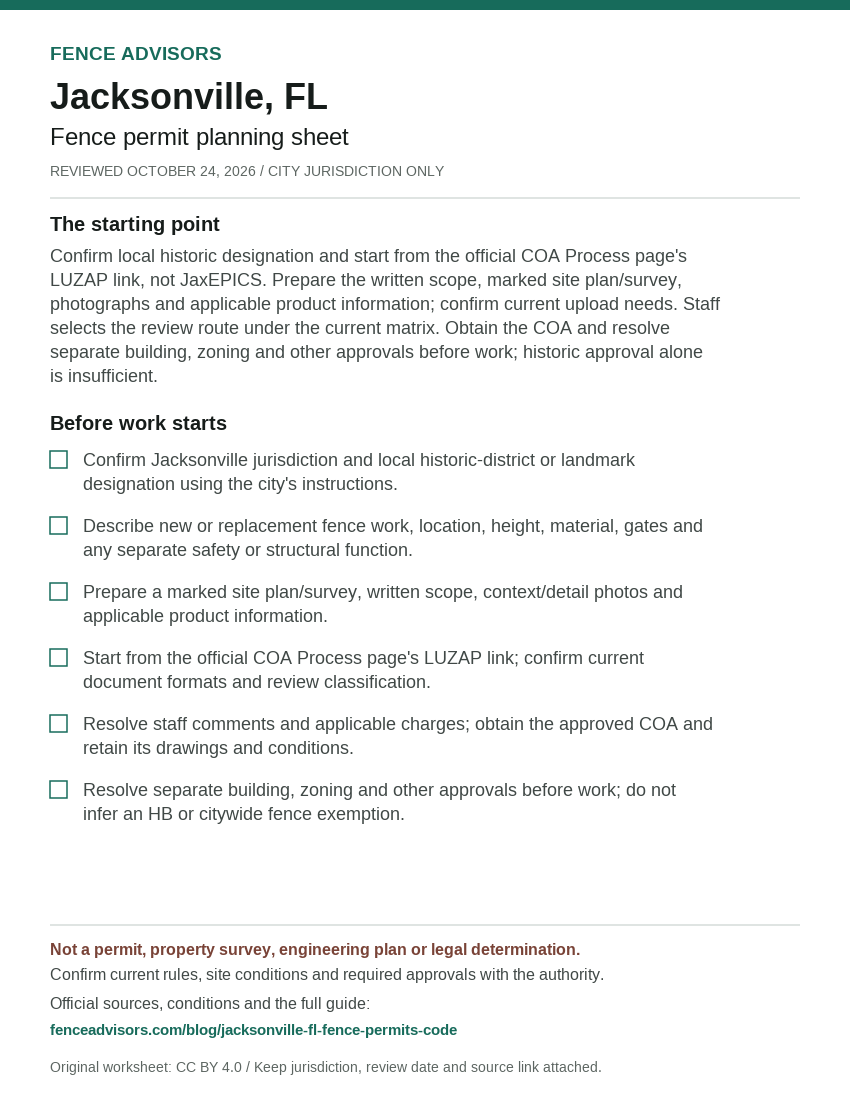
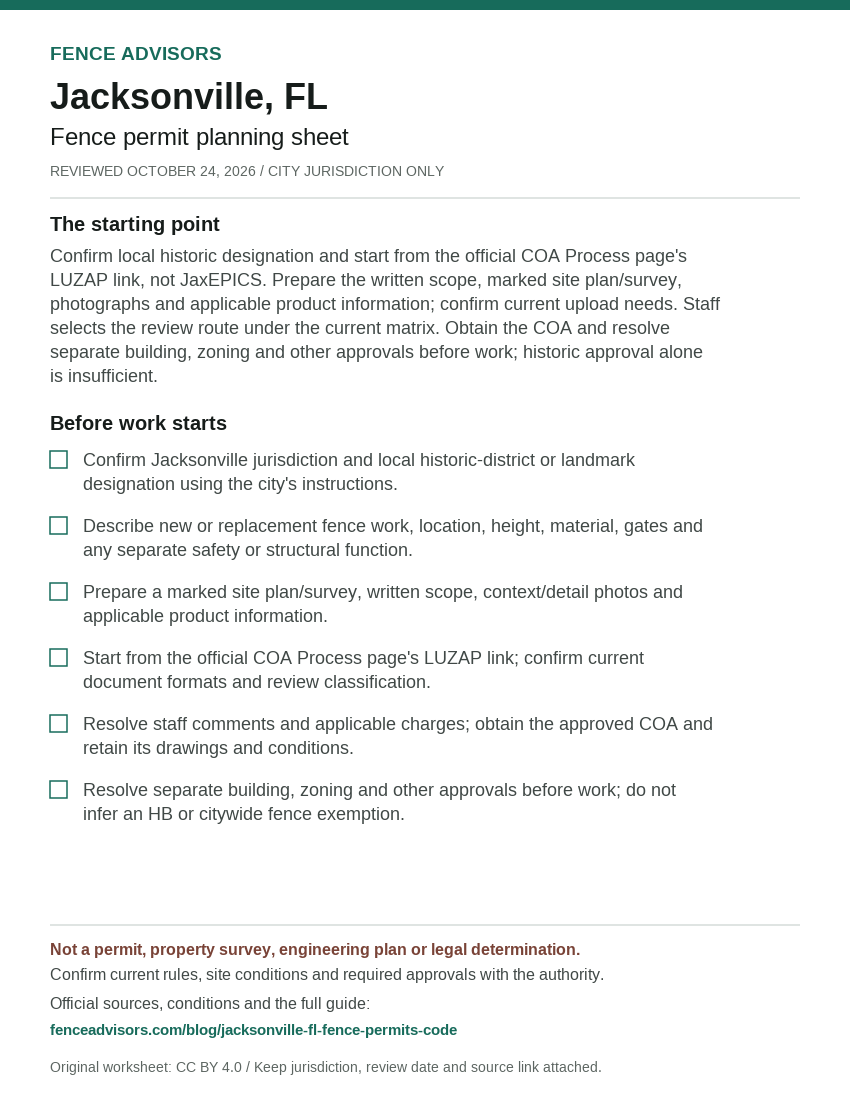
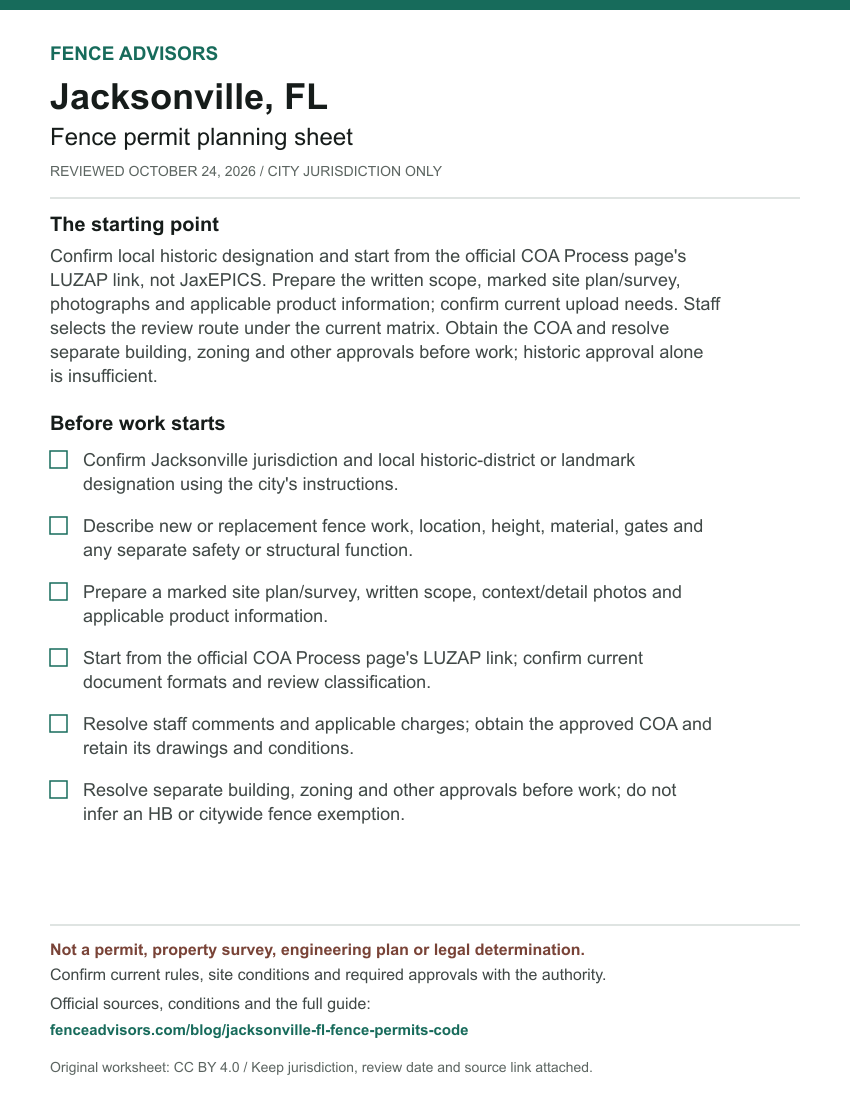
- Confirm Jacksonville jurisdiction and local historic-district or landmark designation using the city's instructions.
- Describe new or replacement fence work, location, height, material, gates and any separate safety or structural function.
- Prepare a marked site plan/survey, written scope, context/detail photos and applicable product information.
- Start from the official COA Process page's LUZAP link; confirm current document formats and review classification.
- Resolve staff comments and applicable charges; obtain the approved COA and retain its drawings and conditions.
- Resolve separate building, zoning and other approvals before work; do not infer an HB or citywide fence exemption.
Download or embed this graphic
<figure>
  <a href="https://fenceadvisors.com/blog/jacksonville-fl-fence-permits-code"><img src="https://fenceadvisors.com/media/research/jacksonville-fl-permit-cheat-sheet.svg" alt="Jacksonville fence permit planning sheet: Historic scope only: fence work on local landmarks/in local historic districts requires COA review; citywide building duty unresolved. Six preparation checks; the complete accessible checklist and source-checked rules are in this article." width="850" height="1100" loading="lazy" style="max-width:100%;height:auto"></a>
  <figcaption>Graphic: <a href="https://fenceadvisors.com/blog/jacksonville-fl-fence-permits-code">Fence Advisors</a>. Source, period and limitations are in the linked article. Original graphic: CC BY 4.0.</figcaption>
</figure>
Jacksonville and Florida planning links
Compare Jacksonville fence companies with COA preparation and review duties assigned. The Florida contractor directory, Florida permit framework and national permit navigator provide geographic context; the national directory covers other locations. The Florida framework is not a Jacksonville HB classification or an exemption determination for this project.
The Gainesville historic-fence guide covers a different Florida city's COA process. Its packet and email route do not replace Jacksonville's LUZAP application or local review criteria.
Sources and reuse
We checked the linked government guidance on October 24, 2026. The scope above and source notes identify what was verified and what still needs confirmation. This article is not an ordinance, survey, engineering design, legal opinion or permit approval. The downloadable fact sheet records each finding's source and section. Confirm current rules, fees and submission instructions with the responsible authority before ordering materials or starting work.
You may reuse our original cheat sheet with attribution to this article. Keep the review date, jurisdiction and limitations attached. Government documents remain with their original publishers. Send corrections with a source link to editorial@fenceadvisors.com.
Sources and Downloads
- Jacksonville current Certificate of Appropriateness Process - Complete substantive body: exterior/site-work COA duty, File a new COA application, 2026 COA Matrix, fence supplement and district guideline links. Full official process body read October 24, 2026. Dedicated new-application link leads to maps.coj.net/Luzap; current links do not make older appendix counter/deadline language current.
- Jacksonville Historic Preservation FAQ - Complete substantive FAQ: fencing/site-work duty, LUZAP application, staff scope/matrix review and email response, commission fee categories, work-before-approval and validity. Full current official body read October 24, 2026; posted processing estimates are not guaranteed issuance times or a verified project fee.
- Jacksonville historic designation search instructions - Entire address/RE-number workflow: Historic layers, Local Historic Districts/Landmarks; non-contributing and non-street-visible property qualification. Full current instructions read October 24, 2026; map procedure verified, not a tested parcel, boundary survey or individual designation determination.
- City-linked LUZAP public application entry - Complete public homepage: registered-user submission/New Application instructions versus public Historic Preservation application search. Full public entry read October 24, 2026 after following the dedicated historic File a new COA link. No login, registration, agreement, upload, payment or form entry; public search is not a new application or approval.
- Current-linked Riverside Avondale historic guidelines: COA documentation appendix - Appendix A printed pp.75-77, especially complete application/documentation page76 (PDF sheet109) and continuation: written scope, site plan/survey, context/detail photos, material description on staff request. Current official COA Process page still links this guideline; internal title January 1992. Complete relevant appendix text read October 24, 2026, not an assertion of modern digital fields or all 131 sheets reviewed. Old addresses, counter-first sequence, deadline/photo-size prescriptions and permit premises not used as current intake rules.
- Jacksonville 2026 COA Matrix - Current process-linked 2026 matrix; full applicable headers/conditions and Site Work item23 Fences on p.7; decorative walls separately item30. Official PDF relevant complete text read October 24, 2026. Administrative criteria are cumulative; staff determines route. Screenshot attempt returned cache miss, so no visual-diagram verification claimed; no numerical special-height exception published.
- Jacksonville adopted historic Fencing and Wall Guidelines - Retained complete five-page Historic Preservation supplement: design/location/material guidance and COA duty; all design questions limited to local historic scope. Internal Version December 2023; previously read full official evidence reused October 24, 2026 and same supplement still linked by current COA Process page. Not re-downloaded; no old no-building-permit premise used as current permission.
- Jacksonville current zoning FAQ: responsible jurisdictions - Previously read full relevant jurisdiction answer and JaxGIS reference; separate Atlantic Beach, Neptune Beach, Jacksonville Beach and Baldwin departments. Retained current official body, page labels Updated August 4, 2026; reused October 24, 2026 only for jurisdiction, not a complete fence building-exemption or numerical design answer.
Original Fence Advisors graphics, data compilations and worksheet are available under CC BY 4.0. Retain source, period and scope when reusing data. This license does not relicense third-party documents or trademarks.
Corrections: editorial@fenceadvisors.com.
Related Research
Plan your Jacksonville fence project
Confirm the approvals for your property, then compare written contractor scopes.
Get the next guide in your inbox
Fence costs, rankings, and what AI is telling homeowners — researched, no fluff.