
Kansas City, MO / Fence permit planning
Ordinary non-electric residential fence planning within Kansas City, Missouri, not Kansas City, Kansas or the wider metro. Chapter 18's fence building-permit exemption has no height cutoff, but the four-/six-foot Chapter 27 baselines, including ordinance 250575 passed July 24, 2025, do not grant universal zoning, overlay, boulevard or visibility permission. Complete Chapter 88 and later legislation are not independently verified here, and no numerical visibility or grade formulas are supplied. Pre-March-20-2000 applicability language is not a universal replacement right. Historic, pool, retaining, electrical, floodplain and public-property work needs applicable review; this guide is not parcel approval or engineering design.
Sources and scope checked .
Kansas City, Missouri exempts fences from building permits under section 18-16(b)(1)e. That does not mean a fence of any height or location is allowed. Chapter 27 generally limits residential fencing to six feet, with four-foot limits in the defined front yard and street-side yard on a corner lot, and other applicable requirements remain. Special exceptions, historic review and other project components are separate questions. Kansas City adopted administrative provisions; Kansas City building-permit-exempt work; Current city BZA-linked Chapter 27 fence and wall code.
This is a Kansas City, Missouri homeowner planning guide, not Kansas City, Kansas law or a rule for the entire metropolitan area. Verify the city boundary regardless of the county containing the property. Use the Kansas City, MO contractor directory for hiring after identifying the actual scope and approvals.
Quick reference
| Question | Source-checked answer |
|---|---|
| Ordinary fence building permit | Section 18-16(b)(1)e lists fences as building-permit-exempt without a height cutoff. That exemption does not authorize violations of Chapter 27, zoning or other applicable laws. Kansas City adopted administrative provisions; Kansas City building-permit-exempt work; Current city BZA-linked Chapter 27 fence and wall code |
| Residential height baseline | Chapter 27 generally limits residential fences/walls to six feet, with 48-inch limits in the defined front yard and street-side yard on a corner lot. Vacant-lot definitions, boulevards/parkways and other applicable standards need separate checks. Current city BZA-linked Chapter 27 fence and wall code; Authenticated Kansas City ordinance 250575 |
| Need a height exception? | BZA may grant a special exception under 27-11; approval is not automatic. Consult staff before applying through CompassKC and prepare owner consent, a site plan and site imagery. Material examples are encouraged in the checklist. Kansas City BZA process and fence exceptions; Actual required plan documents for Kansas City BZA cases; Kansas City property ownership consent and affidavit; Current city BZA-linked Chapter 27 fence and wall code |
| Repair and public property | Chapter 27 requires structurally sound fencing, stable posts and securely attached panels, and prohibits public-right-of-way encroachment. Its pre-March-20-2000 applicability provision is not a blanket right to replace any old fence. Current city BZA-linked Chapter 27 fence and wall code; Authenticated Kansas City ordinance 250575 |
| Historic fence review | A designated historic property's applicable publicly visible exterior fence changes need historic review. The current checklist identifies site plans, dimensioned elevations, product sheets and historic photographs if available; applications use CompassKC. Kansas City historic design review; Kansas City actual historic application submission materials |
| Fees and timing | No ordinary fence building permit is required, but separate exceptions or special approvals can carry charges. Confirm the current route and invoice; Chapter 27 permits fee adjustments, and this guide promises no flat total or approval time. Kansas City building-permit-exempt work; Current city BZA-linked Chapter 27 fence and wall code; Kansas City building and development fee resources |
What the building-permit exemption actually says
The city's currently linked administrative code lists fences as exempt in 18-16(b)(1)e without adding a six- or seven-foot permit threshold. Its current Building Permit Exempt Work page gives the same answer. A height limit in Chapter 27 is therefore not a height-triggered building permit in disguise: an overheight proposal needs the appropriate exception, not simply a generic building permit to override the limit. Kansas City adopted administrative provisions; Kansas City building-permit-exempt work.
Both sources retain compliance with other codes and laws. A retaining structure, pool project, electrical gate equipment, historic property or public-property proposal needs its own classification. This guide does not extend the ordinary fence answer into a complete pool-barrier exemption or provide a partial gate/opening specification as a safety design. Describe every project component to the appropriate city reviewer. Kansas City adopted administrative provisions.
The current adoption resource distinguishes the adopted 2018 code package, effective June 28, 2020, from separately labelled 2024 drafts. We use the city's actual administrative text, not a proposed package or an unamended model-code exemption. Later energy-code changes do not by themselves change the ordinary fence answer. Kansas City building-code adoption and amendment resources.
Chapter 27: front, corner and rear yards are not interchangeable
The Chapter 27 copy linked by the city's BZA page incorporates ordinance 250575, passed July 24, 2025. That ordinance replaces 27-10 and 27-11 and adds maintenance requirements. Its enacted residential height provisions agree with the linked chapter. Current city BZA-linked Chapter 27 fence and wall code; Authenticated Kansas City ordinance 250575.
Section 27-10(a) sets the general six-foot residential limit, further restricted by its yard provisions. Subsection (b) limits fencing in the defined front yard to 48 inches. For an improved residential lot, the definition references the dwelling's front wall and its extended line, the side property lines and the front property line nearest the street on which the building fronts. It is not simply a universal distance measured from the curb. Current city BZA-linked Chapter 27 fence and wall code.
On a residential corner lot, subsection (d) applies a 48-inch limit to the front and defined street-side yard. The street-side definition follows the side wall to the street-side property line and extends from front yard to rear yard. Do not apply the general six-foot allowance across that entire street-facing area just because a contractor calls it a side fence. Current city BZA-linked Chapter 27 fence and wall code.
Vacant residential lots have their own front/side yard definitions tied to platted or established building/setback lines. The vacant front-yard provision also considers existing improved residential properties on the same block face. A vacant lot is not a blank site where the owner's preferred fence line determines the required yard. Current city BZA-linked Chapter 27 fence and wall code.
Boulevards and parkways are expressly referred to separate standards in 88-323-02-D. Other zoning, historic, floodplain, access or visibility conditions can also matter. Our four-/six-foot findings are the Chapter 27 baseline, not an independently verified combined zoning entitlement for every parcel. We establish no numerical sight triangle, grade-measurement formula or universal setback here. Have the city confirm those issues for the proposed line. Current city BZA-linked Chapter 27 fence and wall code; Kansas City development process and boundary resources.
A height exception is a distinct application
Section 27-11 authorizes BZA special exceptions from 27-10. It requires good and sufficient cause proportionate to the request, no adverse effect on neighborhood/adjacent-property appearance, and compatibility with the residence or building in materials, color and design. The board may impose conditions. A neighbor's support or an application fee is not approval. Current city BZA-linked Chapter 27 fence and wall code; Authenticated Kansas City ordinance 250575.
The current BZA instructions require a staff pre-application consultation before filing. Its actual Special Exception checklist requires owner consent, a site plan and site imagery; examples of proposed building materials are encouraged. Do not treat every generic BZA document as mandatory for every fence, or confuse a fence exception with a special use permit. Kansas City BZA process and fence exceptions; Actual required plan documents for Kansas City BZA cases.
The linked owner-consent form identifies the property, application type, owner or authorized representative and a notarial block. It is not merely an unsigned email saying a neighbor likes the proposal. Follow the city's actual authorization requirements and ask staff how the case should be classified in CompassKC. Kansas City property ownership consent and affidavit.
Chapter 27 has fence-specific notice provisions. The BZA page also expressly says fence exceptions do not require the generic sign posting described for some other cases. We do not convert the page's general public-hearing description into a universal fence notice checklist or promise a particular hearing date. Follow the assigned planner's current instructions. Current city BZA-linked Chapter 27 fence and wall code; Kansas City BZA process and fence exceptions.
Historic fencing needs its own design review
For a property on the Kansas City Register of Historic Places, applicable exterior changes visible from public right-of-way need historic review. The city links separate fencing/wall guidance and distinguishes administrative from commission review. An ordinary building-permit exemption does not approve historic materials or design. Kansas City historic design review.
The actual historic submission-materials document has a Site Work row covering fencing and gates. It calls for a dimensioned site plan, dimensioned elevations, product sheets and historic photographs if available. The document accepts accurate hand drawings in the described format; it does not prescribe an engineer for every ordinary fence. Applications go through CompassKC. Confirm the applicable review level before removing historic material or ordering a substitute. Kansas City actual historic application submission materials; Kansas City historic design review.
Property lines, old fencing and maintenance
Use the city Parcel Viewer and zoning-verification resources to begin identifying zoning, overlays, historic status and recorded approvals. The development guide identifies Parcel Viewer as a resource for parcels within city limits. A county name, mailing address or map image alone is not a legal boundary survey. This article does not certify an unidentified parcel's jurisdiction or line. Kansas City zoning verification resources; Kansas City development process and boundary resources.
Chapter 27 requires sound fencing, firmly set posts and securely attached rails/slats, and prohibits encroachment on public right-of-way. Do not move a fence into public land on the assumption that no building permit means no city control. The development guide describes separate encroachment processes, but does not itself grant a right to place an ordinary private fence there. Current city BZA-linked Chapter 27 fence and wall code; Kansas City development process and boundary resources.
The height section excludes certain building walls, below-grade retaining portions and fences/walls constructed before March 20, 2000 from that section's applicability. That is not a blanket exemption from maintenance, every other law or review of a new replacement. Describe the existing structure, age evidence and proposed changes to staff; this guide establishes no percentage-based replacement safe harbor. Current city BZA-linked Chapter 27 fence and wall code.
A practical planning and filing sequence
- Verify the authority and site. Confirm KCMO limits, zoning, yard classifications and any historic, boulevard/parkway, floodplain or access conditions.
- Prepare a clear layout. Show actual property lines, dwelling, fence runs, heights, materials, gates, streets, easements and relevant grades.
- Separate the approval questions. A compliant ordinary yard fence does not need a generic building-permit application. Ask about a height exception, historic review or distinct pool, retaining, electrical or public-property work where applicable.
- Use the applicable current checklist. BZA exceptions require the pre-application consultation and their plan/consent/imagery package. Historic applications have a different submission list.
- File the required special application in CompassKC. Follow staff classification, pay applicable charges, respond to corrections and obtain the approval before work requiring it.
- Keep the approved scope and records. Arrange any inspections associated with separately permitted work and maintain the finished fence. Schedule utility locating before excavation.
Use the official CompassKC instructions for the required special application. A saved application or receipt is not a special-exception or historic approval. Official CompassKC application instructions.
No ordinary fence building permit is required, but that does not make all special reviews free. Chapter 27 permits adjustments to its fee amounts, and the city fee resource distinguishes separate charges. We quote no guaranteed current exception fee, all-in total or approval time. The optional paid zoning-compliance letter and business-license clearance are not universal homeowner fence requirements. Current city BZA-linked Chapter 27 fence and wall code; Kansas City building and development fee resources; Kansas City zoning verification resources.
Before-you-build checklist
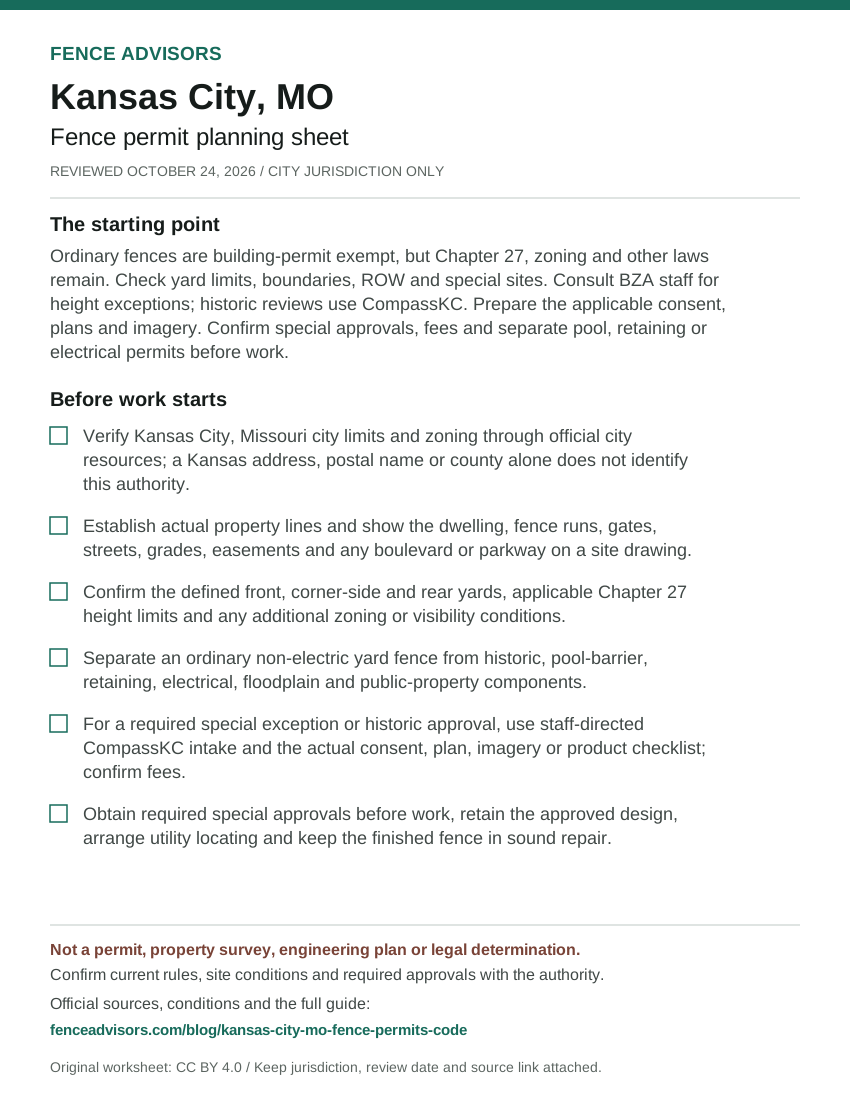
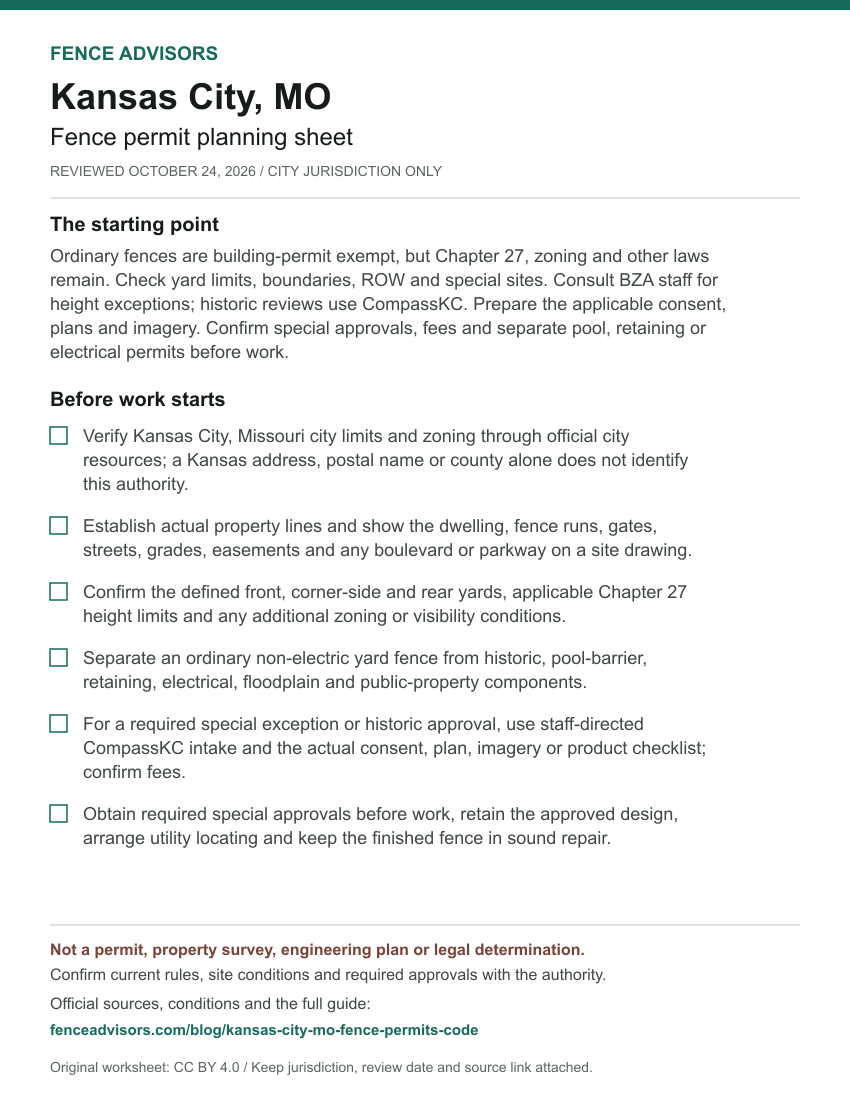
- Verify Kansas City, Missouri city limits and zoning through official city resources; a Kansas address, postal name or county alone does not identify this authority.
- Establish actual property lines and show the dwelling, fence runs, gates, streets, grades, easements and any boulevard or parkway on a site drawing.
- Confirm the defined front, corner-side and rear yards, applicable Chapter 27 height limits and any additional zoning or visibility conditions.
- Separate an ordinary non-electric yard fence from historic, pool-barrier, retaining, electrical, floodplain and public-property components.
- For a required special exception or historic approval, use staff-directed CompassKC intake and the actual consent, plan, imagery or product checklist; confirm fees.
- Obtain required special approvals before work, retain the approved design, arrange utility locating and keep the finished fence in sound repair.
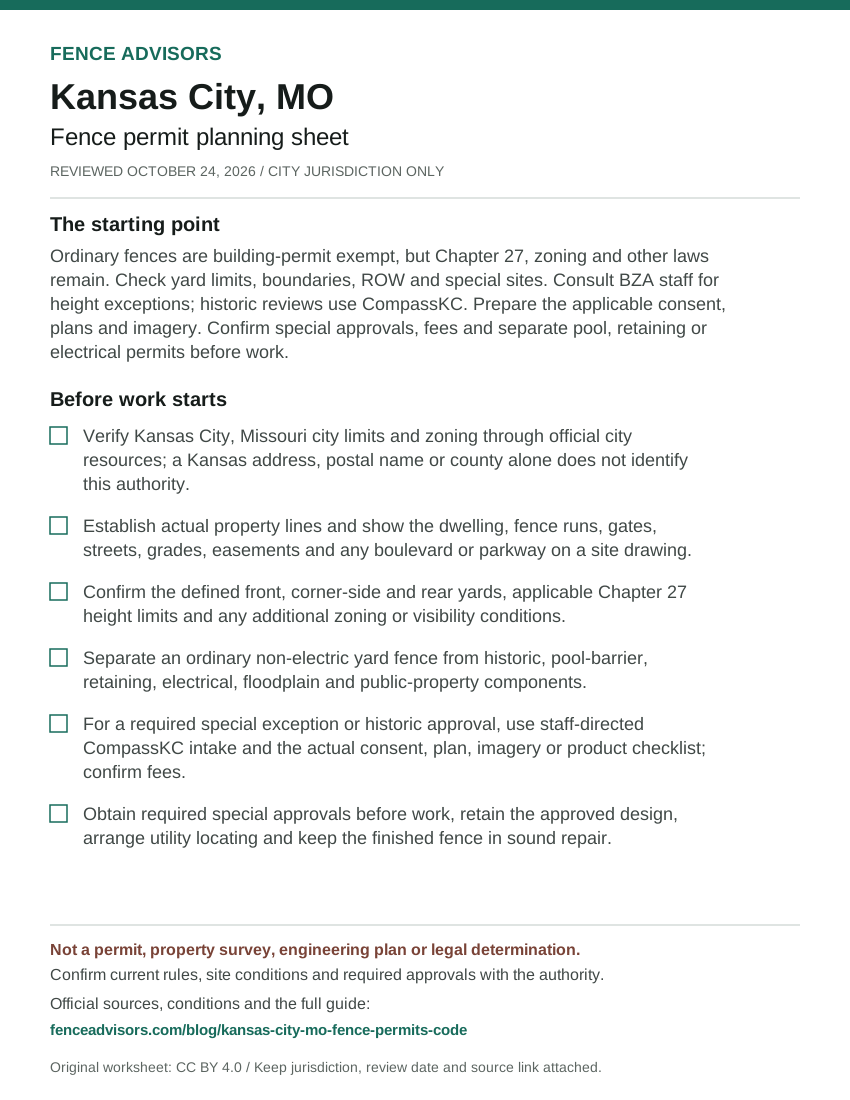
Download or embed this graphic
<figure>
  <a href="https://fenceadvisors.com/blog/kansas-city-mo-fence-permits-code"><img src="https://fenceadvisors.com/media/research/kansas-city-mo-permit-cheat-sheet.svg" alt="Kansas City fence permit planning sheet: Ordinary fence building-permit exemption; special reviews remain conditional. Six preparation checks; the complete accessible checklist and source-checked rules are in this article." width="850" height="1100" loading="lazy" style="max-width:100%;height:auto"></a>
  <figcaption>Graphic: <a href="https://fenceadvisors.com/blog/kansas-city-mo-fence-permits-code">Fence Advisors</a>. Source, period and limitations are in the linked article. Original graphic: CC BY 4.0.</figcaption>
</figure>
Kansas City and Missouri planning links
Compare Kansas City, MO fence contractors with responsibilities for layout, any special application, fees and inspections identified in writing. Use the Missouri directory, national directory and national permit navigator for other locations. The separate St. Louis City permit guide covers a different new-fence permit policy; Kansas City's exemption does not apply there. The buyer checklist and setback/easement guide organize hiring and private-rights questions without replacing city approval.
Sources and reuse
We checked the linked government guidance on October 24, 2026. The scope above and source notes identify what was verified and what still needs confirmation. This article is not an ordinance, survey, engineering design, legal opinion or permit approval. The downloadable fact sheet records each finding's source and section. Confirm current rules, fees and submission instructions with the responsible authority before ordering materials or starting work.
You may reuse our original cheat sheet with attribution to this article. Keep the review date, jurisdiction and limitations attached. Government documents remain with their original publishers. Send corrections with a source link to editorial@fenceadvisors.com.
Sources and Downloads
- Kansas City adopted administrative provisions - 18-16(a), (b) opening and (b)(1)e Fences; distinct retaining/pool/electrical provisions. Full currently linked city administrative PDF retrieved; complete relevant provisions read October 24, 2026. Building exemption has no fence-height cutoff and does not waive other laws.
- Kansas City building-permit-exempt work - Opening city-limits/compliance scope; Section 18-16 building list item e; city contact. Full current department body read October 24, 2026; agrees with adopted administrative text, not a no-approval guarantee.
- Current city BZA-linked Chapter 27 fence and wall code - Complete chapter: 27-2, 27-4, 27-5, 27-10, 27-11 and scoped 27-12. BZA page identifies this as its Chapter 27 copy updated for hearings; full text read October 24, 2026; incorporates 250575 of July 24, 2025. No independent later-ordinance audit claimed.
- Authenticated Kansas City ordinance 250575 - All four pages; authenticated passed date; new 27-5 and replaced 27-10/27-11. Authenticated as passed July 24, 2025; full text read October 24, 2026, agreeing with BZA-linked current chapter; not a draft or special nonresidential-use ordinance.
- Kansas City building-code adoption and amendment resources - Adopted 2018 package/local amendments versus separate Proposed Updates 2024 drafts; administrative PDF link. Full current page read October 24, 2026; 2018 package effective June 28, 2020, later energy changes separately identified. Proposed 2024 drafts not applied as enacted fence law.
- Kansas City BZA process and fence exceptions - Special Exceptions to Fencing Requirements; application checklist; pre-application consultation; CompassKC; fence sign-posting exception. Full current page read October 24, 2026; links rules adopted September 23, 2026 and current Chapter 27. Generic BZA notices not substituted for fence-specific 27-11 procedure.
- Actual required plan documents for Kansas City BZA cases - Special Exception checklist and required-versus-encouraged table. Current city-linked complete checklist read October 24, 2026; owner consent/site plan/site imagery required; material examples encouraged, not universally mandatory.
- Kansas City property ownership consent and affidavit - Complete one-page ownership/authorized representative/application/case form with notarial block. Current BZA-linked actual form read October 24, 2026; no form completed or signed.
- Kansas City historic design review - Register/public-right-of-way exterior changes; fence supplement; administrative/commission review; submission materials and CompassKC. Full current page read October 24, 2026. Building exemption not treated as historic design approval.
- Kansas City actual historic application submission materials - Complete current-linked document; Site Work row for walls/fencing/gates. Full text read October 24, 2026: site plan, dimensioned elevations, product sheets and historic photos if available; not an engineer requirement for every fence.
- Kansas City zoning verification resources - Parcel Viewer and staff verification; separate business clearance and optional paid compliance letter. Full current page read October 24, 2026; business clearance/compliance-letter purchase not prescribed as a universal homeowner fence application.
- Kansas City development process and boundary resources - Historic designation; encroachment definition/process; KCMO Parcel Viewer within city limits. Full current body read October 24, 2026; GIS/records not a legal boundary survey; no right-of-way fence authorization inferred.
- Official CompassKC application instructions - City-linked portal and registration/plan/permit/document guides; departmental and concierge support. Full current instructions and public production portal shell read October 24, 2026; no login, terms, signature, payment or submission. Not a universal ordinary-fence permit route.
- Kansas City building and development fee resources - Separate charges; fee estimator scope; Permits Division confirmation, alongside 27-11 fee adjustment authority. Full current entry read October 24, 2026; Chapter 27 historical fee subject to CPI adjustment, so no current exception invoice quoted.
Original Fence Advisors graphics, data compilations and worksheet are available under CC BY 4.0. Retain source, period and scope when reusing data. This license does not relicense third-party documents or trademarks.
Corrections: editorial@fenceadvisors.com.
Related Research
Plan your Kansas City fence project
Confirm the approvals for your property, then compare written contractor scopes.
Get the next guide in your inbox
Fence costs, rankings, and what AI is telling homeowners — researched, no fluff.