
Sacramento, CA / Fence permit planning
Ordinary residential yard-fence planning inside the City of Sacramento, not unincorporated Sacramento County. Building-permit exemptions do not waive Planning approval. Historic/design-review sites, special districts, pools, retaining structures, powered gates and sound walls need their applicable review; not parcel approval or an engineering design.
Sources and scope checked .
In the City of Sacramento, an ordinary residential fence not over seven feet can be exempt from a building permit, but proposed fencing is still subject to Planning approval. The exemption does not authorize a seven-foot fence wherever you want: the residential zoning defaults are four feet in front/street-side yards and six feet in rear/interior-side yards, with specific exceptions. Historic/design-review qualifications and other project components need their applicable review. Sacramento required building permits; 2025 California Residential Code, January 2026 errata; Sacramento City Code: wall and fence regulations.
Use this guide for the City of Sacramento, not unincorporated Sacramento County or another municipality with a Sacramento mailing address. Define the location and approval scope before comparing Sacramento fence contractors. This is an application-planning reference, not a contractor ranking, boundary survey or engineering design.
Quick reference
| Question | Source-checked answer |
|---|---|
| Does a six-foot fence need approval? | Ordinary fences not over 7 feet are building-permit exempt under the cited residential rule, but the city requires Planning approval for proposed fencing. Historic/design-review qualifications and other work can change the review. Sacramento required building permits; 2025 California Residential Code, January 2026 errata; Sacramento current building codes and adopted local amendments |
| Front and street-side default | The residential zoning default is 4 feet along front/street-side property lines and within those setbacks. The open-metal exception allows up to 6 feet for qualifying decorative wrought iron or tubular steel, not solid wood, chain link or woven wire. Sacramento City Code: wall and fence regulations |
| Rear and interior-side default | Within required rear/interior-side yards the general maximum is 6 feet. An 8-foot property-line exception requires an abutting school, park, alley or other nonresidential use; it is not permission for every residential boundary. Sacramento City Code: wall and fence regulations |
| How height is measured | Measure from the highest point of the fence or wall to adjacent finished grade. Where the two sides have different finished grades, Chapter 17.620 uses the higher adjacent finished grade. Sacramento City Code: wall and fence regulations |
| Local-street driveway clear zones | Within the defined driveway triangles, fences may not exceed 3.5 feet, including open wrought iron or tubular steel. Exhibit A uses 10-foot legs from the specified driveway and sidewalk/right-of-way references, not a universal curb setback. Sacramento City Code: wall and fence regulations; Sacramento wall and fence driveway visibility sheet |
| Fee and turnaround | No universal flat fence fee or approval time was verified. Planning review, any required Building permit and other project scopes can have separate charges; obtain the city's determination before committing to construction. Sacramento building fee information; Sacramento Planning applications: how to submit |
Building permission and Planning approval are different decisions
The city's Required Building Permits page says fences not over seven feet are exempt, with a design-review/preservation-district or historic-landmark qualification. Its fence footnote separately subjects all proposed fencing to Planning approval and Chapter 17.620. The exemption therefore does not mean no city review, no height limit or no restrictions on location and materials. Sacramento required building permits.
For ordinary residential work, the adopted 2025 California Residential Code R105.2, Building item 2, includes exactly seven feet in its not-over-seven-foot exemption. The city's Planning FAQ uses shorter less-than-seven-foot wording; the adopted rule includes equality. Sacramento requires the 2025 codes and local amendments for new applications from January 1, 2026. None of this overrides a lower zoning limit or site-specific review. 2025 California Residential Code, January 2026 errata; Sacramento current building codes and adopted local amendments; Sacramento Planning and zoning FAQ.
Ask Planning whether the proposal needs a planning permit, qualifies for a director-determined site-plan/design-review exemption, or needs Building Permit Clearance before a required building application. Those are different paths. Do not buy a discretionary application simply because a general webpage mentions fences, and do not assume an exemption has been granted merely because your design seems minor. The applicable determination belongs to the city. Sacramento site plan and design review code; Sacramento Planning applications: how to submit.
Front-yard and street-side fences: material matters
Section 17.620.110 applies to single-unit, duplex and multi-unit dwelling development. It generally allows fences up to four feet along front and street-side property lines and within those setbacks. The decorative open-metal exception allows up to six feet for open wrought iron or tubular steel. It does not include solid wood, chain link, woven wire or every product advertised as an open fence. Chain link and woven wire are prohibited within the front/street-side setback areas. Sacramento City Code: wall and fence regulations.
Supporting solid posts or pilasters under the open-metal exception may be no more than 18 inches square and six feet high, with at least six feet between posts. A tall solid section between decorative posts does not become an open-metal fence. Show the actual panel and support details when asking for review. Sacramento City Code: wall and fence regulations.
There is a separate street-side-yard alternative for a fence up to six feet: placement at least five feet from the street-side property line or along the line parallel to the street extending the main building wall nearest the street. The provision also requires living landscaping, irrigation and maintenance. Do not reduce those alternatives and conditions to a universal five-foot setback or a universal six-foot corner fence. Driveway visibility can impose a lower height. Sacramento City Code: wall and fence regulations.
Rear and interior-side fences: six feet is the default, not eight
The general limit along rear/interior-side property lines and within those required yards is six feet. A fence up to eight feet is allowed along a rear/interior-side property line abutting a school, park, alley or other nonresidential use. Two ordinary neighboring residential yards do not meet that exception simply because the owners agree. Sacramento City Code: wall and fence regulations.
The code separately allows fences exceeding six feet outside the required rear/interior-side setbacks. First establish the actual required yard, then seek Planning's review; this is not an unlimited boundary-height allowance. Freeway/railroad sound-attenuation walls, arterial sound walls and multi-unit parking screens have their own scoped requirements. Do not apply those specialized wall dimensions to a routine backyard privacy fence. Sacramento City Code: wall and fence regulations.
Grade and driveway clear zones can change the design
Sacramento measures fence or wall height from its highest point to adjacent finished grade. Where the grades differ on the two sides, Chapter 17.620 uses the higher adjacent finished grade. That is a zoning measurement rule, not permission to alter drainage or a method for deciding retaining-wall structural requirements. Show both grades where the fence is stepped or sits above a wall. Sacramento City Code: wall and fence regulations.
On local streets, the defined driveway clear zones limit fencing to 3.5 feet, including decorative open wrought iron or tubular steel. The city's Exhibit A uses ten-foot legs referenced to the driveway edge and the back of sidewalk or right-of-way line specified in the code. It is not a ten-foot setback from every curb, nor a complete specification for every type of street intersection. Sacramento wall and fence driveway visibility sheet; Sacramento City Code: wall and fence regulations.
Mark the driveway, sidewalk, right-of-way and proposed fence on the site drawing. Use the official diagram with actual site information; a generic drawing from another city can put the triangle in the wrong place. We do not provide an engineered visibility, grading or retaining-wall design.
Replacing an old fence does not establish a blanket exemption
New and replacement proposals still need the applicable Planning determination. Chapter 17.620's nonconforming provision allows same-location repair, maintenance or replacement when the fence was built before February 14, 1980. It is not a blanket grandfather rule for every existing fence. Age, location and the relevant code scope need evidence, not an assumption based on weathered boards. Sacramento City Code: wall and fence regulations.
Chapter 15.156 has separate materials, maintenance and chapter-specific nonconforming provisions. Its maintenance allowance does not silently replace the zoning chapter's date condition. For damaged, leaning or nonconforming work, describe the actual condition and proposed change to the city rather than infer that replacing like for like approves every existing material or location. Sacramento City Code Chapter 15.156, Fences.
A practical Sacramento application sequence
- Identify the authority. Confirm the parcel is in the city. Use the city's Land Information Lookup through its Planning FAQ for zoning, design-review and historic context. A mailing address is not jurisdiction.
- Establish the fence line. Collect available survey/parcel information, easements and recorded conditions. The city expressly says Planning does not locate or verify your property lines; a sidewalk, old fence or public map is not a boundary survey.
- Describe the complete work. Record new versus replacement scope, height, material, supports, gates, streets, grades and any wall or pool function. Ask the contractor to separate those responsibilities in the quote.
- Obtain Planning's route determination. Confirm any required planning permit, exemption determination or clearance. Historic resources, special planning districts, overlays and PUDs can need additional review.
- Prepare the actual digital package. Follow the city's current Planning forms and file requirements for the selected route. When Building plan review is required, the city uses electronic submission; paper plans are not accepted.
- Use the official Public Permit Portal. For Building review, Planning clearance creates a SUB record and an email with the next steps. A created account or uploaded file is not an issued permit.
- Confirm fees and inspections before construction. Retain the applicable approvals and required inspection records. Do not start permit-required work simply because an application was accepted.
The Planning FAQ and property resources explain zoning and boundary limitations. The Planning submission instructions distinguish application types, and Electronic Plan Check explains the Planning-to-Building handoff. Follow the instructions for the route the city selects for your property. Sacramento Planning and zoning FAQ; Sacramento Planning applications: how to submit; Sacramento electronic plan check.
The city's online minor-permit examples do not establish that every fence can be instantly issued online. Its applicant instructions distinguish property owners, authorized agents and licensed contractors, with applicable declarations. Confirm the correct applicant and records for your job; this guide does not fill an official form for you.
Fees, special projects and what this guide does not promise
The current fee resources do not establish one flat price for every fence. Planning entitlement or exemption review, Building plan review/inspection, and other project scopes can carry separate charges. A building-permit exemption is not proof that every planning service is free. The city's formal preliminary fee-estimate service itself has a processing charge; do not assume a requested written estimate is free. Sacramento building fee information.
Scope and completeness determine the actual review; no fixed approval time is guaranteed. Ask for the applicable route and fee determination before signing a construction schedule.
Pool barriers, retaining structures, powered gates, sound walls, public right-of-way work and historic resources are not fully covered by an ordinary privacy-fence answer. Describe them at intake and obtain the appropriate specialist review. Private HOA/deed restrictions and neighbor boundary or cost-sharing questions are also separate from municipal approval. The setback and easement guide and fence buyer checklist help organize those conversations without replacing local authority.
Before-you-build checklist
- Confirm City of Sacramento jurisdiction, zoning, historic/design-review status and special districts.
- Record new or replacement scope, material, heights, nearby grades and street frontage.
- Locate real lot lines, required yards, easements, driveways and applicable clear zones.
- Ask Planning which approval or exemption determination applies before ordering materials.
- Prepare the required digital drawings/photos and use the appropriate portal application.
- Confirm all fees, issued approvals and inspection requirements; keep final records.
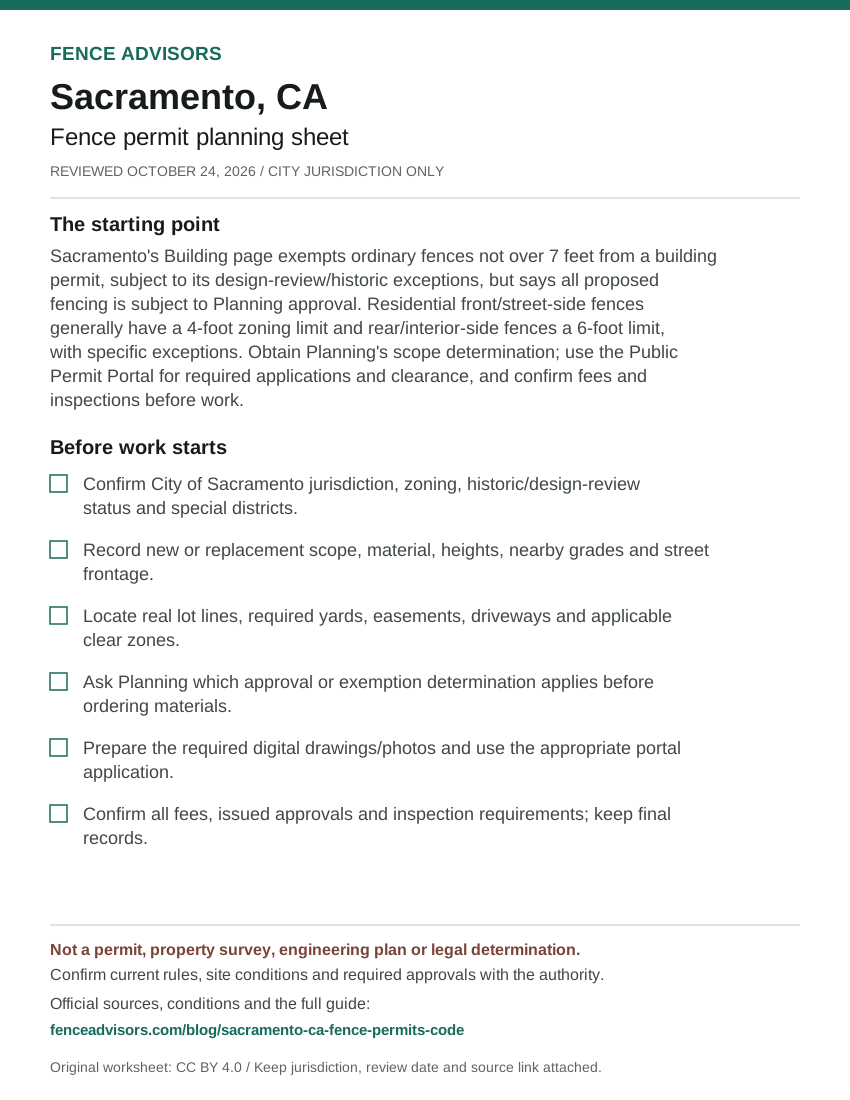
Download or embed this graphic
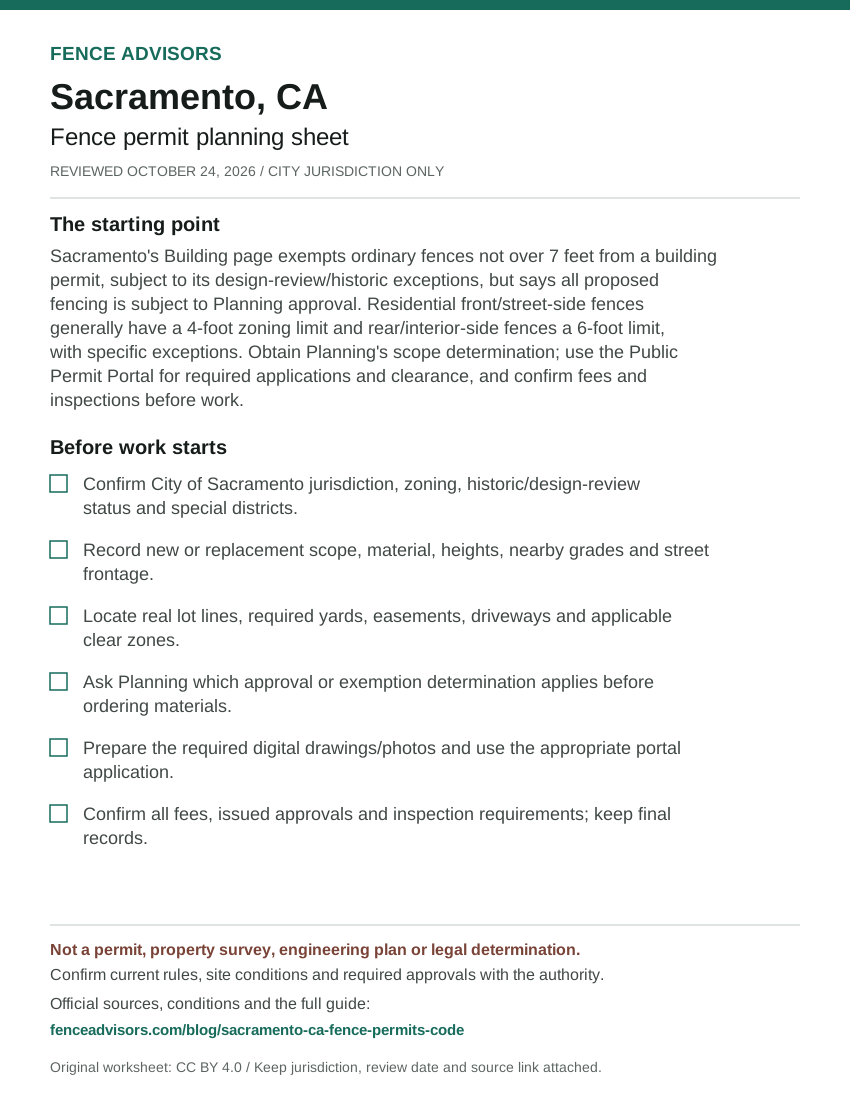
<figure>
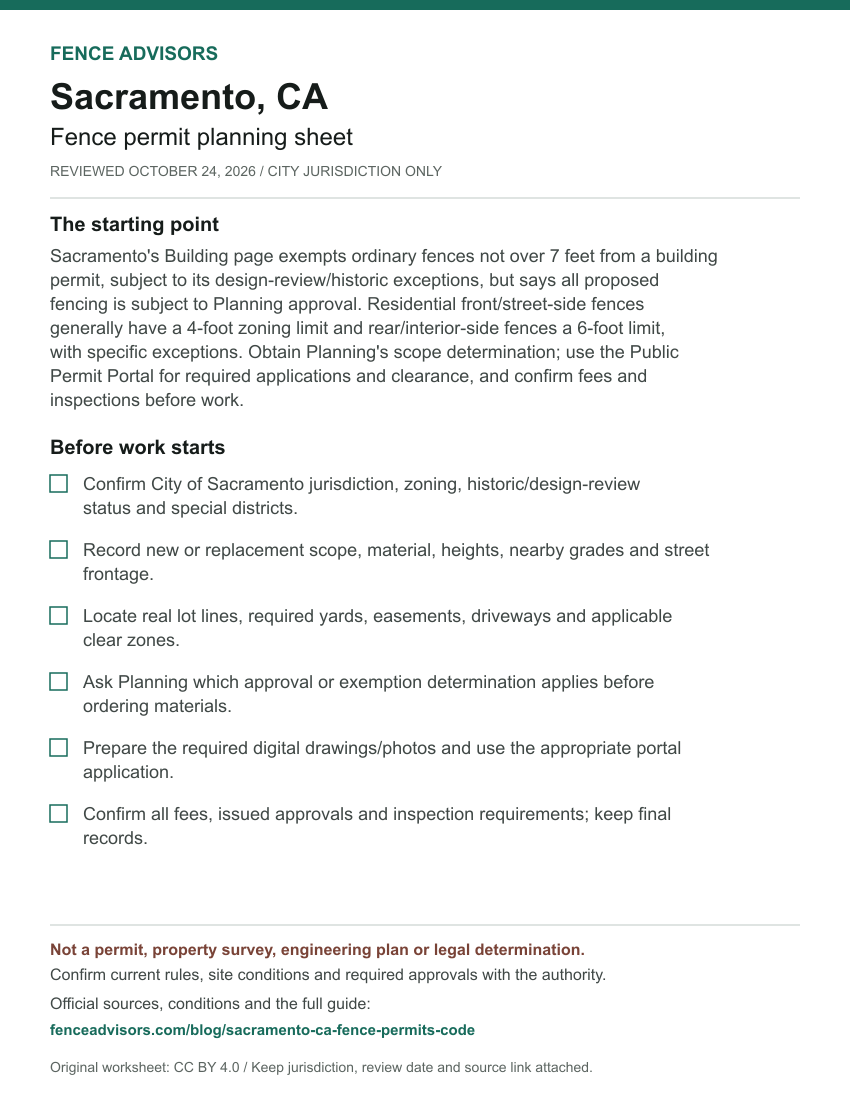
  <a href="https://fenceadvisors.com/blog/sacramento-ca-fence-permits-code"><img src="https://fenceadvisors.com/media/research/sacramento-ca-permit-cheat-sheet.svg" alt="Sacramento fence permit planning sheet: Planning approval applies; building permits depend on height and site. Six preparation checks; the complete accessible checklist and source-checked rules are in this article." width="850" height="1100" loading="lazy" style="max-width:100%;height:auto"></a>
  <figcaption>Graphic: <a href="https://fenceadvisors.com/blog/sacramento-ca-fence-permits-code">Fence Advisors</a>. Source, period and limitations are in the linked article. Original graphic: CC BY 4.0.</figcaption>
</figure>
Sacramento and California planning links
After confirming the scope, compare Sacramento contractors, use the California contractor directory for another city, and keep installed-price questions in the separate California fence cost guide.
The California fence permit navigator connects the statewide context to local guides. Los Angeles's zoning-track guide is a same-state jurisdiction alternative, not Sacramento law. The national permit navigator helps identify another state; no neighboring jurisdiction's rules substitute for this city's requirements.
Frequently Asked Questions
Is a seven-foot Sacramento fence automatically allowed without review?
No. The adopted ordinary residential building-permit exemption includes exactly seven feet, but zoning defaults can be lower and Planning approval remains applicable. Historic/design-review and special-project conditions must be checked separately. 2025 California Residential Code, January 2026 errata; Sacramento required building permits; Sacramento City Code: wall and fence regulations.
Can I use a six-foot solid fence across my front yard?
Not under the ordinary four-foot front-yard rule. The six-foot open-metal exception is material-specific; a solid wood panel is not qualifying wrought iron or tubular steel. A driveway clear zone can impose a lower limit even on qualifying open metal. Sacramento City Code: wall and fence regulations.
Does an eight-foot rear fence work whenever both neighbors agree?
No. The property-line exception requires the specified abutting school, park, alley or nonresidential use. A private agreement does not create that zoning condition or approve the fence under other applicable rules. Sacramento City Code: wall and fence regulations.
Sources and reuse
We checked the linked government guidance on October 24, 2026. The scope above and source notes identify what was verified and what still needs confirmation. This article is not an ordinance, survey, engineering design, legal opinion or permit approval. The downloadable fact sheet records each finding's source and section. Confirm current rules, fees and submission instructions with the responsible authority before ordering materials or starting work.
You may reuse our original cheat sheet with attribution to this article. Keep the review date, jurisdiction and limitations attached. Government documents remain with their original publishers. Send corrections with a source link to editorial@fenceadvisors.com.
Sources and Downloads
- Sacramento City Code: wall and fence regulations - 17.620.100 and 17.620.110; Article III sound-wall scope. Official-linked 2026 S-4 code, retrieved October 24, 2026; publisher lists Supplement 4/July 2026 and ordinance 2026-0022 passed September 15, 2026.
- Sacramento required building permits - Work exempt from permit; design-review/historic qualification; fence footnote 3. Current city page read October 24, 2026.
- 2025 California Residential Code, January 2026 errata - R105.2, Building item 2; 1.8.4.1 and 1.8.4.4; ordinary residential scope. State DGS-linked publisher, effective January 1, 2026; full relevant text read October 24, 2026.
- Sacramento current building codes and adopted local amendments - 2025 code transition; linked adopted ordinance 2025-0031, sections 3-6 and 10. Effective January 1, 2026; linked ordinance passage December 2, 2025 and signed certification visually reviewed; footer's 2026 year is inconsistent with adoption text.
- Sacramento wall and fence driveway visibility sheet - 17.620.100(C) and Exhibit A; local-street driveway clear zones. CDD-0148 revised August 18, 2021, currently linked; corroborated against code and code Exhibit A visually reviewed October 24, 2026.
- Sacramento site plan and design review code - 17.808.110-170, especially director-determined exemption scope in 17.808.160. Current official-linked code read October 24, 2026; not a project-specific exemption determination.
- Sacramento Planning applications: how to submit - Planning Permit Application versus Building Permit Clearance; Public Permit Portal. Current city instructions and actual anonymous portal entry read October 24, 2026; no authenticated submission tested.
- Sacramento electronic plan check - Planning clearance, automatic SUB record, digital submittal requirements. Current city instructions read October 24, 2026; residential minor-permit examples do not establish fence eligibility.
- Sacramento building fee information - Current fee resources, project-specific estimate and separate fee administrators. Current page, average-minor-permit list and fee-estimate instructions read October 24, 2026; no universal fence price established.
- Sacramento Planning and zoning FAQ - Land Information Lookup, special districts, historic resources and property-line limitations. Current city page read October 24, 2026; its less-than-7-foot shorthand is narrowed by the adopted CRC and Building page's not-over-7 wording.
- Sacramento City Code Chapter 15.156, Fences - Materials, maintenance and chapter-specific nonconforming-fence rules. Official-linked current code read October 24, 2026; distinct from Chapter 17.620 zoning grandfathering.
Original Fence Advisors graphics, data compilations and worksheet are available under CC BY 4.0. Retain source, period and scope when reusing data. This license does not relicense third-party documents or trademarks.
Corrections: editorial@fenceadvisors.com.
Related Research
Plan your Sacramento fence project
Confirm the approvals for your property, then compare written contractor scopes.
Get the next guide in your inbox
Fence costs, rankings, and what AI is telling homeowners — researched, no fluff.