USDA Wood Handbook, 2021 edition
Species reference averages for green-to-oven-dry wood. Not seasonal fence measurements, treated-lumber performance or recommended installation gaps.
Sources and scope checked .
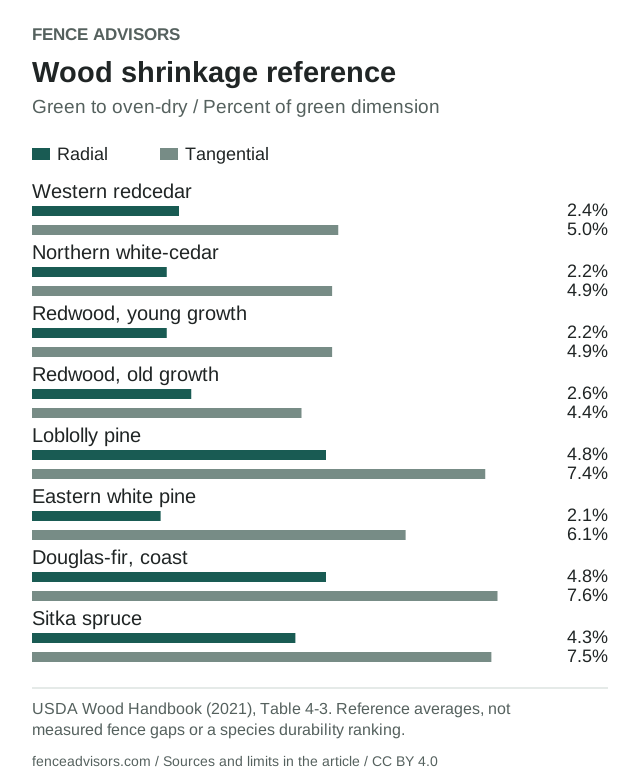
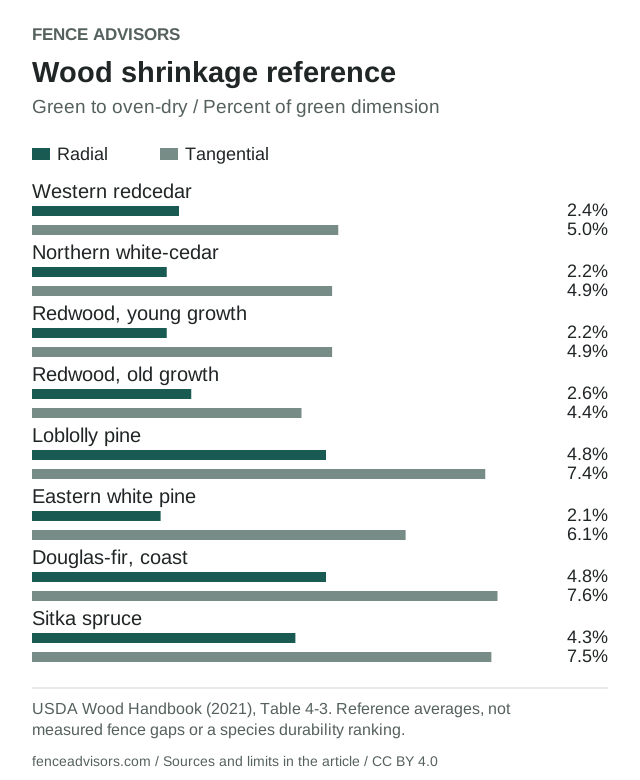
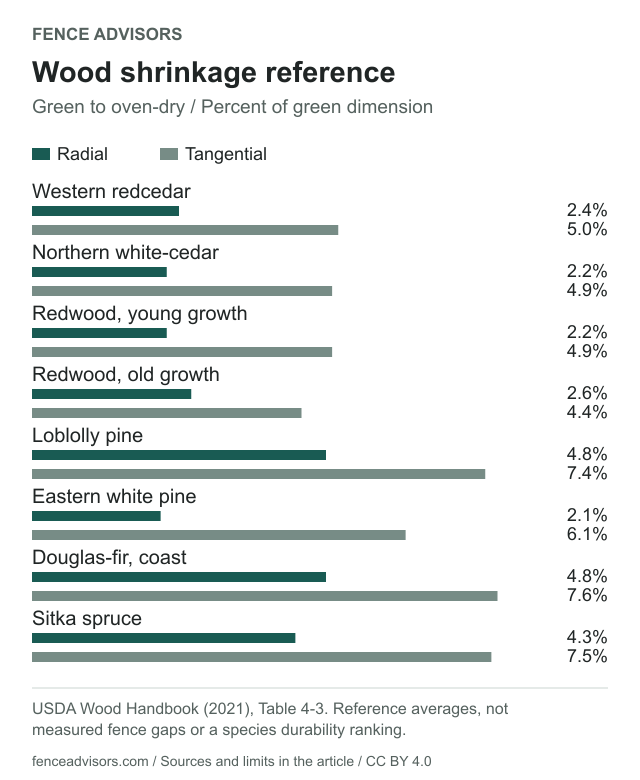
USDA's 2021 Wood Handbook lists 2.4% radial and 5.0% tangential shrinkage for western redcedar, versus 4.8% and 7.4% for loblolly pine, from green to oven-dry. These percentages are based on the green dimension. They are not ordinary seasonal fence-gap measurements. Table 4-3.
The important question is not simply which wood moves more. It is what the measurement means, which direction the board was cut, and whether the endpoints resemble the proposed installation. This reference makes the underlying wood data usable without pretending to predict every fence.
Selected wood shrinkage statistics
Download or embed this graphic
<figure>
  <a href="https://fenceadvisors.com/blog/wood-fence-shrinkage-statistics"><img src="https://fenceadvisors.com/media/research/wood-shrinkage-reference.svg" alt="USDA green-to-oven-dry radial and tangential shrinkage values for eight woods. Western redcedar is 2.4% radial and 5.0% tangential; loblolly pine is 4.8% and 7.4%." width="640" height="780" loading="lazy" style="max-width:100%;height:auto"></a>
  <figcaption>Graphic: <a href="https://fenceadvisors.com/blog/wood-fence-shrinkage-statistics">Fence Advisors</a>. Source, period and limitations are in the linked article. Original graphic: CC BY 4.0.</figcaption>
</figure>| Species or source grouping | Radial shrinkage | Tangential shrinkage |
|---|---|---|
| Western redcedar | 2.4% | 5.0% |
| Northern white-cedar | 2.2% | 4.9% |
| Redwood, young growth | 2.2% | 4.9% |
| Redwood, old growth | 2.6% | 4.4% |
| Loblolly pine | 4.8% | 7.4% |
| Eastern white pine | 2.1% | 6.1% |
| Douglas-fir, coast | 4.8% | 7.6% |
| Sitka spruce | 4.3% | 7.5% |
Source: USDA Forest Products Laboratory, Wood Handbook (2021), Table 4-3. These are reference species averages, green to oven-dry, not Fence Advisors tests. Coast Douglas-fir is the source's geographic grouping; young- and old-growth redwood remain separate. Loblolly is a species, not a measurement of every board marketed as treated Southern pine.
Radial, tangential and lengthwise movement differ
Radial movement crosses the growth rings; tangential movement follows their direction. A board's growth-ring orientation determines how these directions relate to its width and thickness. The table is not a license to apply the tangential number to every face dimension. Normal lengthwise movement is a separate direction. USDA Chapter 4, dimensional stability.
A reference average also cannot describe all boards. Grain orientation, reaction wood, initial moisture, drying history and the particular piece affect movement. The species buying guide addresses material choice; this table addresses a defined physical measurement, not a durability ranking.
Why a 5% reference is not a seasonal gap prediction
For the full reference endpoint only, 5.0% of a 5.5-inch green tangential dimension is 0.275 inch. That arithmetic illustrates the denominator. It does not predict a 0.275-inch opening in an installed fence: outdoor wood normally does not become oven-dry, and a real board may not be oriented in the tangential direction.
Wood exchanges moisture with its environment, influenced by humidity and temperature. Water removal and dimensional change are not proportional across every moisture state. Do not linearly apply the full table to an arbitrary outdoor humidity change or treat one assumed fiber-saturation percentage as a universal measured board condition. USDA wood-moisture discussion.
For the same reason, green-to-oven-dry percentages cannot establish a recommended picket gap. The relevant installation instructions, measured board moisture, assembly and local requirements need to determine that detail.
What a fence owner can actually record
| Record | Why it helps the decision |
|---|---|
| Exact species and grade | A marketing name may combine species or grades |
| Actual width and thickness from several boards | Nominal dimensions are not guaranteed coverage |
| Moisture readings and meter settings | One surface touch or elapsed day count is not the wood's internal condition |
| Date, weather and storage conditions | Measurements need context |
| Installed gap/overlap and end detail | Layout affects whether movement reveals a sightline |
| Approved finish and application instructions | A finish is not a guarantee of zero dimensional movement |
This is an original observation checklist, not a prescription for a meter, wood-moisture threshold or installation gap. The picket quantity model uses the width entered; it does not automatically apply this shrinkage table to future board sizes.
Connection to staining and maintenance
The staining guide distinguishes a coating manufacturer's moisture requirement from a fixed waiting period. For example, Ready Seal's current technical sheet calls for product-specific preparation and consistently low moisture readings, not a universal wait of three or six months. That is an application requirement for that finish, not a moisture-movement law for every wood.
Avoid fastening an entire assembly on the assumption that a finish stops movement. Ask the installer to explain the selected pattern, compatible fasteners, end treatment and product instructions in the written bid. Use the quote worksheet or find a local fence company for a site-specific answer.
Methodology and citation
This selected excerpt was checked against Table 4-3 on October 3, 2026. Only eight identified species/groupings are compiled; this is not the complete handbook. The original chart and CSV retain direction, endpoint and denominator. We do not claim to have tested treated pickets, collected field failures or measured seasonal change.
Suggested citation: Fence Advisors, Wood Fence Shrinkage Statistics, October 3, 2026, selected USDA Wood Handbook (2021), Table 4-3, green-to-oven-dry radial/tangential shrinkage. Keep that endpoint when reusing a statistic; omitting it changes the claim.
Frequently Asked Questions
Does cedar fencing shrink 5% outdoors?
The 5.0% western redcedar figure is a tangential green-to-oven-dry reference average, not a measured outdoor seasonal change. Board orientation and actual moisture conditions matter.
Can I use these percentages to set picket gaps?
No. They do not specify installation gaps. Use the actual product instructions and site-specific assembly design, and record board dimensions and moisture condition.
Is treated pine the same as the loblolly row?
No. The row identifies loblolly pine reference wood. A treated-lumber product can involve other species, preservatives, retention levels and moisture histories.
Sources and Downloads
Original Fence Advisors graphics, data compilations and worksheet are available under CC BY 4.0. Retain source, period and scope when reusing data. This license does not relicense third-party documents or trademarks.
Corrections: editorial@fenceadvisors.com.
Related Research
Put your research to work
Estimate your budget, then compare fence companies in your area.
Get the next guide in your inbox
Fence costs, rankings, and what AI is telling homeowners — researched, no fluff.