Original calculations, October 2026; USDA dimension reference, 2021
Original quantity model for measured board widths and specified layouts. Not installation statistics, structural design, or a guaranteed supplier order.
Sources and scope checked .
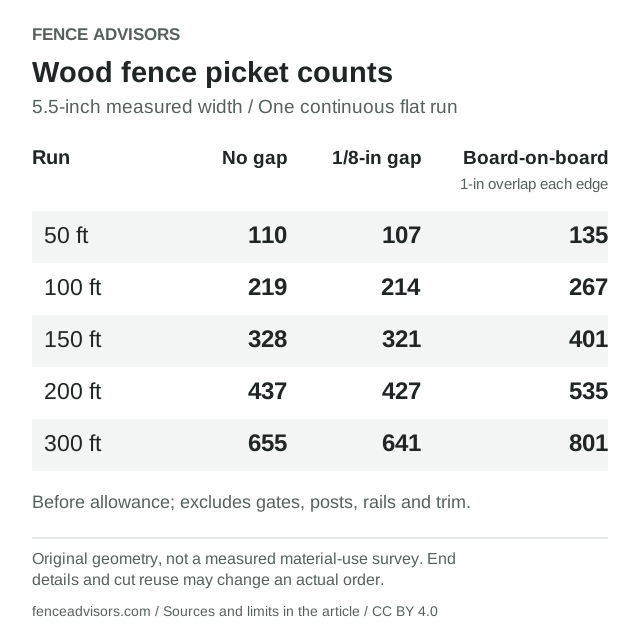
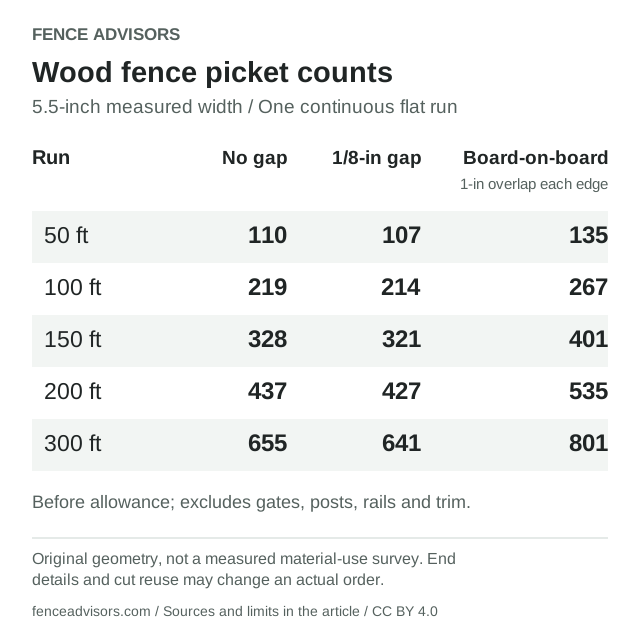
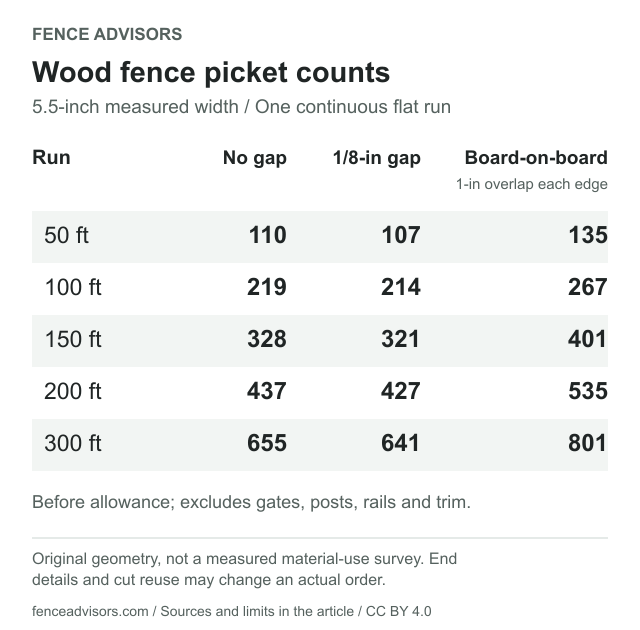
For 100 feet of continuously boarded fence with 5.5-inch-wide pickets, our side-by-side model with no gap needs 219 pickets before waste. The defined board-on-board layout with 1-inch overlap at each cover-board edge needs 267. Those are geometric calculations, not an observation of what a contractor used or a structural design.
Measure each boarded run separately before ordering. Compare materials in the wood species guide, and use the cost calculator for installed-price planning. A picket count alone does not establish a finished project price.
Wood fence picket count chart
Download or embed this graphic
<figure>
  <a href="https://fenceadvisors.com/blog/wood-fence-picket-count-chart"><img src="https://fenceadvisors.com/media/research/wood-picket-counts.svg" alt="Calculated picket counts for 50 to 300 feet with 5.5-inch boards: side-by-side, 1/8-inch gaps and board-on-board with 1-inch overlap. Counts exclude waste, gates, rails and posts." width="640" height="630" loading="lazy" style="max-width:100%;height:auto"></a>
  <figcaption>Graphic: <a href="https://fenceadvisors.com/blog/wood-fence-picket-count-chart">Fence Advisors</a>. Source, period and limitations are in the linked article. Original graphic: CC BY 4.0.</figcaption>
</figure>| Boarded run | Side-by-side, no gap | Side-by-side, 1/8-inch gap | Board-on-board, 1-inch overlap |
|---|---|---|---|
| 50 ft | 110 | 107 | 135 |
| 100 ft | 219 | 214 | 267 |
| 150 ft | 328 | 321 | 401 |
| 200 ft | 437 | 427 | 535 |
| 300 ft | 655 | 641 | 801 |
Assumptions: measured width 5.5 inches; one flat continuous run; gates and non-boarded openings excluded; no waste, cut reuse, corner trim, caps, rails, posts or decorative layers. Counts are rounded up by run. Gap and overlap values are comparison scenarios, not spacing recommendations. Source: original Fence Advisors arithmetic, with the dimensions caveat from USDA Chapter 6, Table 6-6.
Calculate a measured run
Picket quantity
- Before allowance
- 219 pickets
- With chosen allowance
- 219 pickets
The calculator uses the same formulas as the downloadable table. Enter net boarded length, not a property perimeter that still includes driveway gates or a wall. Repeat for separate spans when end details prevent sharing an offcut. The additional allowance is your chosen purchasing assumption, not a measured national waste rate.
Side-by-side formula
Board count = round up [(run inches + gap inches) / (board width + gap inches)]. There are one fewer interior gaps than boards, which is why the numerator includes one gap. At zero gap, this becomes round up(run inches / measured width).
For 100 feet, 1,200 / 5.5 = 218.18, rounded to 219. If you choose a 10% extra-board allowance, round up(219 x 1.10) = 241 order boards. The 10% is an illustrative choice. Rejects, dog-ear cuts, terrain and return policies can justify a different allowance; ask the installer rather than treating this example as a rule.
Board-on-board formula and overlap
Download or embed this graphic
<figure>
  <a href="https://fenceadvisors.com/blog/wood-fence-picket-count-chart"><img src="https://fenceadvisors.com/media/research/wood-picket-layout.svg" alt="Plan view of a 5.5-inch base board, a 3.5-inch gap and a 5.5-inch cover board overlapping each neighboring base board by 1 inch." width="640" height="480" loading="lazy" style="max-width:100%;height:auto"></a>
  <figcaption>Graphic: <a href="https://fenceadvisors.com/blog/wood-fence-picket-count-chart">Fence Advisors</a>. Source, period and limitations are in the linked article. Original graphic: CC BY 4.0.</figcaption>
</figure>
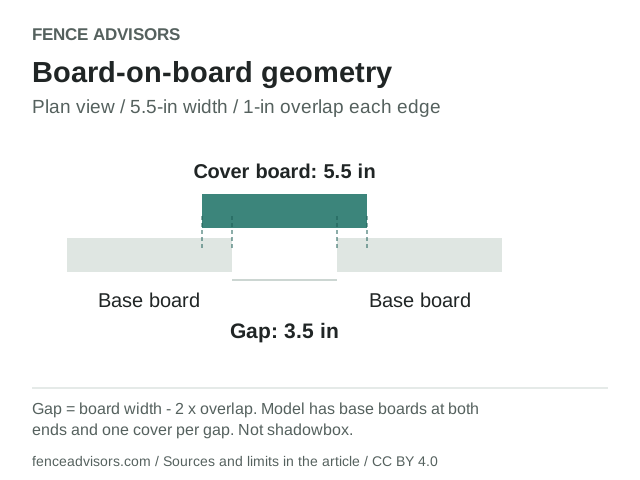
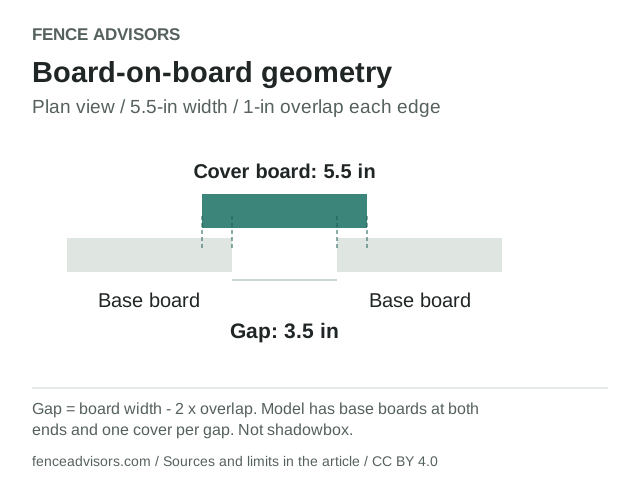
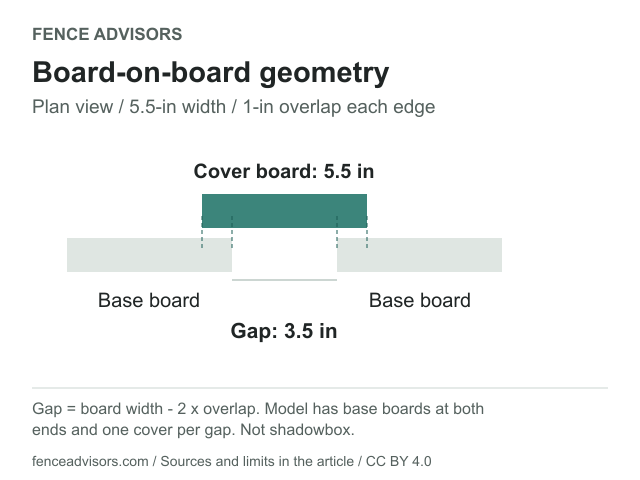
Our model has base boards in one plane and a cover board bridging each gap. Let b be measured board width and o be overlap on each edge. The base-row gap is b - 2o, and its repeating pitch is 2(b - o).
Base boards = round up [(run inches + base gap) / (board width + base gap)]. Cover boards = base boards - 1. Total = base boards + cover boards. The modeled run begins and ends with a base board, with the final module cut or adjusted to the actual boundary. A panel kit, different end treatment or short return can use a different count. This is a planning model, not a cutting schedule.
At b = 5.5 and o = 1, the base gap is 3.5 inches. A 100-foot run gives round up(1,203.5 / 9) = 134 base boards, 133 cover boards and 267 total. Do not use this formula for alternating-side shadowbox, double-sided solid fencing, proprietary interlocking boards or horizontal layouts.
Nominal size is not measured coverage
| Standard dressed-dry reference | Thickness | Width |
|---|---|---|
| 1 x 4 | 0.75 in | 3.5 in |
| 1 x 6 | 0.75 in | 5.5 in |
| 2 x 4 | 1.5 in | 3.5 in |
| 4 x 4 | 3.5 in | 3.5 in |
| 6 x 6 | 5.5 in | 5.5 in |
Source: USDA Wood Handbook, Table 6-6. This is a standard reference for dressed-dry lumber, not every fence picket sold as 1 x 6. Rough-sawn, green, proprietary and specially surfaced products can differ. A 5.75-inch picket is not interchangeable with our 5.5-inch example.
Measure several boards from the intended product, record moisture condition, and confirm the supplier's actual face width. Read the wood shrinkage reference before assuming that today's tightly fitted green boards will retain the same coverage after drying.
Turn the count into an order
- Confirm style, height, species, grade, actual thickness/width, finish and acceptable defects.
- Separate line-fence boards from gate infill, trim, top caps and repair stock.
- Specify posts, rails, fasteners and approved footing detail separately; a picket count cannot size them.
- Record your allowance, return policy, bundle quantity and which offcuts can actually be reused.
- Ask for written substitutions rather than allowing a narrower board to silently change the takeoff.
Use the supplier RFQ template to obtain a comparable material price and the buyer worksheet to compare installed bids. Find fence suppliers or local contractors when you need a product or site-specific quantity confirmed.
Methodology and reuse
Fence Advisors created the formulas, scenarios and diagrams in October 2026. Values are generated from one stored set of assumptions; no purchasing survey or popularity statistic is claimed. Cite this article with the measured-width and layout assumptions, not just a number of pickets per foot. SVG, PNG and CSV downloads are ungated.
Frequently Asked Questions
How many 1 x 6 pickets do I need for 100 feet?
If the measured width is 5.5 inches and the boarded run has no gaps, our model gives 219 before any extra allowance. A nominal 1 x 6 label alone is insufficient; measure the actual product.
Does board-on-board use twice as many pickets?
Not in this defined layout. A 100-foot run uses 267 versus 219 side-by-side at 5.5-inch width and 1-inch cover overlap. Different overlap, end details or a truly double-sided solid fence changes the result.
Are posts, gates and waste included?
No. The chart is a line-fence picket count before waste. The calculator adds only the allowance you enter; gate infill, structural components and trim remain separate.
Sources and Downloads
Original Fence Advisors graphics, data compilations and worksheet are available under CC BY 4.0. Retain source, period and scope when reusing data. This license does not relicense third-party documents or trademarks.
Corrections: editorial@fenceadvisors.com.
Related Research
Put your research to work
Estimate your budget, then compare fence companies in your area.
Get the next guide in your inbox
Fence costs, rankings, and what AI is telling homeowners — researched, no fluff.