CLFMI March 2017 manual; reviewed October 4, 2026
Selected CLFMI March 2017 fabric coating references. Mass and thickness are different measurements; published metric rounding retained. No comparison of corrosion life across different materials or current-standard certification.
Sources and scope checked .
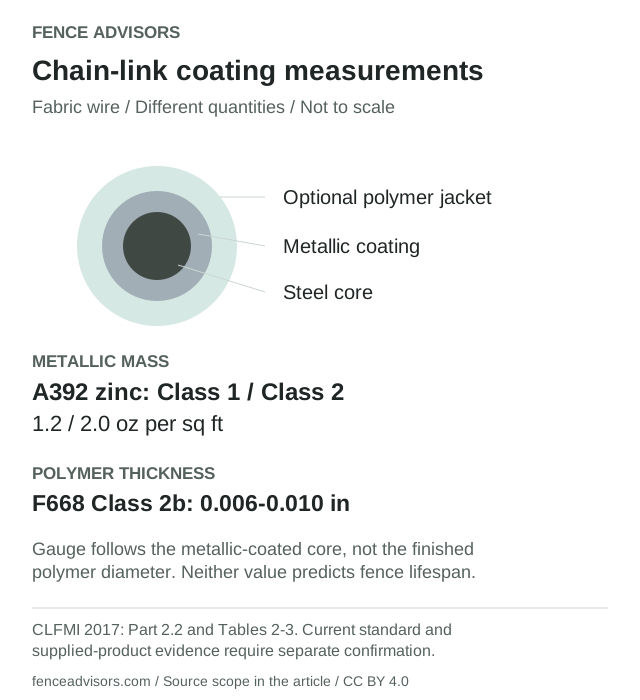
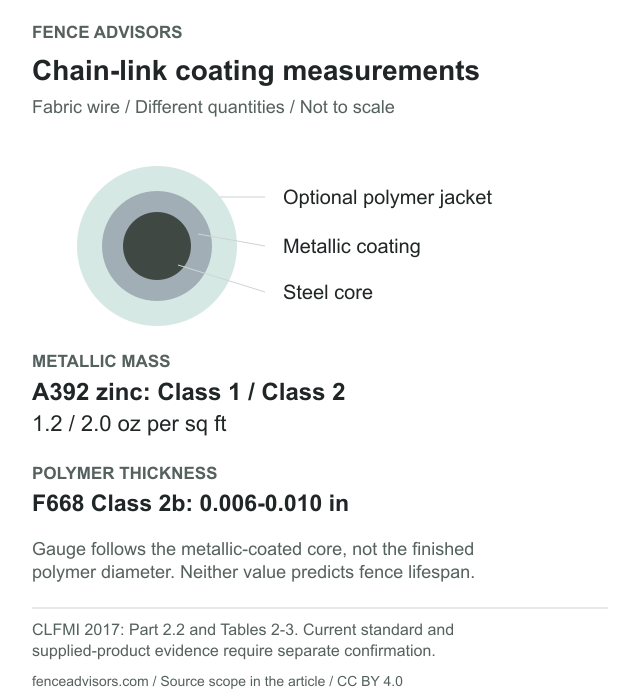
Chain-link coating mass, polymer thickness and wire gauge are three different specifications. A zinc coating class describes metallic coating mass; an F668 polymer class describes a process and thickness range; the fabric gauge refers to its metallic-coated core. A quote that only says "black vinyl-coated chain link" leaves important questions unanswered. CLFMI Product Manual, March 2017, Tables 2-3 and Part 2.2.
Use this reference to ask a supplier precise questions, not to certify current stock. The numbers below are from the March 2017 public manual, checked October 4, 2026. We did not review every full current ASTM standard or test a product's corrosion resistance.
Metallic coating reference
The March 2017 CLFMI manual lists A392 Class 1 zinc coating at 1.2 oz/sq ft and Class 2 at 2.0 oz/sq ft, with published equivalents of 366 and 610 g/sq m. CLFMI Product Manual, revised March 2017.
| Referenced standard | Fabric-wire coating | Class | Mass, oz/sq ft | Published g/sq m |
|---|---|---|---|---|
| A392 | Zinc-coated steel fabric | 1 | 1.2 | 366 |
| A392 | Zinc-coated steel fabric | 2 | 2.0 | 610 |
| F1345 | Zinc-5% aluminum-mischmetal alloy-coated steel fabric | 1 | 0.6 | 183 |
| F1345 | Zinc-5% aluminum-mischmetal alloy-coated steel fabric | 2 | 1.0 | 305 |
Source: CLFMI Part 2.2(A)(1)-(3). Published rounded metric values are retained. These are coating masses on the fabric wire, not the weight of a roll or the thickness of a polymer jacket. Compare classes within the same coating specification; a larger mass across different coating materials is not a demonstrated durability ranking.
The manual also identifies A491 aluminized steel fabric. That means aluminum-coated steel, not solid aluminum wire. We do not attach a fabric coating-mass value from a different component's specification: the manual's aluminized tension-wire requirement is not automatically a fabric requirement.
Polymer coating classes
CLFMI Table 2 gives polymer thickness ranges of 0.015-0.025 inch for F668 Classes 1 and 2a, and 0.006-0.010 inch for Class 2b. CLFMI Product Manual, revised March 2017.
| F668 class | Process in the reference | Minimum at a point | Maximum at a point | Published metric range |
|---|---|---|---|---|
| 1 | Extruded | 0.015 in | 0.025 in | 0.38-0.64 mm |
| 2a | Extruded and adhered | 0.015 in | 0.025 in | 0.38-0.64 mm |
| 2b | Fused and adhered | 0.006 in | 0.010 in | 0.15-0.25 mm |
Source: CLFMI Table 2 and Part 2.2(A)(4). The thinner listed Class 2b range does not prove it is worse than Class 1: the application processes differ. This table does not turn thickness into service life, abrasion resistance, warranty coverage or a current purchase approval.
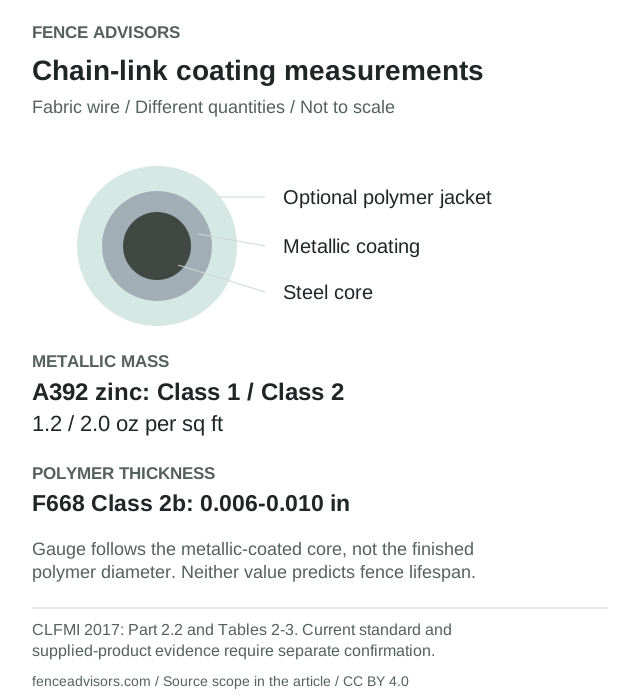
Download or embed this graphic
<figure>
  <a href="https://fenceadvisors.com/blog/chain-link-coating-specifications"><img src="https://fenceadvisors.com/media/research/chain-link-coating-layers.svg" alt="Conceptual steel core, metallic coating and optional polymer coating. A392 Class 1 and 2 zinc coating masses are 1.2 and 2.0 oz per square foot; polymer thickness and core-wire gauge are separate measurements." width="640" height="700" loading="lazy" style="max-width:100%;height:auto"></a>
  <figcaption>Graphic: <a href="https://fenceadvisors.com/blog/chain-link-coating-specifications">Fence Advisors</a>. Source, period and limitations are in the linked article. Original graphic: CC BY 4.0.</figcaption>
</figure>
Core wire is not finished diameter
The CLFMI manual specifies polymer-coated fabric gauge by the metallic-coated core wire, not the finished polymer-coated diameter. CLFMI Product Manual, revised March 2017.
A caliper reading across the finished polymer coating answers a different question from core-wire diameter. Ask the supplier for the stated core gauge/diameter and coating class, rather than trying to infer both from an outer measurement. Use the separate chain-link wire gauge reference for the manual's diameter table and mesh definition.
Fabric does not specify the whole fence. Posts, rails, fittings, ties, tension wire, gates, height and site loading still need their own requirements. None of the coating entries is an installed fence wind or security rating.
Put the coating requirements in the quote
| Quote field | What to record | What not to substitute |
|---|---|---|
| Exact fabric product | Manufacturer, SKU and applicable standard/edition | Color alone |
| Core wire | Specified metallic-coated core gauge or diameter | Finished polymer diameter |
| Metallic coating | Material, class and required evidence | A weight from another component |
| Polymer coating | Process/class, color and specified thickness limits | A generic "vinyl coated" label |
| Fabric geometry | Height, mesh opening and selvage | A coating class |
| Framework and fittings | Exact matching system requirements | Fabric requirements applied to every part |
| Documentation | Supplier confirmation, certification requested and date | An unsupported "ASTM compliant" phrase |
These are original purchasing questions, not a complete design specification. Attach them to a supplier RFQ, confirm permitted substitutions in writing, and have the actual project requirements checked by the responsible professional. Find fence suppliers for product-specific documentation or local fence contractors for the installed scope.
Methodology and reuse
Fence Advisors reviewed the cited tables and fabric clauses in the first 30 of the manual's 34 retrieved PDF pages. 2017 is the source edition; October 4, 2026 is our review date. The original diagram is not to scale. The CSV separates quantities and units; the citation ledger connects each finding to a visible section and its source locator. Cite the edition and limitation with the number. No coating-life multiplier or original testing is claimed.
Frequently Asked Questions
Is Class 2 zinc coating twice as durable as Class 1?
This reference does not establish that. The 2017 manual lists 2.0 versus 1.2 oz/sq ft, not a two-times corrosion-life result. Exposure and the actual product matter.
Does black chain link always have the same polymer coating?
No specific class follows from the color alone. Ask for the exact F668 class, core wire and applicable product specification.
Can I use these values as a current ASTM certification?
No. They are an edition-specific public reference. Confirm the current standard, project specification and actual supplied-product evidence separately.
Sources and Downloads
- Fabric coating classes, units and source locatorsCSV
- Citable findings, source URLs and boundariesCSV
- Sourcebook, document dates and methodologyJSON
Original Fence Advisors graphics, data compilations and worksheet are available under CC BY 4.0. Retain source, period and scope when reusing data. This license does not relicense third-party documents or trademarks.
Corrections: editorial@fenceadvisors.com.
Related Research
Put your research to work
Estimate your budget, then compare fence companies in your area.
Get the next guide in your inbox
Fence costs, rankings, and what AI is telling homeowners — researched, no fluff.