Manufacturer and AWPA guidance checked October 2026
Source-linked material compatibility questions, not a universal fastener approval, engineering specification or corrosion-life guarantee.
Sources and scope checked .
A fastener marked galvanized is not enough information to confirm compatibility with a fence. Record the wood species and preservative, the exposure, and the actual connector/fastener product instructions. Simpson Strong-Tie explicitly distinguishes service conditions and coating methods; AWPA treatment tags identify different use categories and preservative retentions. Simpson guidance; AWPA homeowner reference.
This is a purchasing reference, not an engineer-approved fastening schedule. It helps owners and contractors ask for the evidence behind a substitution rather than assuming that all exterior screws, stainless alloys or treated boards are interchangeable.
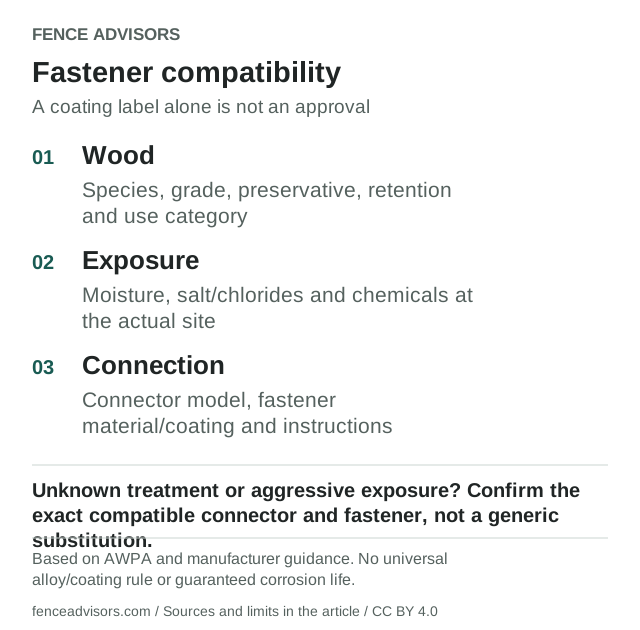
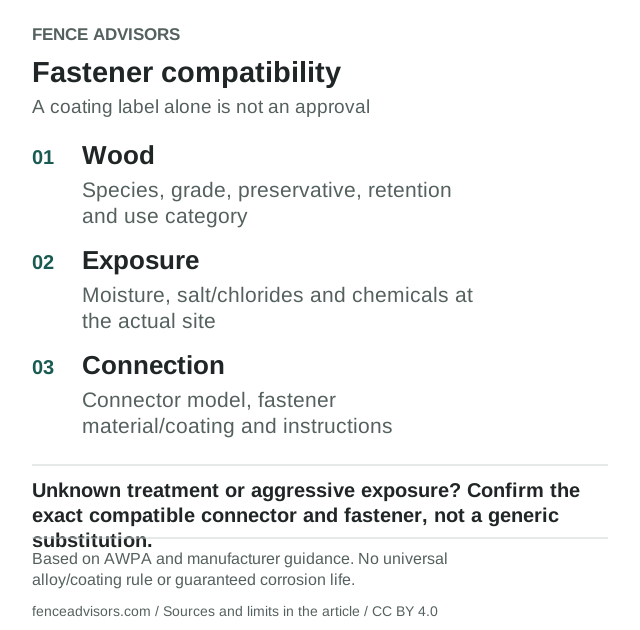
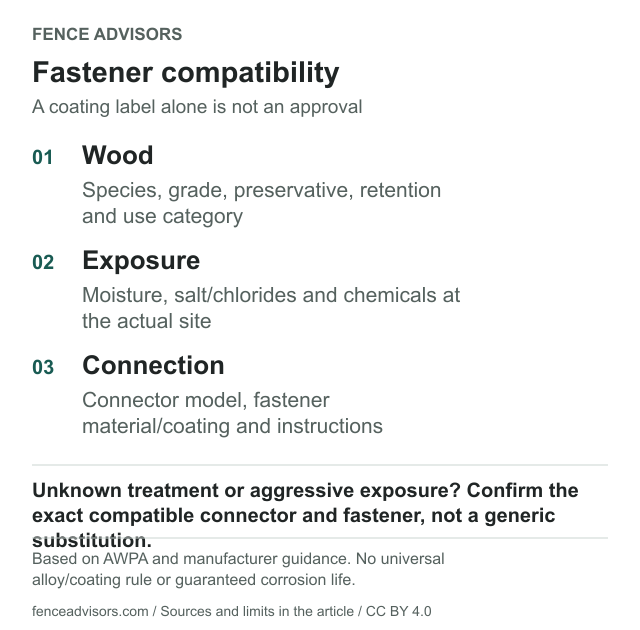
Three inputs before selecting fence fasteners
Download or embed this graphic
<figure>
  <a href="https://fenceadvisors.com/blog/fence-fastener-corrosion-reference"><img src="https://fenceadvisors.com/media/research/fence-fastener-selection.svg" alt="Fastener selection requires three inputs: wood species/treatment, site exposure and connector/fastener product instructions. Unknown treatment or salt exposure requires confirmation, not an automatic coating substitution." width="640" height="630" loading="lazy" style="max-width:100%;height:auto"></a>
  <figcaption>Graphic: <a href="https://fenceadvisors.com/blog/fence-fastener-corrosion-reference">Fence Advisors</a>. Source, period and limitations are in the linked article. Original graphic: CC BY 4.0.</figcaption>
</figure>| Input | What to record | What not to assume |
|---|---|---|
| Wood | Species, treatment name, use category and retention on end tag | Green-looking wood identifies a preservative |
| Exposure | Wetting, drainage, ground contact, salt air/splash and chemicals | Every outdoor site is the same exposure |
| Connection | Exact connector and fastener model, coating/alloy, diameter and required installation | A coating approval also proves structural capacity |
This checklist is Fence Advisors' synthesis of AWPA and manufacturer corrosion guidance. It is not a copy of a product approval table. Unknown wood treatment or exposure calls for confirmation with the treating/fastener supplier, not an automatic low-cost alternative.
UC3B, UC4A and retention are different fields
AWPA's public guide identifies UC3B as exterior above-ground, uncoated or poor runoff, and UC4A as general-use ground contact. More demanding exposures can require other categories. Its U1-25 excerpt also warns that some above-ground applications have ground-contact-type hazards. A post sunk in soil should not be specified from a generic above-ground board label. AWPA guide and U1-25; public excerpt.
The category describes exposure. Retention describes the amount of preservative and depends on the actual preservative and commodity. Do not transfer a pounds-per-cubic-foot number from one treatment to another or claim that a higher number alone is a stronger structural grade. Ask the lumber supplier for the end-tag photograph and applicable product guidance.
Hot-dip galvanized is not the same as electroplated
Simpson's FAQ distinguishes hot-dip galvanizing from electroplated and mechanical processes. Sheet-steel coating designations, fastener coatings and proprietary products are not one universal interchangeable scale. A connector's coating name does not establish which nail or screw belongs in it. Manufacturer FAQ.
For a substitution, request a written product compatibility statement covering the wood and exposure. The connection must also use the specified fastener type, diameter, length and installation. A corrosion-resistant screw can still be an inappropriate replacement for a specified connector fastener.
Cedar and stainless steel need context
The Western Red Cedar Lumber Association's decking guidance favors stainless fasteners, allows suitable hot-dipped galvanized choices, and warns against electroplated fasteners and copper nails because of staining/reaction concerns. We apply the material-compatibility caution here, not its decking nail lengths to fence pickets. Real Cedar fastener guidance.
Simpson describes Type 316's improved resistance in high-chloride environments and identifies 304/305/316 in treated-wood applications. That does not make every unspecified stainless product acceptable in every coastal connection. Confirm the grade and the entire assembly, including contact between different metals. Treated-wood FAQ.
This is a useful distinction from the metal fence rust guide: surface cleaning or paint maintenance cannot retroactively prove that an incompatible original connection is adequate.
Fastener purchasing checklist
- Photograph the lumber treatment tag and record actual species/grade.
- Identify ground contact, trapped moisture, salt exposure and nearby chemical sources.
- Specify the exact fastener and connector models, not just stainless or galvanized.
- Obtain compatible coating/alloy and connection instructions from the relevant manufacturer.
- Check whether the supplier's proposed substitute changes diameter, head, shank, length or installation.
- Retain the supplier response, invoice, packaging and instruction revision with the project record.
Download the blank CSV below and attach it to the supplier RFQ. When comparing installed offers, use the buyer worksheet to keep fastening details visible instead of buried in a material price.
Limits and maintenance
This reference does not predict years to corrosion, certify a connection or list every treatment system. Simpson's recommendations concern its evaluated products and conditions; the exact product instructions control. AWPA durability classifications do not prove local code approval. A finish on the wood is not a license to reduce specified corrosion protection.
If existing fasteners are corroding, connections are loose or wood is split around a structural connection, have the actual assembly assessed. Changing visible picket fasteners alone may not address the underlying post/rail or gate connection. Find a contractor or material supplier and ask for a written, product-specific answer.
Frequently Asked Questions
Can I use any galvanized screw in treated fence lumber?
No. Galvanizing method, treatment/retention, exposure and the fastener/connector instructions matter. A generic galvanized label does not prove compatibility or structural suitability.
Is stainless steel always the same grade?
No. Alloy grades and product specifications differ. Manufacturer guidance distinguishes grades and exposure, including chloride conditions; confirm the selected product rather than relying on the word stainless.
Does UC4A identify which fastener to buy?
Not by itself. It identifies a wood-use category. The preservative, retention, exposure and connection product guidance are also needed.
Sources and Downloads
- AWPA homeowner guide
- AWPA U1-25 public excerpt
- Simpson Strong-Tie material/coating selection
- Simpson Strong-Tie preservative-treated wood FAQ
- WRCLA Real Cedar fastener recommendations (decking context)
Original Fence Advisors graphics, data compilations and worksheet are available under CC BY 4.0. Retain source, period and scope when reusing data. This license does not relicense third-party documents or trademarks.
Corrections: editorial@fenceadvisors.com.
Related Research
Put your research to work
Estimate your budget, then compare fence companies in your area.
Get the next guide in your inbox
Fence costs, rankings, and what AI is telling homeowners — researched, no fluff.