AWPA homeowner guidance and U1-25 (2025) excerpt; reviewed October 4, 2026
Selected public category and retention references. Not all current commodity specifications or a prescription for an unknown product. Treatment does not replace a structural grade or establish a service life.
Sources and scope checked .
Read the use category, preservative, retention, species and treatment specification together. A greenish color, the words "pressure treated" or a retention number alone cannot tell you whether a board fits its intended exposure. Treatment also does not replace the lumber's grade or an approved fence design. AWPA homeowner guidance; AWPA Use Category System.
The most useful distinction is service conditions, not simply whether a piece is currently touching dirt. The cited U1-25 excerpt is from 2025, reviewed October 4, 2026; it is not our review of the full current Book of Standards or every commodity specification.
Use category reference
AWPA identifies UC3B with exposed exterior above-ground use and UC4A with general ground-contact exposure; the required category depends on service conditions and the commodity specification. AWPA U1-25 public excerpt. AWPA Use Category System overview.
| Category | Short service-condition description | Boundary to check |
|---|---|---|
| UC3A | Protected exterior above-ground exposure | Coating/rapid drainage or continuously protected construction conditions matter; not just any painted board. |
| UC3B | Exposed exterior above-ground use | Check Commodity Specification A exceptions that require ground-contact treatment for some above-ground sawn components. |
| UC4A | General ground-contact exposure | Includes qualifying above-ground hazards; commodity, species and treatment requirements still matter. |
| UC4B | Heavy-duty ground-contact exposure | Severe environments or critically important components; not automatically required for every residential fence. |
| UC4C | Extreme-duty ground-contact exposure | Very severe exposure or critical applications; not a universal service-life promise. |
Sources: AWPA U1-25 Section 2 and Using the UCS. These are selected descriptions, not a universal prescription for every fence component. AWPA's selection process connects service conditions to commodity, species and preservative requirements. UC3A is not achieved merely by applying paint to otherwise unspecified lumber.
Above ground does not always mean UC3B
AWPA U1-25 requires ground-contact treatment for some physically above-ground sawn components, including specified difficult-to-replace critical components or ground-contact-like hazards. AWPA U1-25 public excerpt.
For Commodity Specification A, the cited UC4A note describes circumstances such as expected debris/soil accumulation, restricted air circulation, recurrent wetting and certain low-clearance construction conditions. It also addresses difficult-to-maintain, repair or replace components that are critical to system performance and safety. These are contextual conditions, not permission to reduce the specification to "any board above soil is UC3B." U1-25, UC4A Note 1.
Ask the specifier or product supplier which commodity and use-category requirements apply to the actual fence. Do not assume every rail needs the same treatment, or that raising a critical component a few inches resolves every exposure hazard. The cited note's low-clearance condition includes construction and moisture-separation qualifications; height alone is not the complete rule.
Retention number examples
AWPA's Southern-pine homeowner table lists CA-C nominal retentions of 0.060 for UC3B, 0.15 for UC4A and 0.31 for UC4B, in pounds of active ingredient per cubic foot of wood. AWPA homeowner guidance.
| Preservative | UC3B | UC4A | UC4B |
|---|---|---|---|
| CA-C: Copper azole, Type C | 0.060 | 0.15 | 0.31 |
| MCA: Micronized copper azole | 0.060 | 0.15 | 0.31 |
| ACQ B/C: Alkaline copper quaternary, Type B or C | 0.25 | 0.40 | 0.60 |
| ACQ A/D: Alkaline copper quaternary, Type A or D | 0.15 | 0.40 | 0.60 |
Units: pounds of active ingredient per cubic foot of wood. Species scope: Southern pine in the cited homeowner table. Source: AWPA preservative table. These are identified preservative/category combinations, not interchangeable chemical doses, percentages or numbers for all wood species.
Do not rank different preservatives by the larger number: CA-C at 0.15 and ACQ Type B/C at 0.40 are not a controlled head-to-head test. Nor does an applicable retention number establish a service-life guarantee, safe load or compliance of the completed fence.
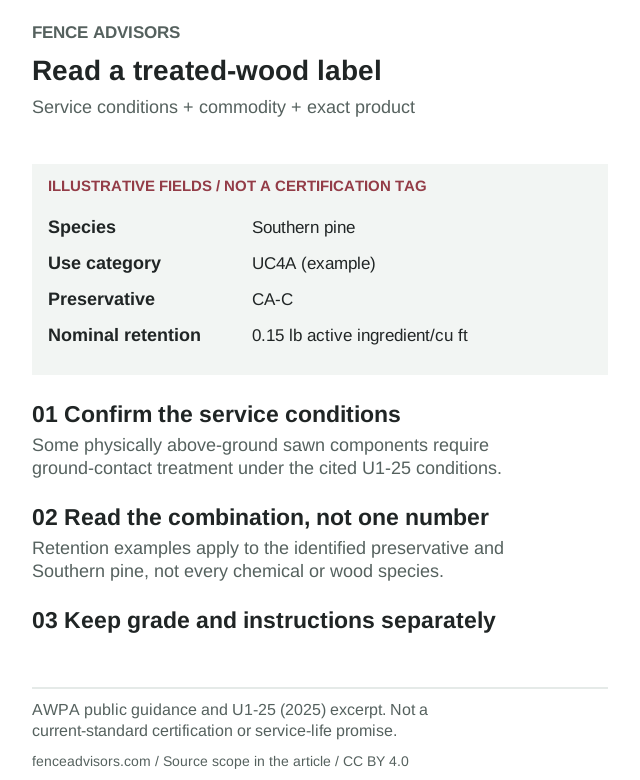
Download or embed this graphic
<figure>
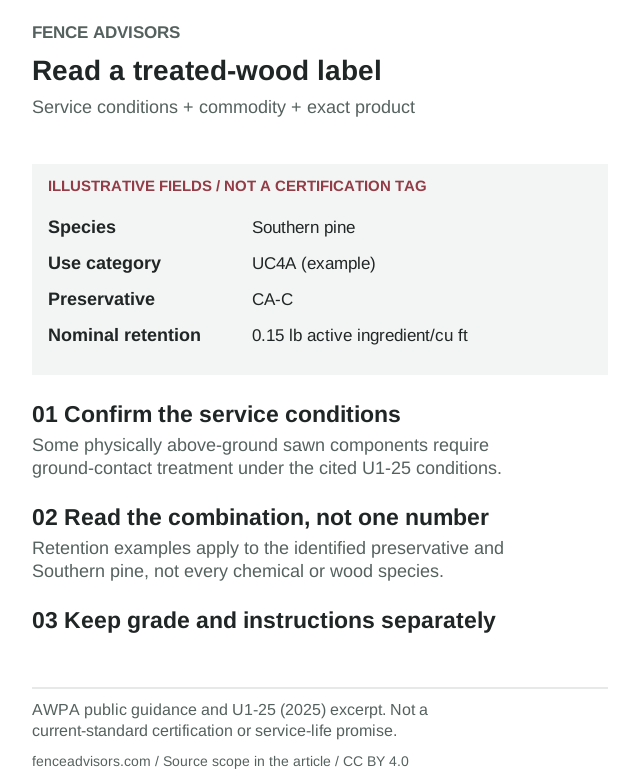
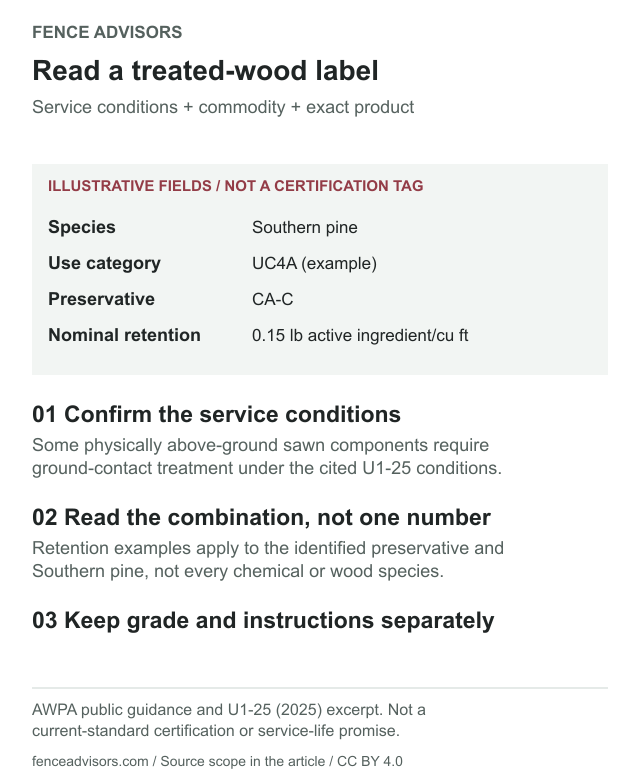
  <a href="https://fenceadvisors.com/blog/treated-wood-fence-tag-guide"><img src="https://fenceadvisors.com/media/research/treated-wood-tag-reference.svg" alt="Illustrative label fields for Southern pine, AWPA U1, UC4A and CA-C at 0.15 pounds active ingredient per cubic foot. Not an actual certification tag; the correct commodity and service conditions must be confirmed." width="640" height="780" loading="lazy" style="max-width:100%;height:auto"></a>
  <figcaption>Graphic: <a href="https://fenceadvisors.com/blog/treated-wood-fence-tag-guide">Fence Advisors</a>. Source, period and limitations are in the linked article. Original graphic: CC BY 4.0.</figcaption>
</figure>
Keep treatment and grade records separate
A treatment tag and a lumber grade stamp answer different questions: treatment records identify preservation requirements, while grade marks identify the lumber's grading and manufacturing information. AWPA homeowner guidance. WWPA grade-stamp overview.
For treatment, retain the actual end tag or a clear photo showing the documented specification, use category, preservative/retention, species, treating plant and applicable quality/inspection identification. AWPA's homeowner guidance describes AWPA U1 marking and agency quality marks for code-relevant inspection; do not invent missing certification or assume an unreadable label proves it. Separately record the lumber's grade/product description and size. AWPA end-tag guidance; WWPA grade marks.
| Before ordering or accepting | What to confirm |
|---|---|
| Intended component and exposure | Actual commodity and use-category requirements |
| Exact product | Species, dimensions, preservative/type and documented specification |
| Treatment evidence | Retention with units, plant/product traceability and applicable inspection mark |
| Grade evidence | Separate grade/rule or supplier standard for the intended component |
| Handling instructions | Actual product's field-cut, fastener, care and disposal directions |
| Unresolved substitution | Written confirmation, not a generic treatment-color match |
Use the fastener compatibility reference to confirm the exact connector and fastener system. This tag guide deliberately gives no universal cutting, disposal or chemical application recipe. Follow the specific product instructions and applicable requirements. Find fence suppliers for a documented product, or local contractors to confirm the full installation scope.
Methodology and reuse
We reviewed the AWPA homeowner/UCS pages, the cited conditions in the first eight retrieved pages of the 20-page U1-25 excerpt, and WWPA's stamp overview. The 2025 source edition and 2026 review date remain distinct. The diagram is an illustrative field decoder, not an actual treatment tag or recreated inspection logo. The CSV labels categories and retention rows separately; cite preservative, species, units and service conditions with any number.
Frequently Asked Questions
Does any above-ground fence board qualify for UC3B?
No universal conclusion follows from height alone. The cited U1-25 Commodity Specification A conditions require ground-contact treatment for some physically above-ground sawn components.
Is 0.40 treatment always better than 0.15?
Not across different preservatives or unspecified products. Retention must be read with preservative type, species, commodity and use category; the number alone is not a performance ranking.
Is a treatment tag the same as a lumber grade stamp?
No. They provide different records. Preserve both where applicable and verify the actual product and installed requirements separately.
Sources and Downloads
- Selected use categories and Southern-pine retentionsCSV
- Blank tag and product traceability recordCSV
- Citable findings, source URLs and boundariesCSV
- Sourcebook, document dates and methodologyJSON
- AWPA homeowner guidance
- AWPA Use Category System overview
- AWPA U1-25 public excerpt
- WWPA grade-stamp overview
Original Fence Advisors graphics, data compilations and worksheet are available under CC BY 4.0. Retain source, period and scope when reusing data. This license does not relicense third-party documents or trademarks.
Corrections: editorial@fenceadvisors.com.
Related Research
Put your research to work
Estimate your budget, then compare fence companies in your area.
Get the next guide in your inbox
Fence costs, rankings, and what AI is telling homeowners — researched, no fluff.