WRCLA and WWPA public guidance; reviewed October 4, 2026
Buying terminology and stamp interpretation, not a full grading rulebook, knot-size limit, structural design or size guarantee. Manufacturing marks do not report today's moisture.
Sources and scope checked .
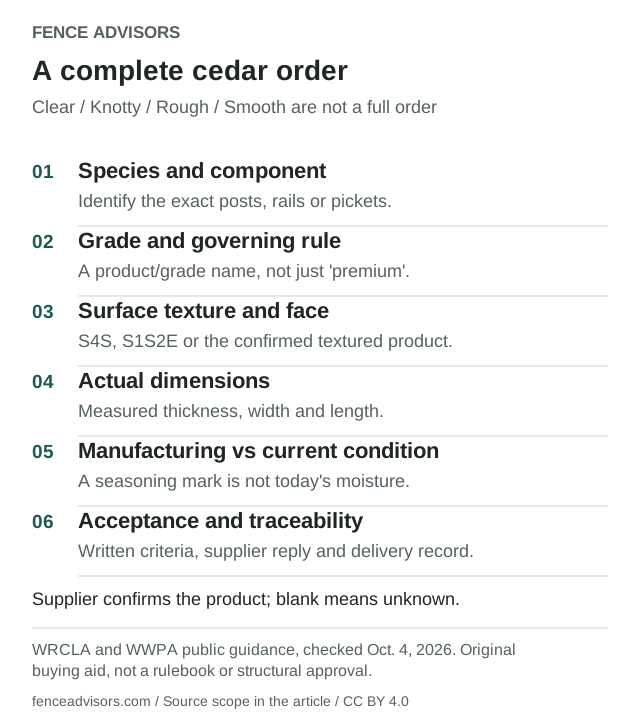
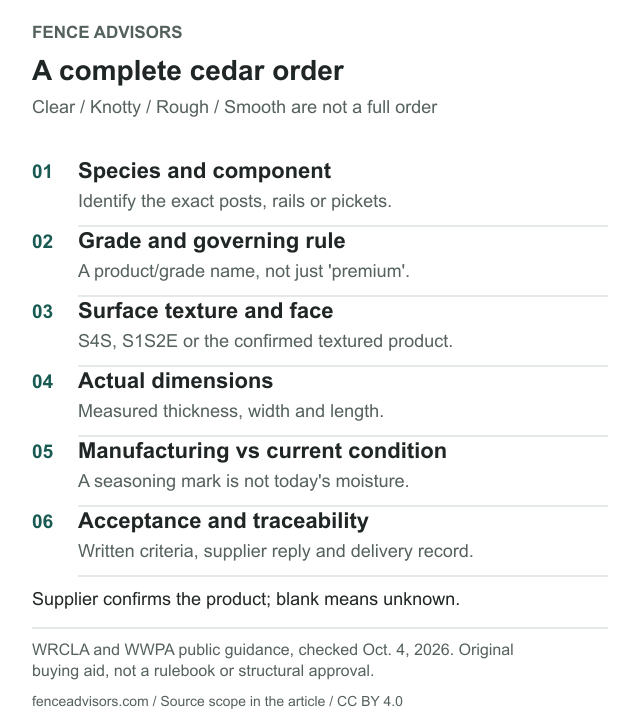
A cedar fence order needs more than "clear," "knotty" or "rough." Record the species, grade and governing rule, surface texture, actual dimensions, condition and agreed acceptance criteria. These attributes are not interchangeable, and a smooth board is not automatically a higher structural grade. WRCLA fence specifications; WWPA grade-stamp overview.
This is a buying-terminology reference, not a complete cedar grading rulebook. The existing wood species guide covers material selection; this article helps define the cedar product you intend to order and accept.
Clear and Knotty are not a full order
WRCLA describes Clear cedar posts as having limited natural characteristics and Knotty posts as an option for a more rustic appearance; neither label is a complete product specification. WRCLA Real Cedar fence specifications.
Do not translate Clear into an absolute zero-defect promise, or Knotty into a universal allowance for any knot, split or decay. Ask which grade or supplier product standard applies to the particular posts, rails or pickets. A claim about appearance does not size a structural member or approve its installation.
| Description in a quote | Question to settle before acceptance |
|---|---|
| Clear or Knotty | Exact grade name, governing grading rule/product standard and allowed characteristics |
| "Premium" or "select" | Is this an identified grade, a named product or just a sales description? |
| Rough or smooth | Which faces, which process and what actual size? |
| Nominal size | What thickness, width and length will be delivered? |
| Dry | Manufacturing stamp or a current measurement, and by what method? |
If a supplier uses its own sorting label, keep that label but ask for written acceptance criteria. Do not quietly substitute a grading rule from another supplier, species or component.
Surface texture terms
S4S describes lumber surfaced on four sides; S1S2E describes one face and two edges surfaced. These surface terms do not establish the lumber's grade. WRCLA Real Cedar fence specifications.
| Surface description | Meaning | Ordering question |
|---|---|---|
| S4S | Surfaced on all four sides | Confirm actual thickness/width and the applicable grade separately. |
| S1S2E | One face and two edges surfaced | Confirm the intended exposed face and actual dimensions. |
| Saw textured | Texture produced by circular or band sawing | Confirm which faces receive this texture in the quoted product. |
| Rougher headed | Texture produced by roughened planer knives | Do not assume texture establishes grade or a universal rough size. |
Source: WRCLA surface descriptions. Saw texture and a rougher-headed planer texture are different production descriptions. Neither alone establishes grade, a universal rough size or which face will be exposed after installation.
We deliberately omit a universal nominal-to-actual cedar size chart. Some inch/millimeter pairs on the cited page are inconsistent; silently correcting them would conceal that source issue. Confirm the actual vendor product and measure delivered pieces. Use those dimensions in the picket quantity model, rather than assuming that the nominal name is the measured width.
Moisture stamp reference
WWPA explains MC-15/KD-15 as a maximum 15% moisture content, S-DRY/KD as a maximum 19%, and S-GRN as over 19%, at manufacturing. WWPA grade-stamp overview.
| Mark explained by WWPA | Moisture threshold | When it applies |
|---|---|---|
| MC-15 / KD-15 | At most 15% | At manufacturing |
| S-DRY / KD | At most 19% | At manufacturing |
| S-GRN | Over 19% | At manufacturing |
These are WWPA's general stamp explanations, not promises that every cedar fence picket carries such a stamp. The overview describes agency certification, mill identity, grade, species and seasoning as the usual five elements, with exceptions for some rough/heavy products. WWPA Interpreting Grade Marks.
A manufacturing threshold is not today's moisture reading, permission to stain, or a recommended picket gap. Record current condition separately and follow the actual finish/product instructions. The wood shrinkage reference explains why green-to-oven-dry percentages are also not ordinary seasonal gap predictions.
Build a cedar purchase record
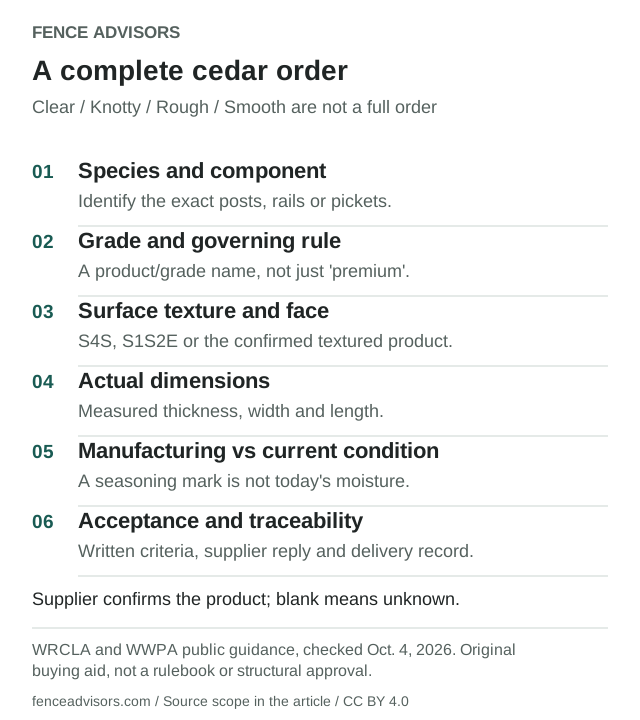
Download or embed this graphic
<figure>
  <a href="https://fenceadvisors.com/blog/cedar-fence-grades-reference"><img src="https://fenceadvisors.com/media/research/cedar-order-identity.svg" alt="Original cedar purchasing record separates species, grade and rule, surface texture, actual dimensions, manufacturing seasoning, current condition and written acceptance criteria. It is not a certification stamp." width="640" height="720" loading="lazy" style="max-width:100%;height:auto"></a>
  <figcaption>Graphic: <a href="https://fenceadvisors.com/blog/cedar-fence-grades-reference">Fence Advisors</a>. Source, period and limitations are in the linked article. Original graphic: CC BY 4.0.</figcaption>
</figure>| Record field | Evidence to retain |
|---|---|
| Species and component | Supplier product description for the actual posts, rails or pickets |
| Grade and rule | Written grade name and governing rule/product standard |
| Surface and face | Quoted process and intended exposed face |
| Actual sizes | Confirmed dimensions and sample/receiving measurements |
| Condition | Manufacturing seasoning plus separately measured present condition |
| Acceptance | Agreed characteristics, inspection method and disputed-item process |
| Quantity and units | Pieces, bundles or other selling unit; permitted substitutions |
| Traceability | SKU, supplier response date, delivery ticket and useful photos |
The blank CSV is an original purchasing record, not an inspection certificate. Ask for the missing fields before choosing the lowest quote. At receiving, compare the actual delivery against the accepted written order and document disputed items before altering them. Use the supplier RFQ for freight, availability and quote terms. Find fence suppliers who can identify their exact product, or contractors who can confirm the installed scope.
Methodology and reuse
WRCLA and WWPA public guidance was checked October 4, 2026. We did not review a full grading rulebook, publish knot-size limits, inspect stock or verify a structural design. The diagram is an original order checklist, not a recreated agency grade stamp. Cite the attribute, source and timing together; keep appearance, texture, size and moisture separate when reusing this reference.
Frequently Asked Questions
Is smooth cedar better than rough cedar?
Smooth and rough describe surface preparation. They do not, by themselves, establish grade, structural capacity or a universally better fence product.
Does clear cedar mean absolutely no knots or other characteristics?
WRCLA describes limited natural characteristics, not an absolute absence of every characteristic. Confirm the exact grade and its written acceptance criteria.
Does S-DRY mean the fence is ready to stain today?
No. WWPA explains the stamp as a manufacturing moisture threshold. Current condition and the chosen finish manufacturer's instructions must be checked separately.
Sources and Downloads
- Blank cedar order and acceptance recordCSV
- Manufacturing seasoning marks and thresholdsCSV
- Citable findings, source URLs and boundariesCSV
- Sourcebook, document dates and methodologyJSON
Original Fence Advisors graphics, data compilations and worksheet are available under CC BY 4.0. Retain source, period and scope when reusing data. This license does not relicense third-party documents or trademarks.
Corrections: editorial@fenceadvisors.com.
Related Research
Put your research to work
Estimate your budget, then compare fence companies in your area.
Get the next guide in your inbox
Fence costs, rankings, and what AI is telling homeowners — researched, no fluff.