FTC 2012 Green Guides in current eCFR and a Trex manufacturer statement; checked October 4, 2026
FTC claim definitions, one attributed manufacturer statement and chosen arithmetic. Not a material carbon ranking, independent content audit or measured recycling-access survey.
Sources and scope checked .
A fence made with recycled material is not automatically recyclable where you live. Recycled content describes inputs to a product; recyclability describes an actual recovery route after use. Neither claim, by itself, proves that one fence has the lowest carbon footprint or is the best environmental choice. FTC recyclable guidance; FTC recycled-content guidance.
Use this reference to ask specific questions about a named product, its components and its disposal route. It interprets the FTC's marketing-claim guidance, includes one clearly attributed manufacturer statement and demonstrates original arithmetic. It is not a life-cycle ranking of wood, vinyl, aluminum or composite fencing.
Recycled content and recyclable answer different questions
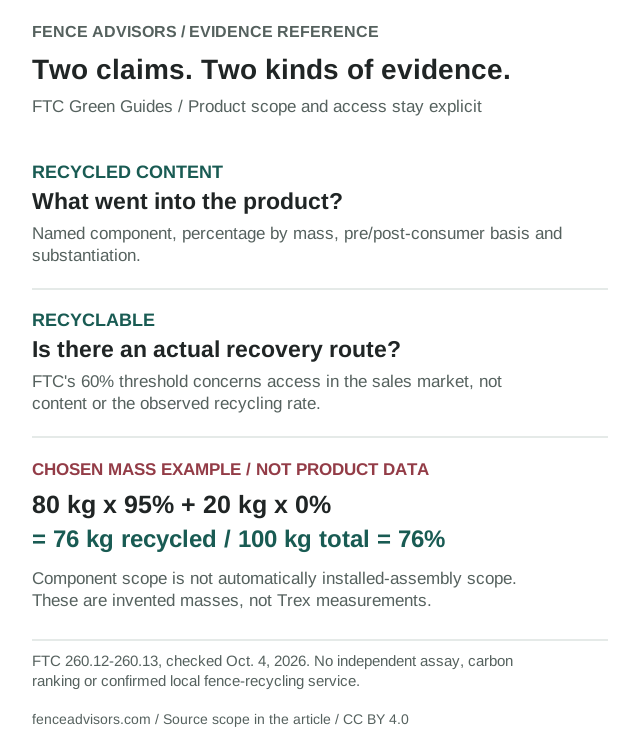
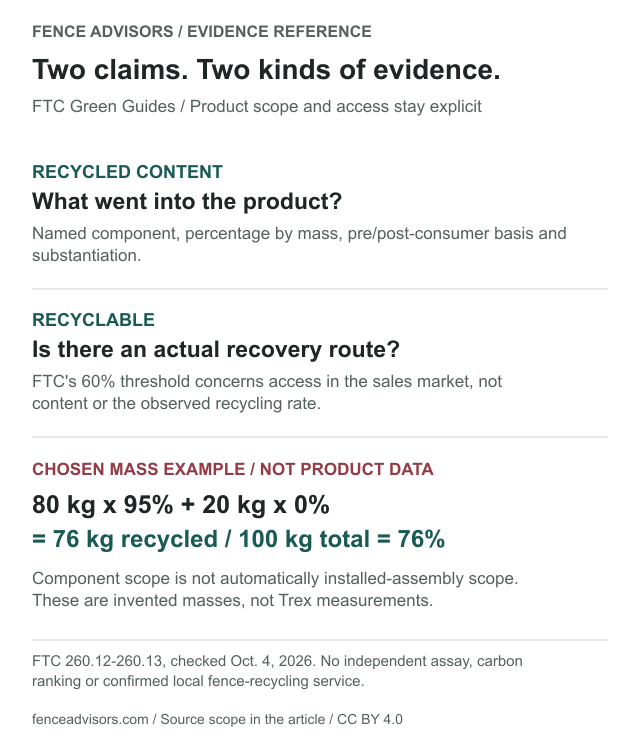
Recycled content describes recovered or diverted material used in a product; recyclable describes an established route to recover the item after use. One claim does not establish the other under the FTC Green Guides. FTC Green Guides: recyclable claims, 16 CFR 260.12. FTC Green Guides: recycled content, 16 CFR 260.13.
| Claim | Evidence to request | What the claim alone does not prove |
|---|---|---|
| Recycled content | Exact component, percentage by mass and pre/post-consumer basis | Local recyclability or lowest life-cycle impact |
| Recyclable | Actual acceptance of this product, recovery route and market access | Recycled content or acceptance of all accessories |
| Renewable material | Named input and substantiated source/scope | Lower carbon footprint of the installed fence |
| Lower carbon footprint | Comparable life-cycle study, function, boundary and assumptions | A result from content percentage alone |
The first two rows follow the cited FTC distinctions. The renewable-material and carbon rows are our purchasing questions, not measured comparative findings. Ask for the actual evidence rather than treat "eco-friendly" as a complete specification.
FTC guidance distinguishes pre-consumer and post-consumer material and calls for substantiation of those claims. Normally reused manufacturing scraps that would not otherwise enter the waste stream do not automatically count as recycled content in the guide's example. A statement about packaging is also not automatically a statement about the product inside it. 16 CFR 260.13.
What the FTC 60 percent threshold means
For an unqualified recyclable claim, FTC guidance defines substantial recycling access as at least 60% of consumers or communities where the item is sold; 60% is not a recycled-content threshold or a measured recycling rate. FTC Green Guides: recyclable claims, 16 CFR 260.12.
The denominator is consumers or communities where the item is sold, not pounds of recycled plastic, households that actually recycle or the number of fence panels recovered last year. FTC also describes stronger qualifications as appropriate recycling access becomes more limited. Other conditions in the guide still apply; 60% alone is not a blanket permission slip for every claim. 16 CFR 260.12(b)-(d).
The relevant program must accept the actual item. A facility that takes a common resin, clean film or beverage container is not thereby shown to take a long, mixed-material fence board with coatings or embedded components. Size, composition and separation requirements can matter. Call the receiving facility or take-back operator with the exact product description and ask for current acceptance instructions.
| Question for the receiver | Why it matters |
|---|---|
| Will you accept this exact used fence product? | Material-family labels alone do not establish a route |
| Which components must be separated? | Panels, frames, caps and hardware can have different destinations |
| What condition and size are accepted? | Dirt, coatings, damage and handling requirements may matter |
| Where and how is it delivered? | A theoretical route is not the same as an available collection option |
| Are there fees or restrictions? | Record the actual operator's conditions rather than invent a free service |
This is a blank verification workflow, not a list of confirmed fence-recycling locations.
How to cite a manufacturer content claim
Trex's fencing page states that its composite fencing blend uses 95% recycled wood and plastic; that is an attributed manufacturer claim, not Fence Advisors' independent audit or a local end-of-life recycling guarantee. Trex composite fencing product page.
The precise formulation matters. Write "Trex states...", identify its composite fencing blend, link the product page and record the check date. Do not rewrite that as "Fence Advisors tested a 95% recycled installed fence" or "95% of every part can be recycled locally." The cited page does not establish those findings.
Use the Trex specifications reference for its separate dimensions and limited-warranty context. Content, warranty coverage, service life, fire behavior and recycling access answer different questions. In particular, an environmental input claim is not a wildfire-safety rating.
Component percentages are not assembly percentages
In an invented two-component example, 80 kg at 95% recycled content plus 20 kg at 0% gives 76 kg recycled material in 100 kg total, or 76% by mass for the defined assembly; these are not actual Trex or fence measurements. FTC Green Guides: recycled content, 16 CFR 260.13.
Chosen example only: assume verified percentages by mass and an assembly consisting of exactly two components. These are invented inputs, not observed product weights or an accusation about any manufacturer's claim.
| Chosen component | Mass | Recycled fraction | Recycled mass |
|---|---|---|---|
| Chosen component A | 80 kg | 95% | 76 kg |
| Chosen component B | 20 kg | 0% | 0 kg |
| Defined total | 100 kg | 76% by mass | 76 kg |
Formula: assembly recycled percentage = 100 × sum(component mass × recycled fraction) / sum(component mass). Enter 95% as 0.95 in that multiplication. The chosen calculation is (80 × 0.95 + 20 × 0) / 100 × 100 = 76%.
The denominator changes when the boundary changes. If you add more components, their masses and substantiated content belong in the calculation. If the claim is only about a named composite component, retain that scope rather than silently expand it to concrete, hardware and every other installed material. This illustration demonstrates weighting; it does not decide legal compliance, minor/incidental-component treatment or the validity of a real product statement. FTC by-weight scope, 260.13(c).
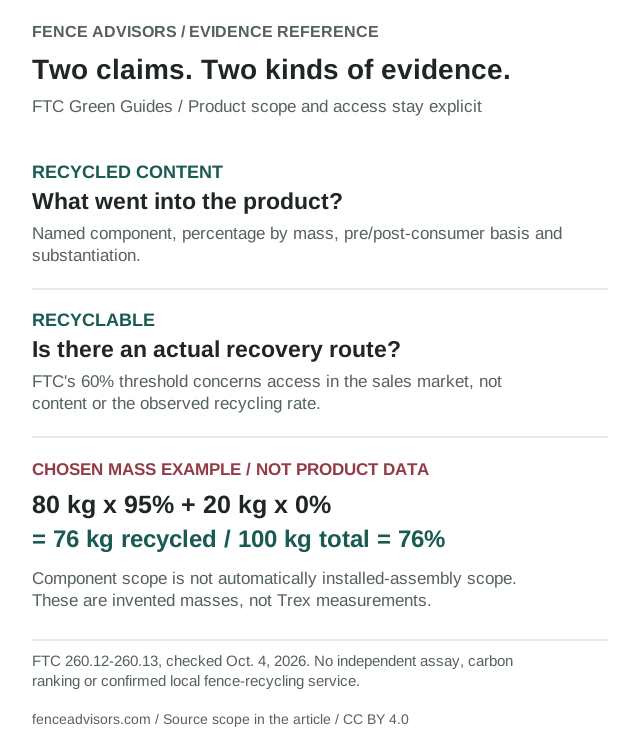
Download or embed this graphic
<figure>
  <a href="https://fenceadvisors.com/blog/fence-recycled-content-vs-recyclable"><img src="https://fenceadvisors.com/media/research/fence-environmental-claims.svg" alt="Recycled content concerns inputs; recyclable concerns an actual recovery route. FTC's 60% threshold concerns market access. An invented 80 kg component at 95% plus 20 kg at zero totals 76% recycled mass, not actual Trex or fence data." width="640" height="740" loading="lazy" style="max-width:100%;height:auto"></a>
  <figcaption>Graphic: <a href="https://fenceadvisors.com/blog/fence-recycled-content-vs-recyclable">Fence Advisors</a>. Source, period and limitations are in the linked article. Original graphic: CC BY 4.0.</figcaption>
</figure>
Ask for a verifiable environmental claim
The FTC Green Guides explain the Commission's views on environmental marketing claims and do not bind the FTC or public by themselves; inconsistent claims can still lead to action under the FTC Act. FTC Green Guides: purpose and scope, 16 CFR 260.1.
The guides apply to B2B as well as consumer marketing. Do not describe a product as "FTC approved" because its brochure includes a recycling symbol or a percentage. Our reference is a way to make a question precise, not individualized legal clearance. 16 CFR 260.1.
Record the exact claim text, product/SKU, component boundary, mass basis, pre/post-consumer scope, source document, date and unresolved questions. For recyclability, add the actual receiving operator and its instructions. The downloadable blank CSV separates those fields so a source quote is not mistaken for independent verification.
For a lower-carbon comparison, ask for a comparable life-cycle study with a defined function, system boundary and assumptions. Fence length/height, useful service, maintenance, transport and end-of-life treatment should not disappear from the comparison. We have not collected comparable studies here, so we do not declare a carbon winner from a recycled-content percentage.
Add the requested documentation to a supplier RFQ before placing an order. Find fence suppliers who can identify the exact product and available evidence; use the buyer checklist to keep environmental attributes separate from installed scope, price and warranty.
Methodology and reuse
We reviewed current eCFR versions of FTC Green Guides Sections 260.1, 260.12 and 260.13, originally published in 2012, and checked Trex's public fencing statement October 4, 2026. We performed no recycled-content assay, recycling-access survey or comparative life-cycle assessment. The two-component calculation is original, invented arithmetic. The SVG/PNG and blank claim record can be reused with attribution; source documents and trademarks are not relicensed. Keep the claim type, product boundary, evidence status and date in any citation.
Frequently Asked Questions
Does 95% recycled content mean a fence is 95% recyclable?
No. Input composition and an actual end-of-life recovery route are different questions. A content statement does not establish acceptance by a local recycling operator.
Does the FTC 60% figure measure how much plastic is recycled?
No. The cited recyclable guidance uses it for access among consumers or communities where the item is sold, not recycled content or an observed recycling rate.
Which fence material has the lowest carbon footprint?
This reference does not establish a winner. That comparison needs compatible life-cycle evidence and defined function, boundaries and assumptions; content percentages alone are insufficient.
Sources and Downloads
- Blank component claims, substantiation and recovery-route recordCSV
- Citable findings, exact sources and evidence boundariesCSV
- Source dates, review scope and original modelsJSON
- FTC Green Guides: purpose and scope, 16 CFR 260.1
- FTC Green Guides: recyclable claims, 16 CFR 260.12
- FTC Green Guides: recycled content, 16 CFR 260.13
- Trex composite fencing product page
Original Fence Advisors graphics, data compilations and worksheet are available under CC BY 4.0. Retain source, period and scope when reusing data. This license does not relicense third-party documents or trademarks.
Corrections: editorial@fenceadvisors.com.
Related Research
Put your research to work
Estimate your budget, then compare fence companies in your area.
Get the next guide in your inbox
Fence costs, rankings, and what AI is telling homeowners — researched, no fluff.