
Las Vegas, NV / Fence permit planning
Zoning preparation only for ordinary new residential fencing inside the City of Las Vegas, not North Las Vegas, Las Vegas, New Mexico or unincorporated Clark County. Published 19.06.040(H) lists amendments through Ordinance 6963 section 2, July 1, 2026, with no known replacement identified in the evidence; legislation may precede codification, and the displayed 1901 effective date is not adoption evidence. H supplements district tables, so downtown/form-based, overlay and approved-development conditions remain relevant, with no construction-ready numerical height, setback, openness, sight geometry or complete finished-grade definition supplied. BAC 301.4.1(31)'s negative pool/spa-barrier wording remains unresolved, and ordinary zoning-application applicability is not established: this guide asserts neither a building exemption nor universal permit duty. Pool, retaining, energized-fence and powered-gate designs are excluded; this is not parcel or engineering approval.
Sources and scope checked .
Las Vegas's published residential fence standards support a useful zoning-preparation task: identify frontage, screening, surface openness, materials, grade exposure and any applicable landscape buffer before selecting the fence. This is not a determination that an ordinary new fence needs, or is exempt from, a building permit or zoning application. The separate BAC fence-exemption wording remains unresolved and is not corrected here. Las Vegas published residential fence zoning standards; Las Vegas retained Administrative Code fence clause.
Use this guide for ordinary new residential fencing under City of Las Vegas jurisdiction. It is not North Las Vegas, unincorporated Clark County or Las Vegas, New Mexico guidance. The Las Vegas contractor directory handles hiring; this article helps define a zoning proposal rather than rank installers or estimate installed prices.
Quick reference
| Question | Source-checked answer |
|---|---|
| District standards still apply | Published 19.06.040(H) adds fence/wall standards to the tables for each district on lots subject to the chapter. It is not a complete height table for every residential parcel; district, overlay, downtown/form-based and approved-development conditions must be identified. Las Vegas published residential fence zoning standards; Las Vegas official zoning-code entry; Las Vegas official UDC publisher index |
| Front-setback screening and openness | H(1) distinguishes front-setback screen-wall restrictions from the openness of higher fence/wall surfaces, viewed perpendicularly from public right-of-way. Its supporting-pilaster exception concerns that surface rule, not a general height waiver or intersection-safety approval. No numerical design allowance is supplied here. Las Vegas published residential fence zoning standards |
| Grade and applicable buffers | H(2)(a) measures height from the side with the greatest vertical exposure above finished grade. Its solid-fence landscape-buffer placement rule has a height trigger and listed frontage exclusions; it is not a rule for every short fence. Record both sides and the actual frontage; no complete grade definition or buffer width is established here. Las Vegas published residential fence zoning standards |
| Qualified material restrictions | H(4)(a) restricts listed screen/perimeter-wall materials, subject to approved-development and separate special-scope provisions. Its chain-link/open-wire restriction concerns front yards and specified public frontages, with temporary-construction and listed frontage exceptions. Corrugated metal, bright-colored plastic, razor/barbed wire and unfinished concrete/block also appear in that scoped list; it is not an all-yard chain-link ban. Las Vegas published residential fence zoning standards |
| Do not import a developer-wall specification | H(2)'s specified multifamily/nonresidential screening duty and H(3)'s subdivision/developer wall provisions are distinct from an optional homeowner fence. The wall-adjacency provision also addresses maintenance access or an approved gap treatment; this guide gives no gap-filling or retaining-wall construction recipe. Las Vegas published residential fence zoning standards |
| Separate unresolved permit questions | BAC 301.4.1(31)'s negative pool/spa-barrier wording remains a material unresolved building question. This zoning preparation neither repairs that text nor establishes an ordinary building exemption, universal permit duty or zoning-application requirement. Determine actual approvals separately before work. Las Vegas retained Administrative Code fence clause; Las Vegas current Building Safety resources; Las Vegas city permit and jurisdiction instructions |
| Conditional application and fee route | If a Building application is required, the July 2026 Dashboard notice removes the separate Wall-Fence application document, not applicable supporting plans. The fee estimator excludes other charges and reserves final assessment to the city. Neither resource establishes the ordinary fence permit trigger or a flat price. Las Vegas July 2026 Dashboard application change; Las Vegas permit fee estimator limitations |
Use the published zoning body with its actual limits
The city's zoning entry links the enCodePlus UDC and separately identifies archived code. The published 19.06.040 body lists amendments ending with Ordinance 6963, section 2, July 1, 2026. That is the published section used here, not an archived 1997 chapter or an unamended model building code. The displayed January 1901 effective-date field is not meaningful adoption evidence. Las Vegas official zoning-code entry; Las Vegas published residential fence zoning standards.
The publisher warns that legislation can precede online updates. No known replacement of this fence body is identified in the reviewed sources, but this review does not certify every later ordinance. More importantly, H's own introduction makes its standards additional to the district tables for lots subject to the chapter. Identify the actual district and applicable overlay, downtown/form-based or development-plan conditions before treating a general paragraph as the whole design standard. Las Vegas official UDC publisher index; Las Vegas published residential fence zoning standards.
Separate front-setback screening from an overall fence maximum
H(1) addresses a screen wall in the residential front-yard setback area and separately regulates the openness of higher wall or fence surfaces. It assesses that openness from a perpendicular view from public right-of-way and excepts supporting pilasters from the surface condition. These are different design questions, not one universal height allowance. Las Vegas published residential fence zoning standards.
On the proposal, identify which run occupies the required front setback, the solid and open portions, and the actual supports. A pilaster exception in the surface rule is not permission for unlimited column height. Nor does openness establish that a fence is safe at a driveway or intersection. This guide deliberately supplies no numerical front allowance or sight geometry while the applicable district and measurement dependencies are not established here.
Show both grades and any landscape-buffer relationship
H(2)(a) uses the side with the greatest vertical exposure above finished grade for fence or wall height. Provide information from both sides rather than select the convenient higher yard or rely solely on a nominal panel label. The linked finished-grade definition and every possible retaining/grade combination are not reproduced here; no authorization to raise grade or calculate extra height is offered. Las Vegas published residential fence zoning standards.
The same paragraph's solid-fence landscape-buffer placement rule has a height trigger and exclusions for the listed alley, railroad, interstate and freeway frontages. Where those conditions apply, the fence belongs behind the required buffer. First establish whether that buffer applies and where it is. This is neither a rule for every short fence nor a universal distance from every curb; no single buffer width for all districts is established here.
Read material restrictions in their stated scope
H(4)(a)'s list concerns screen or perimeter walls, with approved overall-development and separate special-scope qualifications. Chain link and open wire are restricted in front yards and along the specified public frontages, with the listed frontage and temporary-construction exceptions. Do not turn that into a ban on every backyard chain-link fence, or use the temporary exception for a permanent enclosure. Las Vegas published residential fence zoning standards.
The scoped list also addresses razor/barbed wire, corrugated metal, bright-colored plastic and untextured or unfinished concrete/block. A finish or material choice is one zoning issue, not engineering approval. The separate energized-fence provision is not ordinary homeowner permission for electrical fencing; no installation or safety specification is supplied here.
Describe each segment's function and material rather than use a single label such as privacy fence for the entire lot. A sketch can show the house, street frontages, proposed runs, gates, actual boundaries, known easements, open/solid portions and relevant grades. These are preparation suggestions, not newly verified mandatory application fields.
Do not import subdivision-wall requirements into every home project
H(2)'s mandatory screening case concerns specified multifamily or nonresidential development next to residential property. Its statement that other cases do not require construction of a fence is about that screening duty, not a declaration that an optional new fence needs no permit. H(3) separately addresses subdivision/developer perimeter and retaining walls. Those decorative, installation and maintenance conditions are not a universal standalone wood-fence specification. Las Vegas published residential fence zoning standards.
The wall-adjacency provision also distinguishes maintenance access from a Department-approved close-gap treatment. Do not design a gap fill or impose its wall-separation dimensions on every ordinary fence from this article. Identify an adjacent wall for the appropriate review instead. This page offers no retaining-wall, structural-load or footing design.
Keep permit applicability separate from the zoning preparation
The reviewed administrative source has a material unresolved negative phrase concerning pool/spa barriers in 301.4.1(31). The word cannot be treated as a typo to establish a building exemption or decide ordinary nonpool/front-setback applicability. The city retains its local administrative code alongside the updated technical codes; a newer technical-code edition alone does not resolve that wording. Las Vegas retained Administrative Code fence clause; Las Vegas current Building Safety resources.
This zoning guide does not establish an all-fence Planning application or universally mandatory staff-clearance record. Determine what approvals actually apply before work, separately from preparing a compliant material/location proposal. Pool barriers, retaining functions, energized fencing and powered gates must be identified as their own scope questions, not hidden inside an ordinary fence description.
If a Building application is assigned, the city's July 2026 Dashboard notice matters: Patio/Pool-Spa/Wall-Fence applications no longer require a separate application document from July 13. Applicable plans and supporting information still remain. Do not require the older single-lot form upload just because it remains discoverable, and do not mistake this workflow change for a new exemption. Las Vegas July 2026 Dashboard application change.
The permit entry directs applicants to check jurisdiction first. A Las Vegas mailing address does not establish City of Las Vegas authority. The fee estimator's Residential Wall/Fence route excludes other charges and leaves the final assessment to the city. No flat total or approval time is established here; obtain the city's assessment for the classified scope. Las Vegas city permit and jurisdiction instructions; Las Vegas permit fee estimator limitations.
Assign responsibility for the district/amendment checks, separate permit determinations and any required documents in the written bid. Obtain required issued approvals before work, arrange utility locating before excavation and follow inspections assigned to the actual project. The useful result of this preparation is a specific fence proposal and clear unresolved questions, not a certificate of permission to build.
Before-you-build checklist
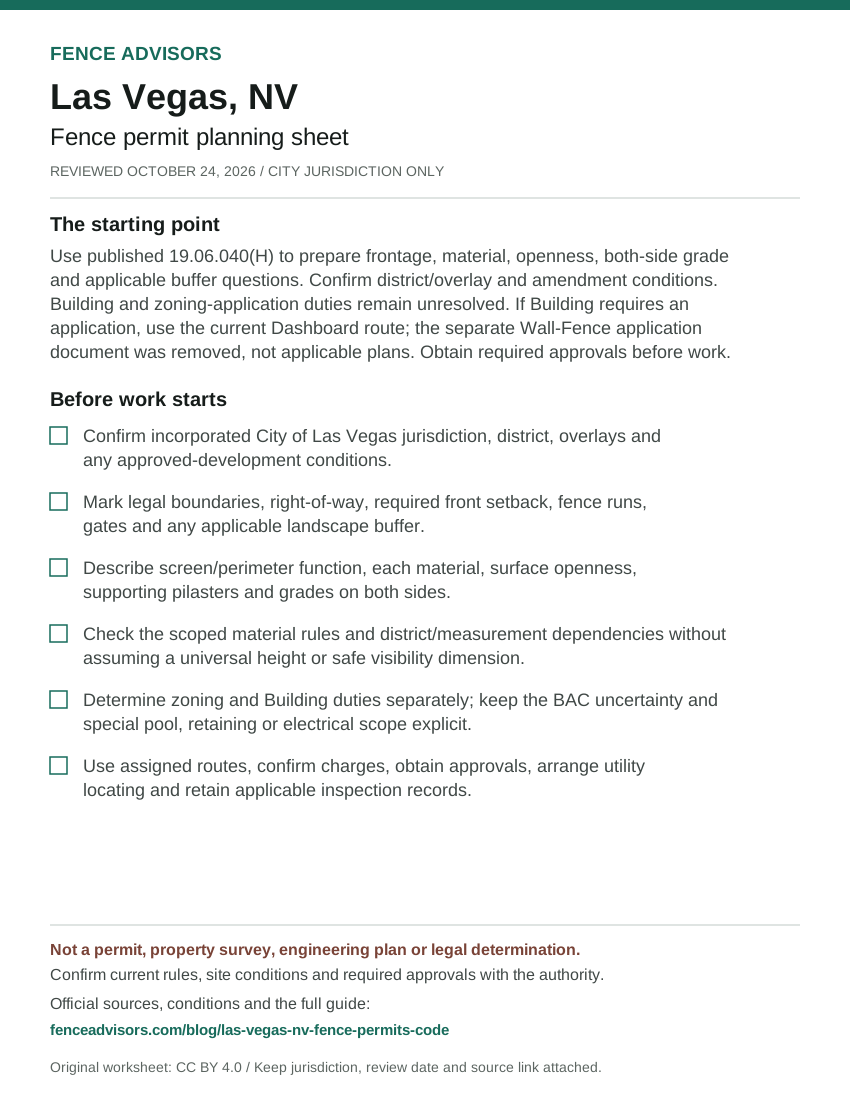
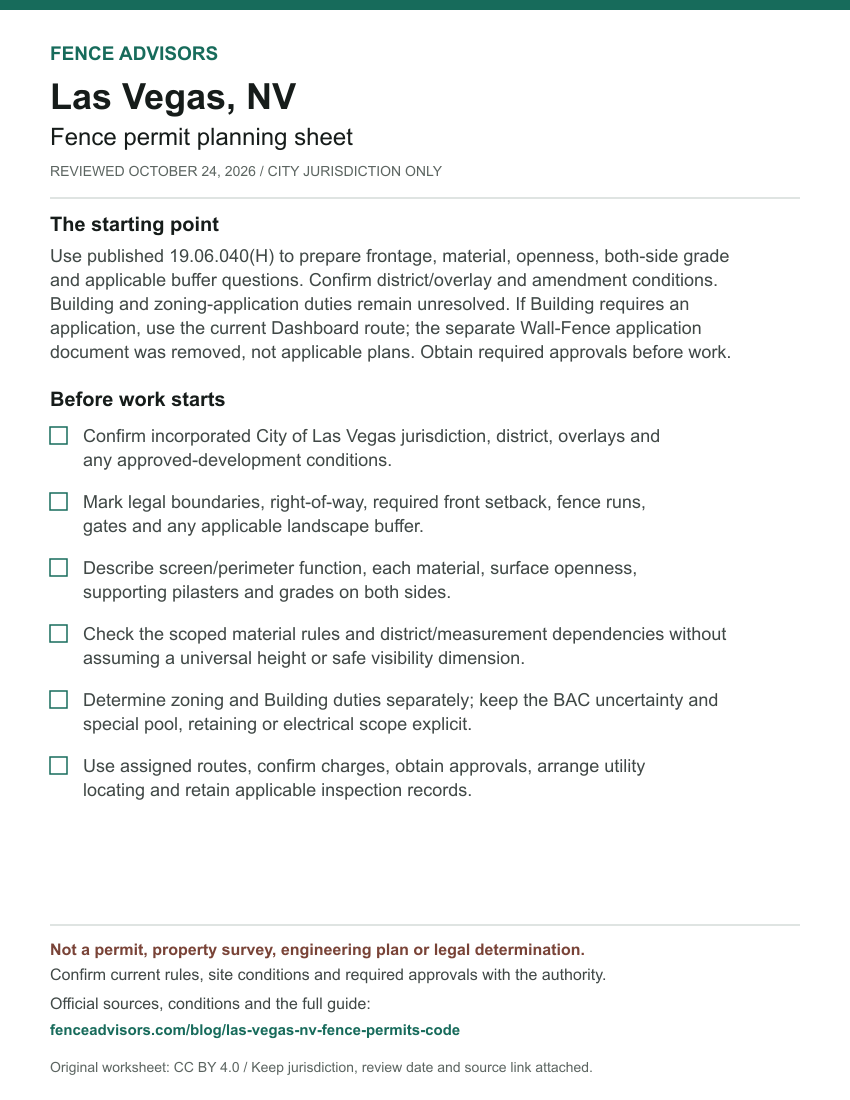
- Confirm incorporated City of Las Vegas jurisdiction, district, overlays and any approved-development conditions.
- Mark legal boundaries, right-of-way, required front setback, fence runs, gates and any applicable landscape buffer.
- Describe screen/perimeter function, each material, surface openness, supporting pilasters and grades on both sides.
- Check the scoped material rules and district/measurement dependencies without assuming a universal height or safe visibility dimension.
- Determine zoning and Building duties separately; keep the BAC uncertainty and special pool, retaining or electrical scope explicit.
- Use assigned routes, confirm charges, obtain approvals, arrange utility locating and retain applicable inspection records.
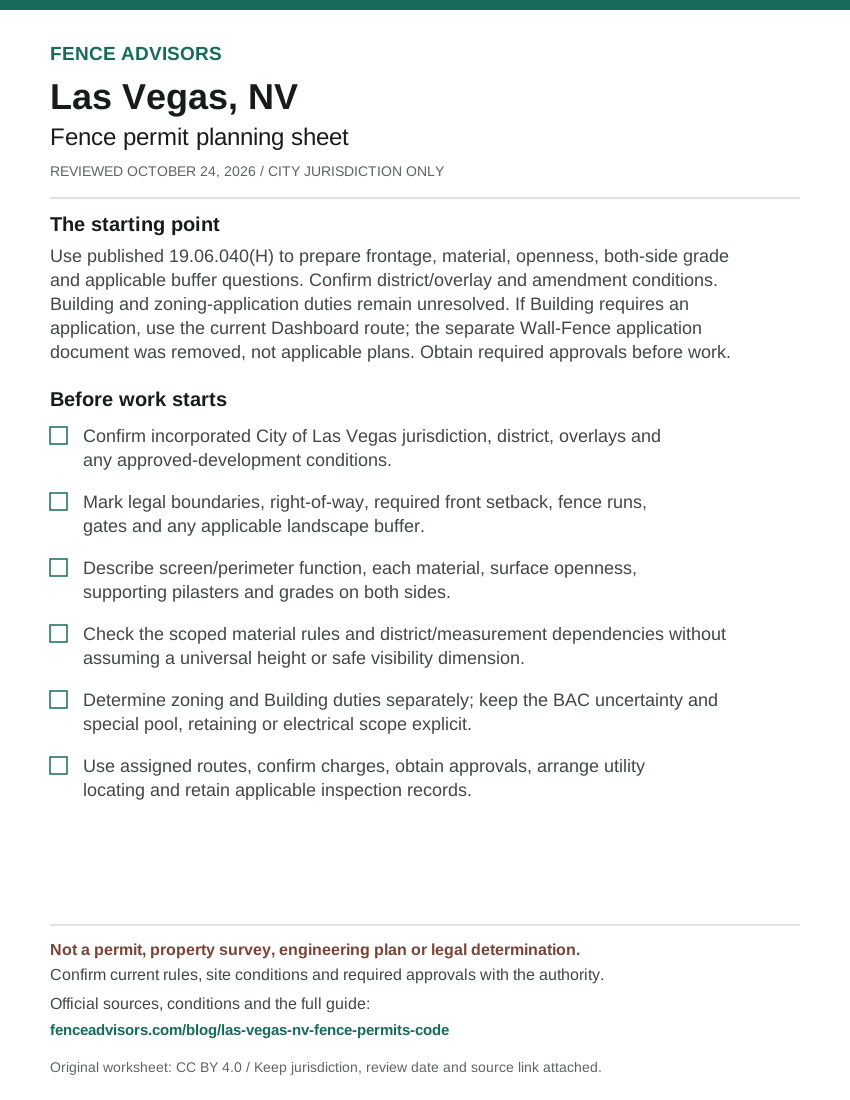
Download or embed this graphic
<figure>
  <a href="https://fenceadvisors.com/blog/las-vegas-nv-fence-permits-code"><img src="https://fenceadvisors.com/media/research/las-vegas-nv-permit-cheat-sheet.svg" alt="Las Vegas fence permit planning sheet: Zoning preparation only; BAC building exemption and ordinary approval applicability unresolved. Six preparation checks; the complete accessible checklist and source-checked rules are in this article." width="850" height="1100" loading="lazy" style="max-width:100%;height:auto"></a>
  <figcaption>Graphic: <a href="https://fenceadvisors.com/blog/las-vegas-nv-fence-permits-code">Fence Advisors</a>. Source, period and limitations are in the linked article. Original graphic: CC BY 4.0.</figcaption>
</figure>
Las Vegas and Nevada links
Compare Las Vegas fence companies, browse the Nevada directory or national directory, and use the national permit navigator for broader jurisdiction context. The Reno guide and Henderson zoning-preparation guide cover separate Nevada jurisdictions, not Las Vegas authority.
Sources and reuse
We checked the linked government guidance on October 24, 2026. The scope above and source notes identify what was verified and what still needs confirmation. This article is not an ordinance, survey, engineering design, legal opinion or permit approval. The downloadable fact sheet records each finding's source and section. Confirm current rules, fees and submission instructions with the responsible authority before ordering materials or starting work.
You may reuse our original cheat sheet with attribution to this article. Keep the review date, jurisdiction and limitations attached. Government documents remain with their original publishers. Send corrections with a source link to editorial@fenceadvisors.com.
Sources and Downloads
- Las Vegas published residential fence zoning standards - 19.06.040(H) introduction, H(1), H(2), H(3) and H(4)(a); amendment footer through Ordinance 6963 section 2. Energized-fence H(4)(b) excluded. Retained original complete relevant clauses reread October 24, 2026; H(4)(b) text truncates, so no energized-fence design or special exception approved. Amendment list ends July 1, 2026; no identified superseding body. Main's later web reader returned only a JavaScript shell, not new substantive evidence or loss of the retained body. Placeholder 1901 is not adoption; district tables and later-law completeness not certified.
- Las Vegas official zoning-code entry - Current enCodePlus UDC linkage versus archived pre-2011 code. Full official entry already read in the retained October 24, 2026 source pass; archived March 1997 Chapter 19.08 PDF not substituted.
- Las Vegas official UDC publisher index - Current publication and warning that updates can lag legislation. Retained complete source finding October 24, 2026; publisher warns of a potential 60-day lag, not a certification that all later ordinances were incorporated.
- Las Vegas current Building Safety resources - B&S-Codes; 2019 CLV Administrative Code retained with 2024 technical codes; industry notices. Full production body read in the retained October 24, 2026 closure; no fresh retrieval or claim that a technical-code update fixes the fence exemption.
- Las Vegas retained Administrative Code fence clause - 301.4.1(31), printed p.24 / physical PDF p.26; pool/spa-barrier negative wording and front-setback qualification. Full source and rendered page previously checked October 24, 2026; older-path official copy matched. Not re-fetched or re-parsed; material ordinary-fence ambiguity remains unresolved, not silently corrected.
- Las Vegas July 2026 Dashboard application change - July 13 change for Patio, Pool-Spa and Wall-Fence applications; application fields on Dashboard, supporting plans retained as applicable. Full official notice previously read October 24, 2026; supersedes older universal application-upload instructions, not a new permit applicability ruling.
- Las Vegas city permit and jurisdiction instructions - Do I Need a Permit jurisdiction check; application and existing-permit resources. Complete official body retained October 24, 2026; mailing address not city jurisdiction. Stale 2021-cycle paragraph not used to classify new applications.
- Las Vegas permit fee estimator limitations - Residential Wall/Fence route, exclusions and final-assessment disclaimer. Full body retained October 24, 2026; no calculator, fee assessment, universal total or turnaround tested.
Original Fence Advisors graphics, data compilations and worksheet are available under CC BY 4.0. Retain source, period and scope when reusing data. This license does not relicense third-party documents or trademarks.
Corrections: editorial@fenceadvisors.com.
Related Research
Plan your Las Vegas fence project
Confirm the approvals for your property, then compare written contractor scopes.
Get the next guide in your inbox
Fence costs, rankings, and what AI is telling homeowners — researched, no fluff.