Original costing model, October 2026
Original arithmetic and blank cost worksheet. Example margins are chosen scenarios, not measured fence-industry profitability or accounting/tax advice.
Worksheet reviewed .
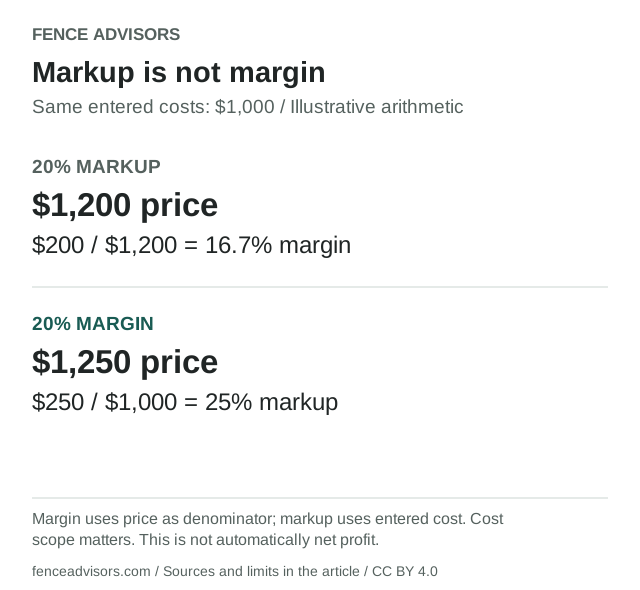
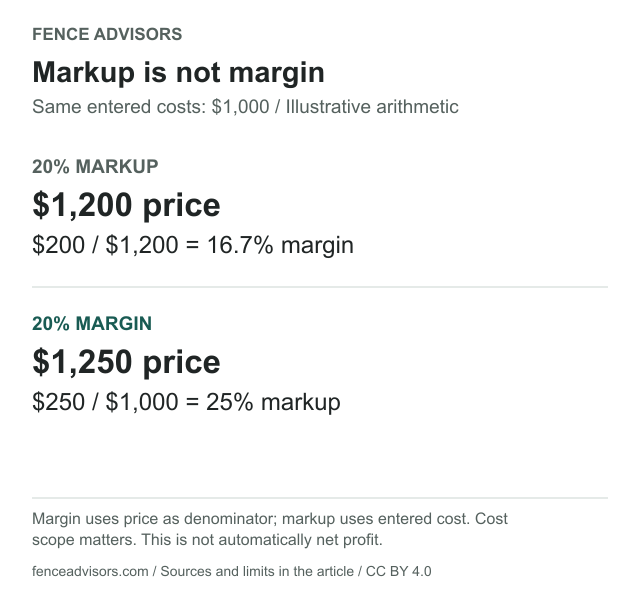
A 20% markup is not a 20% margin. On $1,000 of entered costs, adding 20% gives a $1,200 price and a 16.7% modeled margin. A 20% margin on those same costs requires a $1,250 price, equivalent to 25% markup. These are mathematical scenarios, not a claim about typical fence-company profits.
This reference provides a blank estimated-versus-actual cost worksheet, a calculator and a reusable chart for contractors. Homeowners planning a budget can start with the cost guide. The worksheet does not set a market rate or recommend a target margin.
Markup and margin formulas
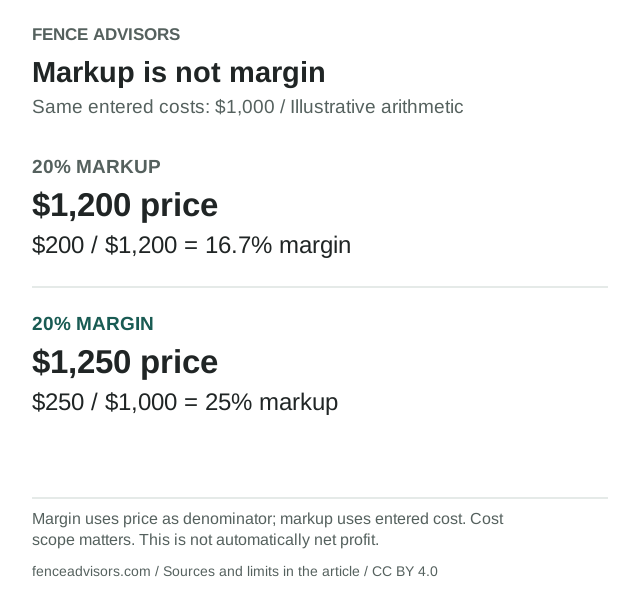
Download or embed this graphic
<figure>
  <a href="https://fenceadvisors.com/blog/fence-contractor-job-costing-worksheet"><img src="https://fenceadvisors.com/media/research/fence-markup-margin.svg" alt="On $1,000 entered costs, a 20% markup gives a $1,200 price and 16.7% margin; a 20% margin requires a $1,250 price and 25% markup." width="640" height="590" loading="lazy" style="max-width:100%;height:auto"></a>
  <figcaption>Graphic: <a href="https://fenceadvisors.com/blog/fence-contractor-job-costing-worksheet">Fence Advisors</a>. Source, period and limitations are in the linked article. Original graphic: CC BY 4.0.</figcaption>
</figure>
Markup = (price - entered costs) / entered costs.
Modeled margin = (price - entered costs) / price.
Price for a selected margin = entered costs / (1 - margin).
Use the margin as a decimal in the last formula: 20% becomes 0.20. A margin of 100% cannot be achieved with positive costs and a finite price. A selling price is also subject to the actual scope, market, contract and accounting treatment; this arithmetic does not prove that a buyer will accept it.
| Chosen target margin | Price on $1,000 costs | Surplus on entered costs | Equivalent markup |
|---|---|---|---|
| 10% | $1111.11 | $111.11 | 11.11% |
| 20% | $1250.00 | $250.00 | 25.00% |
| 25% | $1333.33 | $333.33 | 33.33% |
| 30% | $1428.57 | $428.57 | 42.86% |
| 40% | $1666.67 | $666.67 | 66.67% |
The scenario table is original Fence Advisors arithmetic. No industry survey underlies the selected percentages. If entered costs include allocated overhead, do not automatically label the remainder gross profit; if costs omit expenses, do not call it net profit.
Fence job-cost margin calculator
Price on your stated cost basis
- Modeled price
- $1,250.00
- Surplus on entered costs
- $250.00
The calculator uses only the cost basis and target you enter. Its result is a modeled price before separately handled taxes and contract adjustments. The defaults are an illustration, not a recommended fence-industry margin. It does not transmit your inputs or start a quote request.
Build a complete and consistent cost basis
| Cost group | What belongs in the project record |
|---|---|
| Materials | Accepted order, freight, returns and documented shortages |
| Field labor | Estimated and actual hours, wage basis and applicable employer burden |
| Equipment | Rental, delivery, fuel and any consistently allocated equipment costs |
| Site work | Removal, disposal, rock/access work and separately scoped site conditions |
| Subcontractors | Written scope, exclusions and confirmed amounts |
| Administration and overhead | Stated allocation method; do not charge the same cost twice |
| Contingency | Explicit allowance and what it covers, not a hidden universal waste statistic |
| Changes | Approved scope and price changes separated from original estimate |
National wage statistics are not a contractor's fully burdened labor cost. The fence workforce statistics describe wage-and-salary employees; they do not supply payroll burden, crew productivity, owner compensation or a local installed billing rate.
Use the supplier RFQ to confirm material scope and delivered charges with candidates in the supplier directory. Keep project-specific quantity models separate from pricing. A picket takeoff counts one defined part of the fence; it does not establish total job cost.
Estimated versus actual is the useful feedback loop
The downloadable worksheet provides a cost-group row, estimate, actual, variance, cost-basis note and evidence/source field. Complete it after the work and compare the same definitions. For costs, variance = actual - estimated; a positive variance means spending above that estimate, not improved profitability.
Capture the accepted selling price, approved change orders, credits and separately handled taxes in the same record. A deposit or invoice is not automatically recognized revenue, and cash collected is not the same as final job profit. Ask your accountant to define the appropriate reporting basis rather than relabeling this worksheet as formal financial statements.
Investigate a variance before changing next month's price. A difference may reflect an omitted gate, freight, difficult access, rework, a changed scope or a mistaken quantity. Updating one documented assumption is more useful than treating every overrun as a reason to add an arbitrary percentage.
What this worksheet intentionally does not claim
- No average fence-company profit margin, national crew production rate or guaranteed earnings.
- No replacement for accounting, payroll, tax advice or contract review.
- No assumption that every fence uses the same waste allowance, labor burden or overhead method.
- No link between a paid directory tier and a financial return or AI recommendation guarantee.
For industry classification, see the NAICS reference. For accurate business information consumers can compare, review directory membership; a listing is a separate business expense, not a promised source of jobs or profit.
Methodology and citation
The formulas, chosen scenarios, chart and blank worksheet are original calculations reviewed in October 2026. The calculator and downloadable scenario table use the same formula. Dollars in examples are hypothetical USD. Original materials are CC BY 4.0; preserve the chosen assumptions when quoting them.
Frequently Asked Questions
How do I price a job for a 20% margin?
On the stated cost basis, divide costs by 0.80. For $1,000 entered costs the modeled price is $1,250. Whether that remainder is gross or net profit depends on what the cost basis includes; the example is not a recommendation.
Does adding 20% to costs produce a 20% margin?
No. A $1,200 price on $1,000 costs produces $200 divided by $1,200, or 16.7%. The 20% figure in that example is markup on cost.
What is a normal fence contractor profit margin?
This worksheet does not establish one. We have not collected a representative fence-company financial survey. Choose and review assumptions using your own costs, accounting definitions, scope and market.
Sources and Downloads
Original Fence Advisors graphics, data compilations and worksheet are available under CC BY 4.0. Retain source, period and scope when reusing data. This license does not relicense third-party documents or trademarks.
Corrections: editorial@fenceadvisors.com.
Related Research
Put your research to work
Estimate your budget, then compare fence companies in your area.
Get the next guide in your inbox
Fence costs, rankings, and what AI is telling homeowners — researched, no fluff.