Irving, TX / Fence permit planning
Ordinary yard-fence planning inside the City of Irving. Chapter 15's residential-district definition excludes multifamily. Property-specific zoning/PUD rules, visibility, easements, pool barriers and powered gates need their applicable review; this is not parcel approval or a complete engineering manual.
Sources and scope checked .
For fences covered by Irving's Chapter 15, new fences and replacement sections need a permit, with a narrow exception for component-only maintenance. Its waiver for compliant residential work not exceeding 50 linear feet removes the permit fee, not the permit requirement. A full replacement is not exempt simply because the new fence is the same height or follows the old line. Irving Chapter 15, Fences.
This guide covers ordinary yard-fence planning inside the City of Irving, not every property with an Irving mailing address. Establish the proposed scope before comparing Irving fence contractors or Irving fence suppliers. These directories help with contractor and material discovery; they do not issue permits or approve a property boundary.
Quick reference
| Question | Source-checked answer |
|---|---|
| New fence or replacement sections | Section 15-3 requires a permit before constructing, repairing or replacing a fence or part of it, subject to the component-maintenance exception. Allowed height alone does not exempt the job. Irving Chapter 15, Fences |
| Pickets, rails or posts only | Maintenance replacing these components is exempt from permit and fee when it does not constitute entire fence sections. Do not treat full-panel replacement as component-only maintenance. Irving Chapter 15, Fences |
| Exactly 50 linear feet | Compliant residential repair, partial replacement or a new section not exceeding 50 linear feet qualifies for the stated permit-fee waiver. Exactly 50 is included; the permit is still required. Irving Chapter 15, Fences |
| General front-yard rule | Section 15-10 generally limits front-yard fences to 48 inches with at least 50% through-visibility. The corner vision triangle and property-specific zoning are separate checks. Irving Chapter 15, Fences |
| General side/rear height | Section 15-11 allows a general maximum of eight feet in the chapter's residential zoning districts, whose definition excludes multifamily. This is not blanket permission for every street-side lot or PUD. Irving Chapter 15, Fences |
| How height is measured | The chapter defines height using the maximum distance from finished grade at any point within 18 inches of either side of the fence. Do not measure only from the owner's higher side. Irving Chapter 15, Fences; Irving fence ordinance illustrations |
| Corner visibility | Within the defined corner-lot vision triangle, fences are limited to 30 inches and at least 50% through-visibility. Its two 35-foot legs follow intersecting street right-of-way lines, not a universal curb setback. Irving Chapter 15, Fences; Irving fence ordinance illustrations |
| Wood-fence posts | New and replacement wood fences use metal posts. Replacement fences may use wood posts reinforced with intermediate metal fence posts; that is a replacement-specific exception, not a universal wood-post approval. Irving Chapter 15, Fences; Irving fence design guidelines |
| Residential fee when no waiver applies | The current schedule lists $0.25 per linear foot, minimum $50 for a new single-residential-lot fence and $40 for replacement. These are permit rows, not an all-in price for other reviews, registration or construction. Irving FY26-27 fee schedule |
Replacement, maintenance and the 50-foot waiver are three different tests
Chapter 15 defines a fence as a wall or structure more than 30 inches high used to enclose or screen a portion of a lot or parcel. This guide's ordinary yard-fence answers use that scope; it does not decide that every lower garden border needs a Chapter 15 permit or is exempt from all other rules. Irving Chapter 15, Fences.
Section 15-3 starts with a permit requirement for constructing, repairing or replacing a fence or any part of one. Its exception covers maintenance such as replacement pickets, rails or posts not constituting entire fence sections. Replacing a few failed components and replacing a complete panel are therefore not interchangeable descriptions. Give the city the actual scope rather than label every job a repair. Irving Chapter 15, Fences.
The same section waives fees for qualifying residential repair, partial replacement or construction of a new section when the work complies with the chapter and other applicable laws and does not exceed 50 linear feet. Exactly 50 feet is included. A waived fee does not authorize work before the required permit is obtained, and it does not make a noncompliant height or location acceptable. Irving Chapter 15, Fences.
For example, a compliant 40-foot residential section can fall within the fee-waiver provision while still needing a permit. A component-only repair can fall within the separate permit-and-fee exception. A 150-foot replacement needs the applicable permit and fee determination. These examples explain the different tests; they are not approval for a particular fence or permission to split one project into nominally separate applications.
Ask the quote to distinguish demolition, complete sections, posts, rails, pickets, gates and any retaining work. Also ask who prepares drawings, obtains the permit, confirms any fee waiver and arranges inspections. Use the fence buyer checklist to compare those responsibilities rather than only comparing a per-foot construction price.
Check the zoning district before choosing four or eight feet
The general front-yard rule is 48 inches maximum with at least 50% through-visibility. An opaque four-foot privacy panel does not meet that openness test merely because its height is four feet. Section 15-10 has a separate outside-storage zoning defense, but it is not ordinary residential permission for a tall front fence. Irving Chapter 15, Fences.
The general side/rear maximum is eight feet in the chapter's residential zoning districts. Its definition of residential district excludes multifamily. Do not reuse this answer as the complete standard for an apartment property, a commercial site or a street-side fence affected by another provision. Irving Chapter 15, Fences.
Start with Irving Planning and its property-map and ordinance resources. A property-specific ordinance, overlay, site plan or PUD can displace Chapter 15 for the fencing matters it addresses; matters it does not address remain subject to the chapter. A public map helps identify the questions, but it is not a survey, title determination or evidence that an HOA has approved the design. Irving Planning and property resources; Irving Chapter 15, Fences.
Height is measured near both sides of the fence
Chapter 15's height definition uses the maximum distance from finished grade at any point within 18 inches of either side of the fence. A nominal eight-foot panel measured only from the owner's higher side does not necessarily satisfy that definition on a sloping or stepped site. Show the nearby grades and the complete assembly when asking the city to review the height. Irving Chapter 15, Fences.
Use the city's Appendix A height illustration with the actual site information. Do not substitute the lowest point anywhere on the property, a neighbor's informal measurement or a generic wall-plus-fence formula from another city. This article does not supply an engineered grading or retaining-wall design. Irving fence ordinance illustrations.
Corner and reverse-frontage lots need separate placement checks
Within the defined corner-lot vision triangle, the chapter limits fencing to 30 inches and requires at least 50% through-visibility. The definition uses two 35-foot legs along the intersecting street right-of-way lines. These are not 35-foot setbacks from every curb or driveway. Irving Chapter 15, Fences.
Section 15-12 addresses a side yard adjacent both to a street right-of-way and to the front yard of an adjacent property. Its 15-foot side-property-line restriction depends on that combination of conditions. Do not turn it into a universal 15-foot setback for every side yard. Appendix A illustrates relevant lot arrangements and states its precedence over conflicting text; use the appropriate city illustration rather than an invented generic corner diagram. Irving Chapter 15, Fences; Irving fence ordinance illustrations.
Prepare a site drawing showing the proposed line, streets, adjoining front-yard relationship, rights-of-way and available survey/plat information. If that relationship is unclear, settle it with the city before ordering panels. A fence in approximately the same place as an older fence is not evidence that the proposed work satisfies the current rule.
Posts, masonry, easements and special projects
New and replacement wood fences use metal posts. The code allows wood posts for replacement fences when reinforced with intermediate metal posts. Preserve that replacement-specific condition; a contractor's preferred detail or product photo is not a substitute for the approved design. Appendix B contains additional design guidance. Irving Chapter 15, Fences; Irving fence design guidelines.
The chapter requires a gate or other opening at least three feet wide. Masonry exceeding four feet requires a design submitted by a registered engineer or architect. Exactly four feet does not trigger that particular clause, but it is not a blanket permit or engineering exemption under every applicable rule. These ordinary fence provisions are not a complete pool-gate, footing or powered-gate specification. Irving Chapter 15, Fences.
Do not encroach on public property, interfere with utilities or obstruct normal drainage. Masonry or pier-supported fencing in a utility easement needs city-engineer permission under the chapter; that does not settle another rights-holder's consent or eliminate a possible future removal obligation. Irving Chapter 15, Fences.
Pool barriers and electric gate controllers have their own applicable reviews. Chapter 8B lists these permit scopes separately, and the fence chapter refers pool enclosures to additional requirements. Bring those components into the application discussion rather than assuming a privacy-fence permit approves the entire system. Irving Chapter 8B construction administration; Irving Chapter 15, Fences.
Current residential permit fees
The FY26-27 schedule, effective October 1, 2026, lists these single-residential-lot fence rows. The city's current Rates + Fees page independently publishes the same amounts. Irving FY26-27 fee schedule.
| Work when the waiver does not apply | Listed fee |
|---|---|
| New residential fence | $0.25 per linear foot, $50 minimum |
| Residential replacement | $0.25 per linear foot, $40 minimum |
For a 150-foot replacement, the per-foot calculation is $37.50, so the listed $40 minimum controls before any other applicable charges. For a 250-foot new fence, the calculation is $62.50, above its $50 minimum. These are illustrations of those fee rows, not an official invoice. The separate qualifying 50-foot waiver, additional work, registration and other approvals must be assessed for the actual application. Irving Chapter 15, Fences; Irving FY26-27 fee schedule.
Some city navigation still links an older FY24-25 schedule. Use the current FY26-27 schedule and current rates page rather than treating every linked PDF as equally current. Do not use a permit fee as an installed-fence cost estimate or promise a fixed government processing time.
Who applies and what to prepare
Chapter 8B allows a homeowner to obtain a permit without hiring or registering as a contractor when the residence has the homeowner's homestead tax exemption and the homeowner lives there. Ownership alone, a rental property or a mailing address does not establish that exception. Fence contractors must register; registrations renew annually. Irving Chapter 8B construction administration.
The fence chapter requires an application and proposed-fence plans/construction documents. The director can require professional documents for special conditions. As a practical preparation aid, mark fence location, length, height, materials, posts, openings, street frontage and relevant grade/easement information on the available survey or plot plan. These suggested labels are not a representation of every mandatory portal field, and a general residential brochure does not prove that a fence-only job needs a house floor plan. Irving Chapter 15, Fences; Irving residential permit brochure.
- Confirm municipal jurisdiction, zoning/PUD and the actual lot layout.
- Describe component maintenance, replacement sections or new work, including the full length.
- Prepare the proposed-fence plans and resolve visibility, grade, materials and special-review questions.
- Verify registered-contractor or qualifying homeowner status.
- Start at the official residential permit page. The brochure directs contractors to MGO and also provides an email submission route for homeowners; follow the city's current instructions for the applicant.
- Obtain the issued permit and fee or waiver determination before permit-required work. Keep required work accessible for inspection, arrange inspections through the city and retain approved records.
The brochure directs inspection scheduling through MGO. Section 15-5 requires permit work to remain accessible and exposed until approved; a survey of final fence location may be required beside public property. Confirm the inspection stages and review schedule for the actual scope; neither a universal inspection count nor a guaranteed turnaround is established here. Irving residential permit brochure; Irving Chapter 15, Fences.
Unissued applications and issued permits have separate 90-day expiry conditions in sections 15-2 and 15-3, with limited possible director extensions. Those are not a 90-day processing promise or an automatic extension. Monitor the actual application and issued permit. Irving Chapter 15, Fences.
Before-you-build checklist
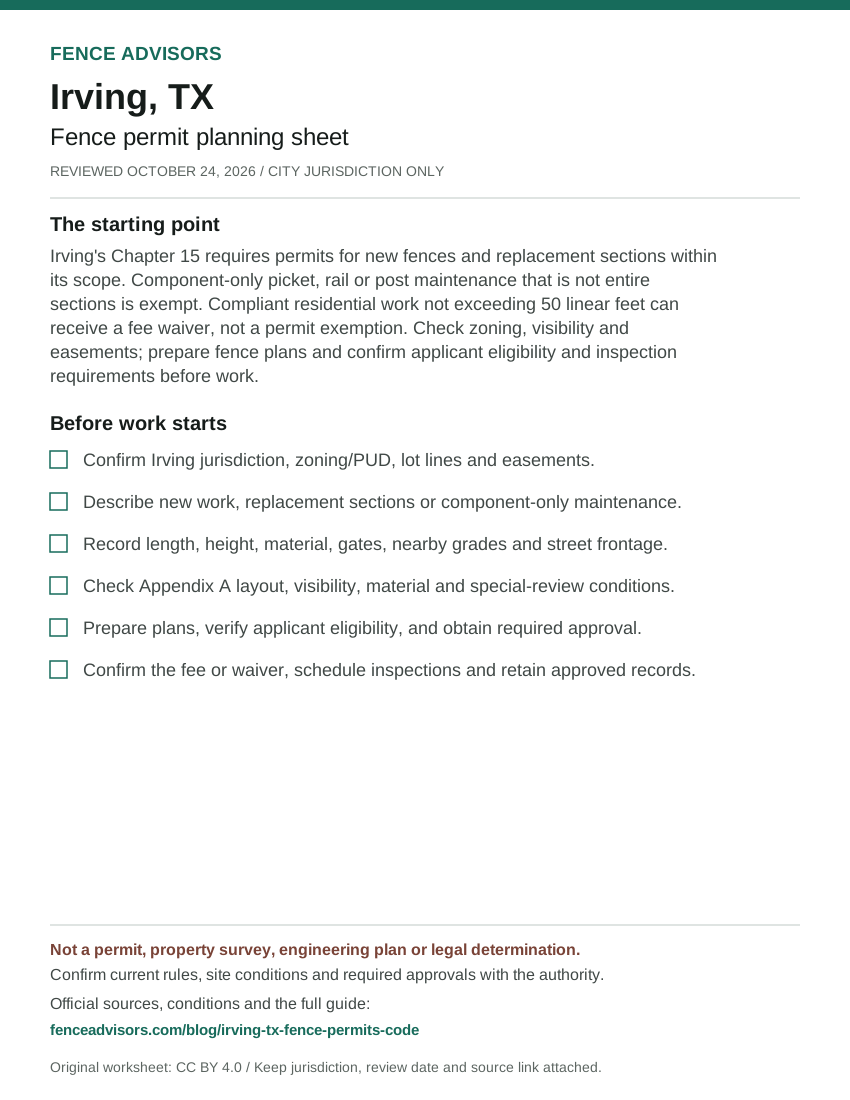
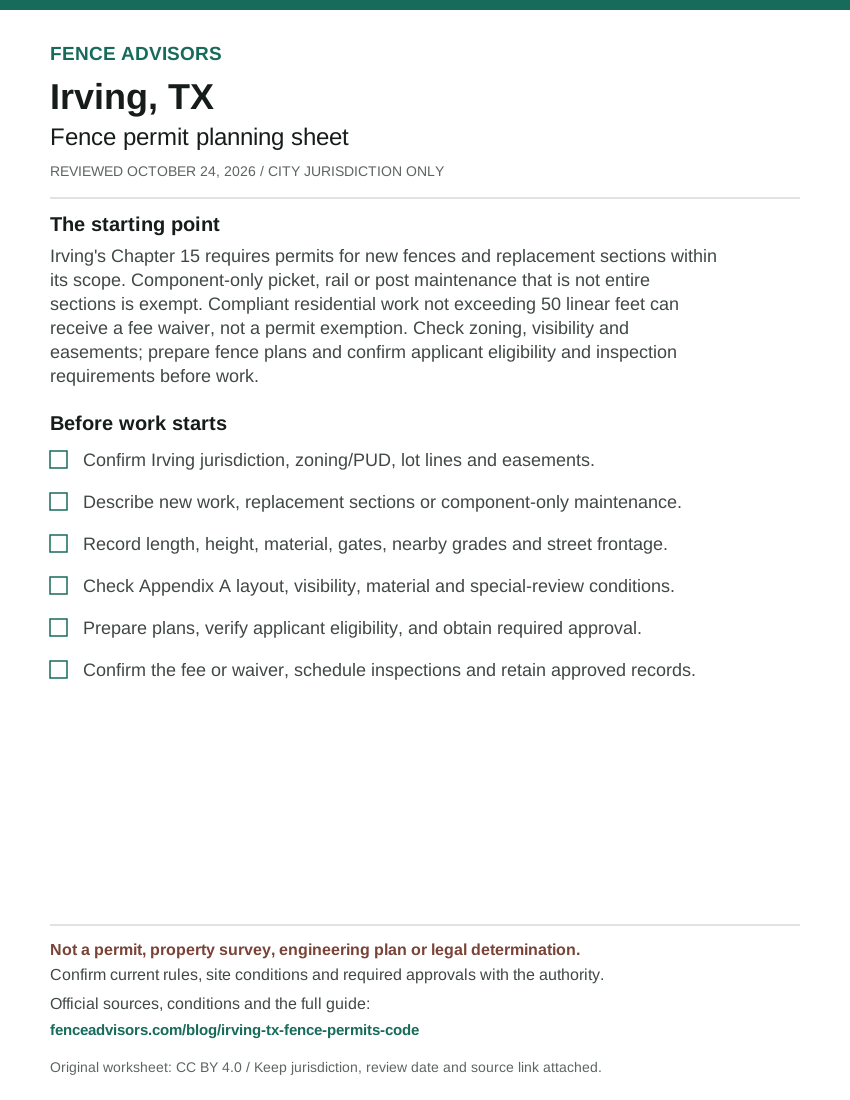
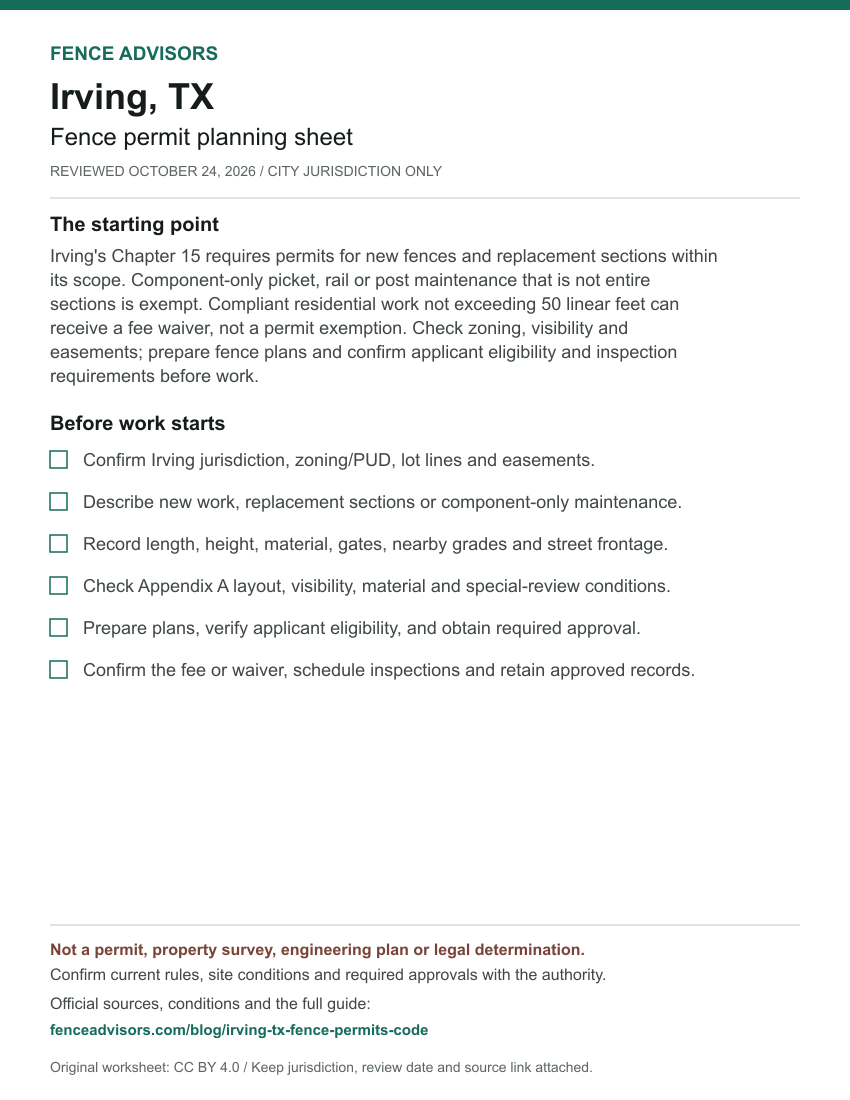
- Confirm Irving jurisdiction, zoning/PUD, lot lines and easements.
- Describe new work, replacement sections or component-only maintenance.
- Record length, height, material, gates, nearby grades and street frontage.
- Check Appendix A layout, visibility, material and special-review conditions.
- Prepare plans, verify applicant eligibility, and obtain required approval.
- Confirm the fee or waiver, schedule inspections and retain approved records.
Download or embed this graphic
<figure>
  <a href="https://fenceadvisors.com/blog/irving-tx-fence-permits-code"><img src="https://fenceadvisors.com/media/research/irving-tx-permit-cheat-sheet.svg" alt="Irving fence permit planning sheet: New fences and replacement sections; narrow maintenance exception. Six preparation checks; the complete accessible checklist and source-checked rules are in this article." width="850" height="1100" loading="lazy" style="max-width:100%;height:auto"></a>
  <figcaption>Graphic: <a href="https://fenceadvisors.com/blog/irving-tx-fence-permits-code">Fence Advisors</a>. Source, period and limitations are in the linked article. Original graphic: CC BY 4.0.</figcaption>
</figure>
Irving, DFW and Texas planning links
Use the Irving contractor directory and Irving supplier directory after defining the approval scope. The Texas contractor directory and Texas supplier directory serve wider searches without implying every listed business serves every parcel.
The DFW fence permit comparison links neighboring jurisdictions. Dallas's height triggers, Plano's repair-area test and Fort Worth's conditional exemptions are different rules, not alternatives for an Irving project. Keep installed-cost planning in the separate DFW fence cost guide.
Frequently Asked Questions
Is a 50-foot fence replacement permit-free in Irving?
No. The stated qualifying residential fee waiver includes work not exceeding 50 linear feet, but it does not waive the permit. Component-only maintenance not constituting entire sections is the separate permit-and-fee exception. Irving Chapter 15, Fences.
Can I put an eight-foot privacy fence in any Irving yard?
No. The eight-foot general side/rear rule is limited by the chapter's zoning scope, excludes multifamily under its residential definition, and does not override front-yard, visibility, street-side, easement or property-specific conditions. Irving Chapter 15, Fences.
Are wooden posts always prohibited on replacement fences?
The chapter requires metal posts for new and replacement wood fences, but expressly allows replacement wood posts reinforced with intermediate metal posts. Confirm the complete approved design rather than reducing that condition to a blanket yes or no. Irving Chapter 15, Fences.
Sources and reuse
We checked the linked government guidance on October 24, 2026. The scope above and source notes identify what was verified and what still needs confirmation. This article is not an ordinance, survey, engineering design, legal opinion or permit approval. The downloadable fact sheet records each finding's source and section. Confirm current rules, fees and submission instructions with the responsible authority before ordering materials or starting work.
You may reuse our original cheat sheet with attribution to this article. Keep the review date, jurisdiction and limitations attached. Government documents remain with their original publishers. Send corrections with a source link to editorial@fenceadvisors.com.
Sources and Downloads
- Irving Chapter 15, Fences - 15-1 definitions; 15-2 through 15-6; 15-8 through 15-12; 15-16. Official-linked code, ordinance annotations include 2018-10044 of April 5, 2018; substantive text rechecked October 24, 2026.
- Irving fence ordinance illustrations - Appendix A, illustrations 1-5, including street-side layout, vision triangle and height measurement. Official code attachment visually reviewed October 24, 2026; no new adoption date inferred.
- Irving fence design guidelines - Appendix B; materials and construction examples. Official code attachment visually reviewed October 24, 2026; not product approval.
- Irving FY26-27 fee schedule - PDF p.1 effective date; p.11 fence fees. Current Rates + Fees page independently corroborates the residential rows. Effective October 1, 2026; current official schedule link and fee rows rechecked October 24, 2026.
- Irving Chapter 8B construction administration - 8B-27(c), contractor registration/homeowner exception; 8B-27(e), separately listed permit scopes. 2024-code administration, including ordinance 2026-11253 of March 26, 2026; reviewed October 24, 2026.
- Irving residential permit brochure - Both pages: applicant, application and inspection instructions. City-hosted brochure reviewed October 24, 2026; reliable internal revision date not established.
- Irving Planning and property resources - Official zoning/property-map and ordinance/PUD lookup routes. Official entry and linked map provenance reviewed October 24, 2026; no actual parcel determination.
- Irving residential permits - Residential application and MGO entry. Current official entry reviewed October 24, 2026; no authenticated application tested.
Original Fence Advisors graphics, data compilations and worksheet are available under CC BY 4.0. Retain source, period and scope when reusing data. This license does not relicense third-party documents or trademarks.
Corrections: editorial@fenceadvisors.com.
Related Research
Plan your Irving fence project
Confirm the approvals for your property, then compare written contractor scopes.
Get the next guide in your inbox
Fence costs, rankings, and what AI is telling homeowners — researched, no fluff.